
Walk about
Some ink, some think, some blink.


I LOVE THE WALKS WE TOOK IN THE DESERT. I love the pink powder of red rock that coats you on the trails. I love the rocky emptiness and sparse vegetation. When I tell myself to leave, I don’t leave. I can’t tell you what movie my life would be if I left when I told myself to leave. Maybe the novels of Thomas Hardy or the movie with Cary Grant and Deborah Kerr, where she winds up hit by a car.
When Gardner was painting trompe l’oeil designs at the Helmsley Palace Hotel, we worked the graveyard shift from midnight to five AM: marbleizing columns, sponging clouds onto domes, applying gold leaf to moldings. In the lobby, we saw the late-night action of hustlers and sharks. Upstairs we had access to winding back corridors and secret attic rooms. After I met Richard, I wondered if you could start a new life at 60.
In real life, Julia Child was probably more of a perfectionist than the way she is portrayed by Meryl Streep, with endless good cheer, in the movie Julie and Julia, but I don’t really know. Years ago, on Monhegan Island in Maine, I said to Richard, “We are married in the presence of the sea and sky.” I said it three times, and he believed me. He unwrapped a chicken sandwich, and a seagull moved over to where he was sitting on a rock. They stared at each other. If Richard had lost focus even for a second, the bird would have known what to do. One of the things I find interesting about Richard is he doesn’t give animals a break for being animals.
A number of years ago, my best friend got married in my house and entrusted me with the top layer of her wedding cake. In a year, she would return to the house and she and her husband would eat the cake. This was a long time before I’d met Richard. I hadn’t known it was a thing to do with with a wedding cake. Months passed, and one night when I was hungry and alone, I shaved off slivers of the cake, convincing myself it didn’t look that bad. Then it became a habit, tiny slivers each time. I was carrying around the box in my mind. It was glowing. I was afraid to open the freezer for any reason. There would be the box. The beautiful box in its fancy thick cardboard. The box looked like something you could eat, too. I would slip off the ribbon in a way I could get it back on. There were chocolate fingerprints on the cardboard. What did I think would happen when my friend opened the box and saw the cake had been tampered with, you could put it? I thought she would find it funny even though I knew she would not.
In my early twenties, I went to see Lila Karp in her house in the West Village. She pronounced the letter “A” with a broad English accent. It didn’t bother me. She was on the top floor of a brownstone in a big bed. I made tea in her kitchen while she stayed up there. She kept brown sugar in a little crock with a peel of lemon in it. I thought this was a wonderful idea. I was collecting ways to be in the world, and I enjoyed being made of clay. In retrospect, I enjoyed it. Or maybe not even in retrospect. Maybe in this moment I feel like putting a loving spin on everything, because why not.
In 1970, on my first trip to England, I arrived at Victoria Station and found a nearby bed & breakfast. I stayed there a few nights, and then the owner told me her sister had a bed & breakfast in Willesden Green for only a pound a night. Her sister’s name was Mary. Mary Smullin and I became friends in a way that did not end. The sisters were from Ireland. I don’t know how old Mary was in 1970. Her house had many rooms for visitors. The most wonderful room was on the first floor. Glass French doors opened onto a brilliant rose garden, tended by Mary’s husband. There were also roses in the front. It was one of those houses in London, where the city looks like a village. Mary told me she was the oldest of nine children. She never saw her mother resting on a chair. When Mary was eight, she vowed never to have children and she kept the vow. At breakfast, she served enough food to last most of the day, and if you were around in the afternoon she’d make a pot of tea and offer you cookies or cake, and you’d talk about your lives. In the basement, where I’ve saved all the letters and cards I’ve ever received, are the Christmas cards and notes from Mary, sent until I don’t know when they stopped.
Six years ago, when we bought the house, there were areas no one could pass through, even with a machete. Over the course of months that turned into years, we turned the land into a park of sorts gardens and trails. We couldn’t stop cutting branches, raking the ground where the branches fall, and digging out masses of rotting logs and tree trunks that had been sitting there for maybe a hundred years. Richard’s Fitbit would say he’d walked like 100 miles every day and burned enough calories to light up our house for a week, while if I was lucky my Fitbit would say I’d walked like maybe a mile and burned zero calories. The pleasure of clearing the back was so great I said to Richard, “I’m afraid we’ll get so involved with this area, we won’t have enough time or energy to plant the front gardens and take care of them.” He said, “Yes, we will.”
One day, he approached me with sadness and confusion on his face. He said, “I was cutting a bush and a long vine snapped back and lifted off my glasses.” I said, “Don’t move.” He was coming to find me when I arrived at the brambles we’d been clearing. He said, “I felt it slip under the temple and spring back.” I said, “Are these the same glasses I found in the flower pot in the garage?” He said yes. He can’t see without glasses. He pointed to where he’d been working. All his glasses are delicate and cost more than a car. They could have shot off anywhere. I looked around, and there they were, sitting in a pile of clippings and branches, and we went back to work.
_____________________________________
Crowd source
A CROWD OF HAPPY PEOPLE IS STILL A CROWD THAT CAN SWALLOW YOU. It was like drowning for a long time, when you can’t get out and still you are bobbing on the surface with heads as far as the eye can see. I could see pretty far. If you are trapped, your vision improves. All your senses do. The sound was a swam of loud bees. I was hungry. I like hunger usually, the feeling of being in a waiting room and anticipating the time you will pass through to a restaurant, a bar, a stand of street food in Thailand.
I was bored. More than anything I was bored by the political fervor around me no one could take seriously because each word was a bee. We were there, all the lonely people, to say “no” to something hurting us, while no one could agreed on “yes.” Everyone was drowning while holding in the air their own private “yes.”
The most interesting feeling was the fear of never getting out. It broke through the boredom and was something to enjoy. I hated everyone for pressing against me with their “yes,” at the same time I loved everyone for sharing with me the gleaming clarity of our collective “no.”
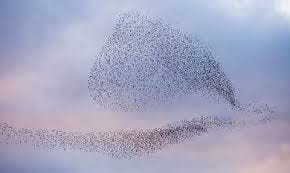
I had never been trapped like this before. I was part of a giant pulsing single organism that could move a few inches or so, this way and that, without a plan or a pace maker of its own. A crowd like this is an emergent system, like the human brain and like traffic patterns on a roadway.
A woman even smaller than me was beside me. I’ll call her Robin. Robin red breast. Robin Hood. I said, “Let’s pretend you’re sick, and I need to get you to a hospital.” She said, “Good idea, mami.” I loved her. Her skin was caramel. She had a slight accent. I wanted to laugh with joy of being with her, the joy that in one sentence I had found a partner, a mate. Isn’t that everything in life. A partner to share an adventure with. I shouted out as loudly as I could, “My friend needs to get to a hospital. Please give us room to get out. She’s had surgery, and her stitches are bleeding.”
Concerned faces were all around. It was beautiful. It was magical the way the crowd parted. I almost believed what I’d said. When you tell a lie and people believe you, the air turns pink and everything feels possible. You know you are a rat and lower down then a rat, and you remember the joy of the rats in the Subway, making a meal of pizza crusts and gnawed chicken bones down on the tracks. All I’d had so far that day was coffee. I thought if we get out of this, Robin and I should go get lunch.
We kept moving forward, although forward was hard to gauge. Was there an edge to the crowd? Theoretically, there would have to be. There were thousands and thousands of us, but we did not cover the entire square mileage of Washington DC. I had to keep shouting, “Please let us pass, my friend is ill.” I was afraid someone might call an ambulance but not so afraid I would stop. I could see Robin wanted to laugh as well. She was a good actor. She kept a straight face. She gripped her side and bent her head down. How was it possible I had found someone so perfect for me?
NOTE TO READERS: This is a fictional account, produced by a prompt at the workshop on Saturday to write about something scary and exciting at the same time.
____________________________________
Zooms on craft.

RICHARD AND I WILL CONTINUE OUR ZOOM CONVERSATIONS ON WRITING for the next several months, focusing on elements of craft and form you can add to your toolkits as creative writers.
At the last session, on May 30, the focus was on the difference between “story” and “memory.” I made the spontaneous claim that a memory might best qualify as material for a “story” if the story was about rethinking the memory. Maybe it didn’t happen that way, after all. Using the baby prompts: “sometimes,” “what if,” and “on the other hand.”
THE NEXT ZOOM CONVERSATION IS ON SATURDAY JUNE 27 from 3 to 4 EST, and it will be about layering. Something happens in sentence one. “I drove up to the house that looked haunted.” Or “I went into a deli and ordered a pastrami sandwich.” Or “The first rabbit he saw asked him what time it was.” Sentence one reports an action. Layering happens when a sentence that reports an action works as a baby prompt for the narrator to tell the reader what the action made them feel or think or reminded them of. In this way, the narrator is seducing the reader into interest in the narrator’s mind and associations.
Another way to put this is narrative layering follows the requirement of IMPROV COMEDY, that is “YES, AND.” Yes, this thing happened, and it reminded me of and made me feel . . . and then it’s possible to report another action because the story has moved to wherever it’s landed. It’s not planned ahead. It’s being invented in the moments of writing. That’s why it’s fun.
TO RSVP: email me at lauriestone@substack.com.
_____________________________________
Money

WHEN YOU GET PAID BY A PUBLISHER OR A MAGAZINE, you don’t have to talk about money publicly. Of course, as anyone who has ever written for a book publisher or magazine knows, when I use the term “get paid by,” I am speaking allegorically and in the comic framework of hyperbole.
Nearly four years ago, when I launched “Everything is Personal”—a title meant as a joke because everything personal is also political and social—it was suddenly possible to get paid through a subscription model. That is: individual people. To reach these individual people, you have to talk publicly about money.
No one wants to do this.
Please chip in whatever you can afford as a one-time shot or start a paid subscription. If you want a one-time shot and not a subscription, let me know and I will tell you how to do it. If you can start a subscription (you can cancel it any time), hit the “subscribe” button below with a steep discount for new people.
In the old format of payment, you didn’t really get paid (except at the Voice if you were on staff). In the new format of payment, you have to ask people for money directly. If you enjoy my work, please help keep the stack afloat. Without new people taking a turn, it can’t continue.
__________________________________
Material reality.
MAYBE PEOPLE WHO ARE YOUNGER THAN ME CAN’T BELIEVE that people who are old, like me, could be having a great time in the moment and assume we live in our memories. As you age, all sorts of assumptions about aging fall away, the same way that every moment of your life as a female human offers you an example of what’s false about your gender assignment.
I find myself very little interested in the past, except as material for writing a scene. I feel a sense of freedom from the past, including my past mistakes, losses, and disappointments, that may have been developing for a while and I have recently become aware of.
I simply don’t care that much about what happened before now. I’m in the moment pretty much all the time, and if not, then I am looking ahead with excited anticipation at what comes next for me and for the world.
Given that, at a social and political level, the present is bleak and mean and composed of gray goo, it’s perhaps tempting to retreat to the past. I don’t go there. This might be a trait of my character. It might be a characteristic of being the age I am—I will be 80 in October. It might be owing to the fact I don’t have children or much of a generational sense of my place in time. I’m not that interested in knowing what might be termed a cause or a prompt or a provocation for the sense of things I’ve arrived at. I’m just reporting.
_________________________________
Happenings for paid subscribers:
UPCOMING ZOOMS, always on Saturdays from 3 to 4 EST To RSVP: lauriestone@substack.com
LAURIE & RICHARD, on the difference between MEMORY and STORY and layering in narrative as “YES, AND.” SATURDAY June 27, from 3 to 4 EST To RSVP: lauriestone@substack.com.
To attend one event or receive one recording, with no future payment obligation, you can buy a “coffee” for $4 at ko-fi.com/lauriestone
Breakout sessions following the Zooms with guest artists
The BREAKOUT SESSION following the Zoom conversation about MEMORY and STORY is on SUNDAY, June 28, from 3 to 4:15 EST. THERE ARE STILL PLACES. There is a cap of 10 at each breakout. You are invited to share a piece of your own writing of around 400 words. The SLAM readings are thrilling impovs—we make a work together larger than the parts! The fee is $30. To sign up please email me at: lauriestone@substack.com.
To request recordings of past Zoom Conversations
with Steven Dunn, with Margo Jefferson and Elizabeth Kendall, with Francine Prose, with Sophie Haigney (of The Paris Review), with David Cale that includes a reading from his hit solo theater piece Blue Cowboy, with poet David Daniel, with Daisy Alioto, publisher of Dirt , Michael Klein, and Marga Gomez, please email me at: lauriestone@substack.com.
Working together one to one on your writing or starting and growing a Substack publication.
If you would like to book time to talk one-on-one about a project you are working on or for guidance in gaining confidence and freedom in your writing practice, please email me at: lauriestone@substack.com.
If you would like to book time to talk one-on-one about STARTING AND GROWING a Substack publication, please email me at: lauriestone@substack.com. I can help you through the software, choosing a title, art design, and ways to gain readers.
__________________________________
Please “comment,” ”like,” and “share” below. Your engagement helps the algorithm notice the stack and gain a presence here for feminism and literary writing.
______________________________
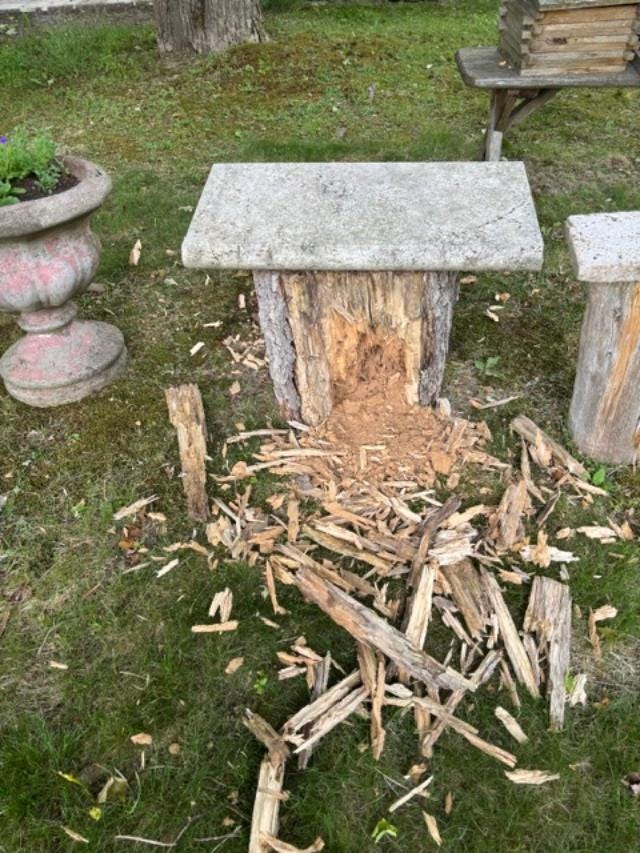
We’ll put our woodpecker up against your woodpecker any day. One hour’s work.
So many sentences to love, but this is the one I choose: “One of the things I find interesting about Richard is he doesn’t give animals a break for being animals.”
"I would slip off the ribbon in a way I could get it back on. There were chocolate fingerprints on the cardboard. What did I think would happen when my friend opened the box and saw the cake had been tampered with, you could put it? I thought she would find it funny even though I knew she would not"
I'm busted and still laughing.