
Windows
The Women's House of Detention was near where I lived.

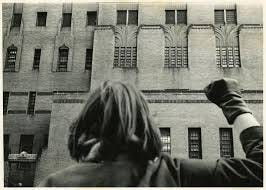
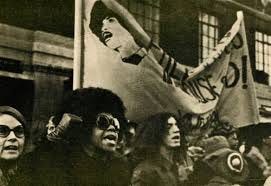
FOR A NUMBER OF YEARS when I was young, I lived in the West Village, close to The Women’s House of Detention, a prison on the corner of Greenwich Avenue and 10th Street. It was a fixture of the area, until Mayor John Lindsay closed its doors on June 13, 1971. There was something so out there about it, with its gay vibe of “women behind bars,” in the heart of gay culture. The women were visible at their windows, shouting down to the street at strangers, lovers, and friends. It was somehow grim and rollicking at the same time, and it came to mind from a quick reference made by Michael Klein in his book of essays, Happiness Ruined Everything.
Michael grew up in that neighborhood. He talks about the cacophony of sound that would greet him after school every day. Suddenly, I was returned to that time in my life and to that ‘hood when, first, I’d lived there with Bruce, and then later in various apartments after Bruce and I separated. Just as suddenly, I didn’t want to return to the feeling space of that time. It felt like returning to a kind of chaos I wouldn’t have described that way in the past. Others may have seen it. I tried not to see what other people were seeing in me.
When I was little, I lived in Washington Heights, where you would call up to your mother at the window to throw down coins for candy and caps. Your mother would wrap the coins in a piece of paper, making a tight little package, so it would land at your feet. At the Women’s House of Detention, there was something of that window-to-street energy, except the women wanted things thrown up to them, not the other way around. The women wanted to fly out of the windows, like figures floating upward in the paintings of Chagall. Our mothers probably wanted that, too.
Who were the women in the jail? What had they done? What was happening to them inside their cells, where some were held, awaiting trial or sentencing, for months and even years? Wikipedia lists some of the famous women who spent time there, among them: Polly Adler, Jane Alpert, Angela Davis, Andrea Dworkin, Miriam Moskowitz, Ethel Rosenberg, Afeni Shakur, and Judith Malina. Davis reported abuse she witnessed. Dworkin’s testimony as part of a suit she brought against the city for assault by two of the prison’s doctors led to the jail’s eventual closing. Dworkin had been arrested in 1965 at a protest against the Viet Nam War and was subjected to a violent and pointless gynecological exam. Audre Lorde described the House of Detention as, “a defiant pocket of female resistance, ever-present as a reminder of possibility, as well as punishment.”
I didn’t have to imagine myself in a jail to feel that other women—any women, really—were connected to my life. If you were a girl, very early on you understood that things it was okay to do to the bodies of women in any part of the world colored the way you were understood in your part of the world, since we all went through life in the bodies of women. Going through life in the body of a woman had more political meaning to me in the past, as it still does, than it ever had in a biological sense. Not even in sex. I am going through life in the body of a woman with sexual feelings I don’t imagine are discrete to women.
In 1971, the year the House of Detention closed, Bruce and I separated. He was having an affair with a woman he wanted to keep sleeping with, and I found an apartment on Charles Street between Greenwich and Hudson Streets. The windows looked out to sleepy Charles Street across from a wooden house with a garden and a fence, a house blown there by a twister in The Wizard of Oz. I would line the windows with shelves and set plants on them, so the place would look like an indoor garden.
I moved in without consulting anyone. For the rent, which was $200 a month, I made just enough money teaching two sections of English at Hunter College. That left another $200 a month for all other expenses. This is not a story about bad Bruce. I had been sleeping with other people, too. I just didn’t want to stick with any of them.
After I moved into the apartment, Bruce visited and we had sex on a mattress on the floor of the tiny bedroom. It was great, maybe the best sex we ever had. Then he left because he needed to get back to his girlfriend. I found this sad and exciting at the same time. I knew the sex had been good because we were no longer together, and this excited me, even just this fact. I felt hurt, but more importantly I felt free, and it was not a good feeling. I didn’t know what to do with it, even though I knew I had to have freedom, or at least I was supposed to have it.
Freedom scared me, and it was funny to be scared by freedom because it was something I knew was a good thing for women and therefore a good thing for me. I had been catapulted into it, ready or not, and I was never as bold or independent as I thought I should be. As all girls I knew believed we had to be in order not to get our scarves caught in the wheel of a Bugatti—and wind up strangled to death. What a strange way for Isadora Duncan to die. What are the odds? I always wore long scarves. I think everyone did.
I think I thought that if I acted like Isadora Duncan, I mean independent and precariously perched in terms of money and future plans, the kind of life I thought I should want would miraculously appear. It was like that scene in Sleeper, where Woody Allen and Diane Keaton set out the clothes on the operating table for the body of the dictator to grow into after they have cloned him from a nose, hooked up to wires and a blood supply. If I wore the clothes and lived in the apartment of a free woman, I would eventually grow a body with the right feelings and thoughts. In the meantime, I was a coin wrapped in paper, making my way from the window to the street and from the street to the window.
________________________________________
Support
If you enjoy what you read and have not yet taken a turn at paid support—it costs very little to jump in!—please consider joining today. To continue, the stack is entirely reliant on you. There are lots of benefits you can read about below, including a free 15-minute conversation about your writing projects. Please make sure to use a browser on your phone or computer, and not the Substack app.
___________________________________________
Freedom

I AM THINKING ABOUT TWO MEN I wanted more than they wanted me. There were lots more. Right now, I’m talking about these two. One I had sex with. One was a friend. The way they placed their needs above anything else reminded me of me.
I put up with them and resented them and didn’t know what else to do because I wanted them more than they wanted me. There is something to be said for wanting someone more than they want you. The wanting makes you less critical and more loving in a way that shows you rooms in yourself you didn’t know were there.
I don’t know why I loved the man I had sex with when I was 51. I gave him my mug from the Soho Grand Hotel. When I think about the regrets of my life, one of the things I think about is giving away that mug.
The other man was a shrink. Not my shrink, just a shrink. One day, when we were in our 50s, we were talking about how we were going to adjust to physical change as we aged, and he said, “You will figure it out. That’s what you do. You adjust.” It’s not true, but I liked the thought, even though he was talking about himself.
When people talk about “facing reality,” I often think they are depressed. Many people are taught to believe the things that give you pleasure will destroy your life. In fact, the things that give you pleasure give you your life.
One day, Richard and I were waiting for a friend to call us back. We were far from home, and Richard didn’t want to wait, and he wouldn’t get out of the car to look at a waterfall near the carpark where we were stopped. I walked up a small hill. The waterfall was spilling from a reservoir above a ledge of stones, and the mood was peaceful. The water in the lake was still. The clouds were gray. The whole sky was a soft pussy willow color without any warm tones, and I thought Richard would have enjoyed the view because as soon as I saw it, my mood lifted.
I was interested in the freedom Richard had to be a pain in the ass. Later that night, when we were home, he said he was sorry for the way he’d behaved in the carpark. I was glad he apologized. He thinks I allow myself to express anger at any moment of the day and night, and he’s right, and this is a terrible aspect of me. When Richard was worse than me in the car, I didn’t mind it that much because I was glad it was him instead of me. You get something of this effect with people you want more than they want you. You take a vacation from yourself.
_____________________________________
Michael Klein, our next guest artist Saturday March 28 from 3 to 4 EST. To RSVP: lauriestone@substack.com

The other day, Richard and I were speaking with Michael about things we might want to talk about, and it was so much fun, we wound up having a mini-hangout together. Here are some elements of craft and form Michael will talk about:
The difference between poet brain and the prose brain.
Writing when he’s happy and writing when he’s unhappy.
The pleasure of writing about figures in his life who have given him joy and showed him how to have a life, among them Adrienne Rich and Jean Valentine—“Adrienne made me want to be a poet.”
How teaching writing makes you a better writer.
Being an addict. Some things he’s learned, among them the “unseen” parts of life Rilke talks about, a key to the sense that reality is not the only reality, there’s something more in our existence.
“Art is where you learn how to live.”
Why his latest book of essays Happiness Ruined Everything is organized as “devotions,” and not with a table of contents.
Different ways of to publish work outside the traditional big-five publishing houses.
______________________________________
Dare I say it.
I am putting together my next book, The Marriage Dividend, a Monologue, and finding it so far a happy book. What I am doing comes down to this: Get rid of every word, every reference, every image, every emotional state that somehow slipped under the limbo pole and that was something you needed to write for yourself. Get rid of everything that was for you in a way you knew and didn't realize, and ask yourself with each word, image, reference, and plot element: does this have a chance of bringing delight to the reader?
_______________________________________
Happenings for paid subscribers
UPCOMING GUEST ARTISTS on ZOOM, always on Saturdays from 3 to 4 EST To RSVP: lauriestone@substack.com
MICHAEL KLEIN, brilliant and beloved poet, prose writer, performer, and teacher on MARCH 28. His new book is Happiness Ruined Everything.
MARGA GOMEZ, utterly original actor, standup, and writer, April 25.
LAURIE & RICHARD, on the difference between Memory and Story, May 30.
To RSVP to these events, please email me at: lauriestone@substack.com.
To attend one event or receive one recording, with no future payment obligation, you can buy a “coffee” for $4 at ko-fi.com/lauriestone
Breakout sessions following the Zooms with guest artists
The BREAKOUT SESSION following Michael’s Zoom is on SUNDAY, MARCH 29 from 3 to 4:15 EST. THERE ARE STILL PLACES. There is a cap of 10 at each breakout. You are invited to share a piece of your own writing around 400 words. The fee is $30. To sign up please email me at: lauriestone@substack.com.
To request recordings of past Zoom Conversations
with Steven Dunn, with Margo Jefferson and Elizabeth Kendall, with Emer Martin, with Perry Yung, with Francine Prose, with Sophie Haigney (of The Paris Review), with David Cale that includes a reading from his hit solo theater piece Blue Cowboy, with poet David Daniel, and with Daisy Alioto, please email me at: lauriestone@substack.com.
Working together one to one on your writing or starting and growing a Substack publication.
If you would like to book time to talk one-on-one about a project you are working on or for guidance in gaining confidence and freedom in your writing practice, please email me at: lauriestone@substack.com.
If you would like to book time to talk one-on-one about STARTING AND GROWING a Substack publication, please email me at: lauriestone@substack.com. I can help you through the software, choosing a title, art design, and ways to gain readers.
__________________________________
Please “comment,” ”like,” and “share” below. Your engagement helps the algorithm notice the stack and gain a presence here for feminism and literary writing.
If there's such a thing as a collective memoir to be built, let me add my little brick of memory to your story. There was a coffee shop across the street from the detention center that made the only authentic croissants to be found in New York in those days. A friend who would later become a famous actress and I sometimes met for coffee there on a Saturday morning. From our table at the window, we could see the husbands and lovers of the incarcerated women, standing in the street desperately calling up to the women inside, many stories above them. They were pleading for the impossible, for those women to come down and comfort them in all the ways they once could and now could not. That's what I remember most. The vulnerability of men left behind and unable to bear it. My friend and I were like accidental voyeurs, adjacent to a misery we knew nothing about.
I lived in the WHOD....after it was renovated and converted into loft apartments. I could feel the women's vibes