
Wild abandon
and flower people.


A WOMAN ON FACEBOOK OFFERED ME PLANTS, and when I went to pick them up, they weren’t there. Before reaching her house, you drive past a stretch of rusting machine parts, hundreds of them, a rusting graveyard and warehouse, the way living things are both existing and waiting to die, a slow disintegration we don’t see moment to moment.
You turn onto her street, and her massive property extends from the ghost town of rust. Wrecked cars and parts of tractors and other farm equipment line the driveway and rise up from other sections of the front yard. There are piles of wood, splintered and towering upwards from palettes and broken sheds. From the road, the inorganic occupies more space than the plants you can also see, growing in beds and near the house down the driveway. Iris stalks and bushes of bleeding heart, and other kind of perennials so well established they don’t need that much care from humans. The whole place radiates a sense of building up and tearing down as simultaneous experiences, and again, you’re reminded of how existence works the same way, and you see a mind at the center of it, living amid this arrangement, a mind at peace with entropy and chaos.
I’ve been here before and never met my benefactor. I’ll call her Emmy. She leaves me plants at the top of her property on an old milk can. Our garden is a collage of plants donated by neighbors and friends, who’ve been working their gardens for a long time. Emmy and I have never spoken. We exchange notes on messenger. She’d mentioned that her husband had had to go into the hospital for treatment of a tick disease. I thought maybe she was in the house and had forgotten to leave the plants.
We eased down the drive, and I got out of the car. A small dog was barking in the house. No one came to the door or to a window. I walked around the back. It was packed even more densely with abandoned wooden structures and wrecked cars. Still growing beautifully and happily were plants in beds that also extended far on the grounds. An unopened bag of mulch was lying near a hydrangea bush. Further along was a bag of garden soil.
I sent Emmy a message we were there. She didn’t reply. I turned the car around, and as we were coming to the end of the drive, a car pulled up and went down to the house. I parked on the road and walked back. A young woman got out and also a woman who was much older with light colored hair. She was wearing a cotton dress that went past her knees. A summer frock from wall paper in the 1930s. She looked around and stood back.
I told the young woman why I was there, and she smiled. I’ll call her Andie. She was a sun all by herself. Sparks of warmth shot off her. She leaned forward a little from the weight of her joy. “Oh my goodness, I’ll call my mother. My dad’s been in the hospital, and she’s picking him up. It must have taken longer than she expected. Here’s what I’ll do. Give me your address, and I’ll bring the plants to you when she comes back.” I said, “You don’t need to do that. It’s too much.” She insisted I give her my address, and she typed it into her phone. She said, “It’s not far, it’s no trouble at all.”
Of course it was trouble, if you thought of the word trouble meaning I want a life free of encumbrances. What if you wanted a life that connected you in the moment to anything that was happening to you. What if you didn’t think of some people as strangers and thought of everyone as people who are not strange to you.
The older woman moved forward. I’ll call her Stella. We were now standing in a circle. Stella said, “Do you need any prayers?” Andie could see on my face this was not a question I was often asked. She might have wanted to say to Stella, What you see in front of you there, Stella, is urban Jew. They don’t know from prayers.
Prayers were what Stella had to offer, the way Eddy had iris plants and Andie had a delivery service. What did I have to offer? The pleasure of being there. Things around me started to look yellow, there was so much light on the spot. Is pleasure a thing to offer? It might be a thing. While the cars and towers of junk were slowly converging into air, my delight was expanding. I said to Stella, “Well, Richard is having cataract surgery in a few weeks, so maybe you could help with that. Also, I had a tick disease myself a few years ago, and I’m hoping not to have that happen again.”
I started to think of other things Stella could pray about, and then I remembered at the supermarket you’re only supposed to take one cookie from the plate of free samples. Stella nodded and said she would pray for me. I wondered if this was something she was always ready to do or if she had to organize a special energy to talk to Jesus, or whomever she asked for these kinds of favors. Were they favors? Or more like the thing that was happening between the three of us, a stroke of generosity that made you forget that at some point you were going to be a machine part rusting in a plot of land overgrown with crab grass.
Back in the car, Richard asked what happened. I said, “I met the most wonderful people imaginable. All they wanted to do was help me.” He said, “Do you think the jacket could have something to do with it?” I was wearing the jacket Richard had many years ago tossed in the garbage and I had fished out. The shoulders were frayed. The sleeves were rolled up. I love the jacket so much I lose sight of the way it lends a vagabond aspect to my appearance. When I forget I present as a vagabond, I can go anywhere and I can say anything to people I don’t know and pleasure will result. When I told Richard about Stella’s question, he said, “You could have asked her to pray for a new jacket.”
___________________________________
Hacks
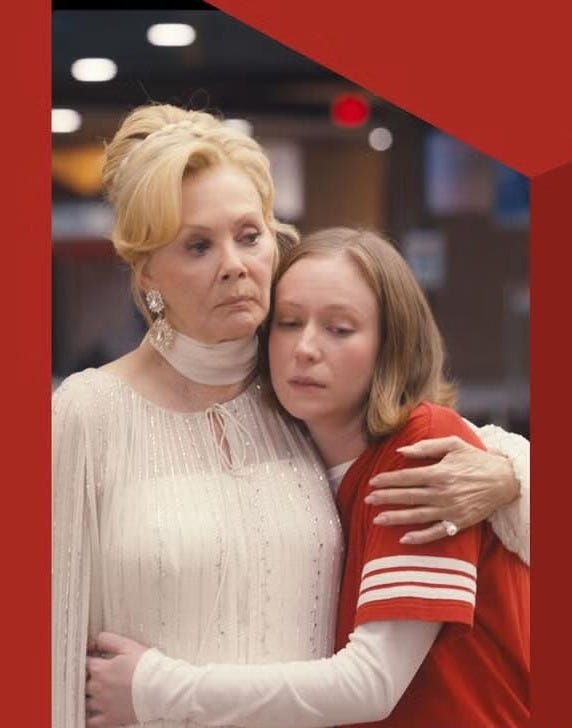
In the final episode of Hacks, Jean Smart and Hannah Einbinder are remarkably real and tender as two women of different generations who deeply love each other for every right reason. It’s a romance that’s seldom given its due dramatically, although it defines our lives.
____________________________________
The Next Zoom Conversation on writing craft is TOMORROW! Saturday May 30 from 3 to 4 EST
The next Zoom Conversation is on the difference between “Memory” and “Story”— To RSVP: lauriestone@substack.com
Richard and I will offer you ideas on how to free your writing from “heroes” and “victims.” We will do this step by step, no secrets withheld and all tricks of the trade revealed on how to keep engaging the reader and how to create the illusion of thought-in-action unfolding in real time. Questions about your own projects are very welcome. You an think of this as a clinic, and we will be continuing this format for a while. The more concrete your questions, the better.
_____________________________________
Please help the stack continue.
To all paid subscribers, thank you for understanding that this is the work of a paid professional, not a free service or a gift.
This Substack is among the least expensive ones to join.
I know money is tight for many people, and if you want to subscribe and need a further discount, just email me, and I will work out an arrangement with you. Don’t be shy. I mean it: lauriestone@substack.com
NOTE!! To start a paid subscription on your phone, you need to switch out of the Substack app and use the Substack website on your phone through a browser such as Safari or use your computer.
____________________________________
Happenings for paid subscribers:
UPCOMING ZOOMS, always on Saturdays from 3 to 4 EST To RSVP: lauriestone@substack.com
LAURIE & RICHARD, on the difference between MEMORY and STORY, SATURDAY May 30, from 3 to 4 EST To RSVP: lauriestone@substack.com.
To attend one event or receive one recording, with no future payment obligation, you can buy a “coffee” for $4 at ko-fi.com/lauriestone
Breakout sessions following the Zooms with guest artists
The BREAKOUT SESSION following the Zoom conversation about MEMORY and STORY is on SUNDAY, MAY 31, from 3 to 4:15 EST. THERE ARE STILL PLACES. There is a cap of 10 at each breakout. You are invited to share a piece of your own writing of around 400 words. The SLAM readings are thrilling impovs—we make a work together larger than the parts! The fee is $30. To sign up please email me at: lauriestone@substack.com.
To request recordings of past Zoom Conversations
with Steven Dunn, with Margo Jefferson and Elizabeth Kendall, with Francine Prose, with Sophie Haigney (of The Paris Review), with David Cale that includes a reading from his hit solo theater piece Blue Cowboy, with poet David Daniel, with Daisy Alioto, publisher of Dirt , Michael Klein, and Marga Gomez, please email me at: lauriestone@substack.com.
Working together one to one on your writing or starting and growing a Substack publication.
If you would like to book time to talk one-on-one about a project you are working on or for guidance in gaining confidence and freedom in your writing practice, please email me at: lauriestone@substack.com.
If you would like to book time to talk one-on-one about STARTING AND GROWING a Substack publication, please email me at: lauriestone@substack.com. I can help you through the software, choosing a title, art design, and ways to gain readers.
__________________________________
Please “comment,” ”like,” and “share” below. Your engagement helps the algorithm notice the stack and gain a presence here for feminism and literary writing.
__________________________________
Brooklyn

ON THE PLATFORM FOR AN F TRAIN, I asked a man how tall he was. He said he was 6 foot 10. I told him he was beautiful. We were both in love with life. I went to a part of Brooklyn where the sky hangs big over dark parks and streets. It was cool and drizzly. I had an umbrella but no sweater, and I moved quickly. I went to a bar to meet a friend. I said, “Anything that feels good is good.” I knew it wasn’t true as soon as I said it, but what are you going to do. It was a little bit true. My friend said, “Do you think that anything that feels bad is bad?” I said, “Do you mean like grief?” He said, “Maybe.” I said, “No, I don’t think things that feel bad are always bad.” I once took care of this man’s dog while he went skiing. I placed my hand on the fur between the dog’s eyes, then moved over his head, across his neck, and down to his tapered waist. The dog had the waistline of a long-distance swimmer. So did the man. I love the beauty of indeterminacy. Anything I have written worth your time is a love letter to something.
I so wanted to know these people, that I kept rereading your precious story. Then I realized I do know them—my Dad’s family are all like this.
And my Dad, a minister for 35 years, forgot most things as he was living, then dying of Alzheimer’s…except who I was, and how much he enjoyed praying for each person he encountered—whether he actually knew you or not! Once again, thank you for the engaging trip down memory lane. 🥰
oh, i love “wild abandon” so much! so often, your posts feel like the antidote to all the evil heart-wrenching crap i see and read about every day. there is still wonder and kindness and humor to turn to. the gears of your mind are so fun to see on the page.