
We can still make the world
beautiful and free.

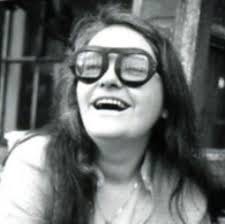
AS LONG AS I HAVE BEEN WORKING, women have been hired by men to beat up the other girls. Women have been hired by men to discredit the women’s movement. Hired to make a case for biological determinism—meaning God wants men to own everything or he would have made men the ones who have babies. As long as I have been working, women have jumped on the opportunity to show they are serious people, serious writers, serious thinkers, by publishing men, by writing about the things men do and the things men make evident everywhere on the planet they focus their attention on. There is nothing more undervalued to men than women. Women’s art, women’s minds, women’s ideas about transforming society, anything having to do with the lives lived in the bodies of women.
The social and political conditions of women, the productions of women’s minds, the aesthetic interests of women are laughably insignificant in the zeitgeist, and if you focus on these things and you are a female human, the amount of respect you will gain from men is zero. If you are a woman and you want to get ahead in the world, turn 180 degrees in the opposite direction from women.
Or, if you care more about changing the world than advancing your own personal opportunities, turn toward women. Turn toward women if you think, as I do, that the ideology of male supremacy and its squealing offspring, white supremacy, have seized the planet by the short hairs, are holding the planet in a vice grip, have placed the planet in a closet with a hood over its head, where it’s forced to listen to unfuckable white men with billions of dollars make a case for themselves as God’s chosen leaders. Turn toward women if you want, in the remaining time you have to be alive, to say no to these men and refuse to comply with their understanding of cause and effect in the world. Turn toward women if you believe it’s possible to unseat this control and for more people like you and me to have access to life’s sweetness and light.
There was a time, when I was young, when everything I’m saying here was understood by millions of women to be Yes, of course. We said it out loud. Millions and probably billions of women still believe this is true. Not so loudly now and definitely with fear of being ridiculed as defunct. Millions and maybe billions of men possibly agree as well, but silently. I have to assume they are agreeing silently with what I’ve written above, because, you know, it’s not like you see that many male humans making these points themselves. Just saying.
To remind you of this time and to honor KATE MILLETT, who swept me into the women’s movement, I’m reposting a piece I published some years ago. Some days, it feels like I should publish this piece every day.
Kate
LAST WEEK, A YOUNG MAN CAME TO THE HOUSE TO TALK WITH ME ABOUT KATE MILLETT. He’s doing research on her life and the comet of the women’s movement, streaking across the skies in the 1960s and early 1970s. He asked me what it was like to sit in Millett’s classroom at Barnard College, and there I was, back at a desk in 1965, watching light fill her face as she talked about the avant garde writers who’d given her a life.
Most of them were men, as I recall, men who were changing forms the imagination could move in, reshaping time and space into the fragmented chunks we felt as reality. Changing forms but not content. She assigned us books by Beckett, Genet, Henry Miller, that lot. In those days, you read these books and you sat in movie theaters, your lips parted in the joy of incomprehension, watching the films of Godard, let’s say, because he was reinventing what a movie could be. You sat in reverence without paying attention to the way the girls and women in these movies and books were moved around the boards of these men’s minds with indifference, contempt, boredom, and intermittent lust, detached from who the females were and what they might want.
Except you did notice. That was the fissure. You did notice. You always noticed. Every woman noticed, and you didn’t have language for the distance between the voice in your head that narrated your life to you and the figure the world said you were.
Here’s what Kate did. She showed us she was happy to be teaching us. We were the reason she was smiling. Teaching girls was not a consolation prize, not a booby prize. Teaching girls was a great joy and an honor, the smile said.
Do you know what it means to be taken seriously? You probably do, or maybe some of you don’t. By seriously, I mean to feel you are interesting, worth the attention of someone with a mind like Millett’s. Every week, you got to spend an hour with her in private conversation as she went over your writing and explained her comments.
She knew everything, had read everything, had watched every movie, had looked at every piece of art. Everyone needs to be given permission to place their own thoughts at the center of their lives. Make up their own minds about what they love and what they believe is true, tested against their own experience.
In those days, teachers and students could hang out together. If you were a girl, you needed to learn to live a life as much as how to read a book or write a paper. The glamor of Kate. The allure of Kate. She was twelve years older than me. At the beginning I’m nineteen and she’s thirty-one. She’s a map.
Everything I write about the past is made up now. I hardly remember anything, really, not because my recall is cloudy. Because living and thinking and feeling, and all the things you need to bring a moment to life, are only possible to gather in the now. I don’t think I’m only talking about writing. When I think about my younger self, I think I am happier now than in the past, but I also think I always thought every moment I was up and about and wanting this thing or that thing to happen was a form of happiness.
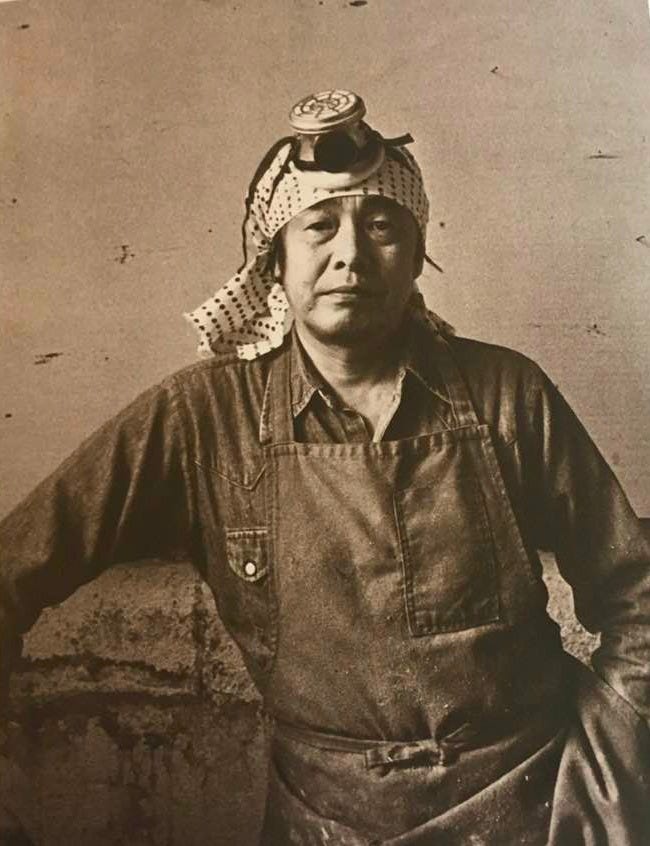
Kate lived with Fumio, her Japanese husband, who was a sculptor. Kate considered herself a sculptor as well. She considered herself an artist. Academic work and teaching occupied different categories to her. She seemed so dazzling because she knew everything and because of the way she could play with you and your ideas. She was an improv girl—yes, and—and she liked to laugh. I could make her laugh. I think I didn’t know how to be censored. I think I said things out loud Kate wasn’t used to hearing people say out loud. She was a well brought up midwestern girl.
Fumio was a gorgeous human being and a great artist. At the time I was getting to know them, I was married to Bruce. There was love all around. For dinner at their loft, you’d get steak and a baked potato.
When I talked to the young man about Kate, I forgot to warn him about my appearance in the film Women Talking, Rushes One. It was made by Midge McKenzie, who would go on to shoot the documentary series Shoulder to Shoulder, about the British suffrage movement. Even before the publication of Sexual Politics (1970), Kate was getting to know all the feminists in the world there were so far, and she suggested Midge interview me about feminism in the States. What we were doing and what had tripped us into the life.
The life! Oh my god that’s what it was. I could tell you about the phone calls to hustle you to the courthouse in downtown Manhattan to protest abortion hearings going on, hearings where no women were called on to testify. I could tell you about picketing the New York Times to end separate job ads for women and men. We won that, by the way, and the Times stopped its practice. I could tell you about the meetings we sat in and the circles we made on the floors of living rooms, talking about how to come with or without a penis in the picture. I could tell you about the furious jostling for power inside the organizations we formed. I could tell you how in 1968 I thought it would always be 1968 because I believed that once a great and incontrovertible idea was launched into the zeitgeist, the zeitgeist would be unable to dislodge it. I was wrong and I was right.
I could tell you about these moments in detail and with joy, but I want to hold you now and tell you about something more intangible. It was the feeling of being part of something that had risen up spontaneously. It had not risen up spontaneously. It had risen up at the crossroads of “Yeah, I want to fuck you, too, but I’m sick of making coffee for you and posting your flyers.” It had risen up from books written by Simone de Beauvoir and Betty Friedan.
The women’s movement clicked into life as a great, laughing monster from an understanding we all suddenly had to share—that we’d been lying all our lives about being happy with not enough. The thing I want to tell you about is the strength this insight gave us because we were numbers. Numbers always count. You can’t do things alone, and you can’t discover that your unhappiness is not a symptom about you. It’s a symptom about everything except you. This is an insight you are never going to lose, and it will give you your life.
In the footage Midge McKenzie shot, I’m smoking. I don’t know how to smoke and I will never learn. I’m smoking the way a chimp smokes, bringing my mouth to the cigarette instead of bringing the cigarette to my mouth. I’m wearing a beret. I have no ability to look unself-conscious. This is still true. I talk about my mother in a way that now, if I saw the clip, I would feel embarrassed by. I’m not tender toward her. Her drifty sense of self is the reason I’m a feminist? Something harsh like that? No one arrives full-blown with irony and compassion. This part of life is unforgivable.
___________________________________
No one else would publish some of the things I write here. I feel emboldened by you to take risks. I hope I embolden you to take risks.
To continue the stack, new people need to take a turn at PAID SUPPORT. I am talking about sustaining the publication. If you have been enjoying the writing and are curious to try out other benefits, please jump in today. There is no paywall. There will never be a paywall.
There is a generous discount for new subscribers and gift subscriptions.
For everyone who is already a paid subscriber and is keeping the thing we are doing together alive, I send love and more love.
NOTE!! To start a paid subscription on your phone, you need to switch out of the Substack app and use the Substack website on your phone through a browser such as Safari or use your computer.
_______________________________
Twelve, a story.

I AM TWELVE, AND WHERE I LIVE there are houses under construction and the clean smell of jetties that jut into the ocean. In the house, there is a chair and a boy. At the end of the block the street melts into the dunes, and the dunes are shaped like a body. The boy smells of salt. We’re on the second floor, and before us is sky because there isn’t yet a wall. The workers have gone home. It’s quiet. The boy’s collar is open. His hair is thick and sandy. This is not like anything I imagined would happen when I woke up that day. The boy is not a friend. We have seen each other around. He whispers into my neck, and I’m happier than I have ever been. He says, “Is this what you like?” I say, “I don’t know what I like.” I’m wearing shorts and a polo shirt. My hair is in pig tails. This is not a memory. The boy’s name is Rick or Ricky, and there are muscles in his freckled arms. He is beautiful, and I will dream about the house when I’m awake. There’s a set of swings near where we meet. It feels private or secret. In another version, my best friend and I enter the house, and there are two boys who circle us. We wrestle with them until we lay on our backs. My friend gets a splinter in her finger, and I pull it out and lick the blood. As each house is finished, we move to a new house where hammers and nails are left on the floor. After this, I will follow people with Ideas about where to go. You can see something like this when you look back. Before you are able to look back, you don’t know this is a tendancy.
__________________________________
Happenings for paid subscribers
UPCOMING GUEST ARTISTS on ZOOM, always on Saturdays from 3 to 4 EST To RSVP: lauriestone@substack.com
MARGA GOMEZ, utterly original actor, standup, and writer, April 25.
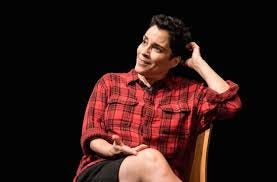
Marga from an interview with me in 2015: “About a year ago, I was in New York performing Love Birds, and I went out for drinks with Ellie Covan (the founder and director of Dixon Place). She asked what I was working on, and I told her I was acting out scenes from lesbian movies in my club act and commenting on them. For example I was in favor of Sharon Stone being a lesbian ice-pick murderer in Basic Instinct because I want people to be afraid of lesbians, so they won’t fuck with us. Ellie said, ‘Why don’t you develop it, and we’ll commission it for Hotfest’. My negative tape goes, that’s not going to happen. But then last November I started getting emails asking me to describe the show, and I thought, Shit, she is serious. So I booked some storytelling nights and started working.”
LAURIE & RICHARD, on the difference between Memory and Story, May 30.
To RSVP to these events, please email me at: lauriestone@substack.com.
To attend one event or receive one recording, with no future payment obligation, you can buy a “coffee” for $4 at ko-fi.com/lauriestone
Breakout sessions following the Zooms with guest artists
The BREAKOUT SESSION following Marga’s Zoom is on SUNDAY, APRIL 26 from 3 to 4:15 EST. THERE ARE STILL PLACES. There is a cap of 10 at each breakout. You are invited to share a piece of your own writing of around 400 words. The SLAM readings are thrilling impovs—we make a work together larger than the parts! The fee is $30. To sign up please email me at: lauriestone@substack.com.
There will also be a BREAKOUT SESSION on June 1, following the Zoom conversation on the difference between “memory” and “story.”
To request recordings of past Zoom Conversations
with Steven Dunn, with Margo Jefferson and Elizabeth Kendall, with Francine Prose, with Sophie Haigney (of The Paris Review), with David Cale that includes a reading from his hit solo theater piece Blue Cowboy, with poet David Daniel, with Daisy Alioto, and with Michael Klein, please email me at: lauriestone@substack.com.
Working together one to one on your writing or starting and growing a Substack publication.
If you would like to book time to talk one-on-one about a project you are working on or for guidance in gaining confidence and freedom in your writing practice, please email me at: lauriestone@substack.com.
If you would like to book time to talk one-on-one about STARTING AND GROWING a Substack publication, please email me at: lauriestone@substack.com. I can help you through the software, choosing a title, art design, and ways to gain readers.
__________________________________
Please “comment,” ”like,” and “share” below. Your engagement helps the algorithm notice the stack and gain a presence here for feminism and literary writing.
I love this, Laurie. I remember pieces of this world because my mother was so alive in that movement and also the peace movement. It brings back vibrant memories of women in the house, talking, excited, knowing they were part of something creative and powerful. And the house smelled like coffee and everyone wore bright colors and I felt like I was part of something amazing just by being in the house. So I went into school in fourth grade, read the dictionary, and when I found the definition of women as being the weaker sex, I told my teacher the dictionary was chauvinist and they should put it in the garbage.
Glad you reposted this, sorry that's it's needed more than ever.