
To go on seeing
Susan Sontag's ways of life.

I don’t remember the original prompt for this piece. It doesn’t matter to me in this moment. I find that pieces of writing change as they move through time, the same as anything else does, and I read them differently, depending on the social and political surrounding I’m in. Lately, I can see I’m less interested in what I could call abjection and disappointment. I find myself able to love more things in the world and in other people than maybe I was able to in the past. Recently, by chance, when I reread this piece, it seemed to have created a new relevance—what we need to go on seeing now. I love this aspect of reading. I love the feeling that the past can always be rewritten with more love.
________________________________
In a diary entry, Susan Sontag wrote, “One of the main (social) functions of a journal or diary is precisely to be read furtively by other people, the people (like parents + lovers) about whom one has been cruelly honest only in the journal.”
To be read “furtively by other people” is an intriguing concept. Would Sontag have published her journals and letters in her lifetime, had she lived longer? How might she have responded to “Illness as More than Metaphor” (NY Times Magazine, December 4, 2005), a chronicle written by her son, David Rieff, of her final treatments and death? And to his subsequent memoir, Swimming in a Sea of Death (2008)? And what would Sontag have felt seeing the photographs of her ill and dead body that Annie Leibovitz included in her book and museum exhibition, A Photographer’s Life?
As a writer, Rieff has mostly looked at very bad things happening to people caught in political nets. Among his books are: Crimes of War: What the Public Should Know; A Bed for the Night: Humanitarianism in Crisis; and At the Point of a Gun: Democratic Dreams and Armed Intervention. Memoir is a genre Sontag didn’t touch. In a memoir, you look at things and say how they make you feel. To hide real feeling in a memoir is like lying to your analyst while shelling out thousands of dollars not to.
Rieff wants to see his mother and to be seen by her, although at times he wishes he’d discovered less about her during her final illness, and he’s never comfortable saying any of this publicly. Writing a piece or a book, you never know where you’re going to wind up, following this trail or that one, and both Rieff and Sontag are squirmy and shy about emotions and the body.
In “Illness not as Metaphor,” Rieff searches for his mother in her medical decisions and questions the ethics of the bone marrow transplant she underwent for myeloydyplastic syndrome (MDS), the rare, deadly form of blood cancer that killed her in 2004. The treatment was exceedingly painful, expensive, and in her case fruitless, and he understands she chose it rather than contemplate her extinction. In his opinion, it was a psychological treatment in the guise of a medical treatment.
Weighing her decision to undergo the transplant, he writes: “What Nimer [her doctor] knew with the horrified intimacy of long clinical practice, but what my mother could not yet know, was just how agonizing the effects of an unsuccessful stem-cell transplant can be: everything from painful skin rashes to inordinately severe diarrhea to hallucinations and delirium. To me, torture is not too strong or hyperbolic a word. . . . After the transplant failed, and my mother returned from Seattle, Nimer obviously knew how long the odds were against an experimental drug like Zarnestra inducing even a brief extension of her life. But he said he felt that he had to try, both because the drug had had some success and because my mother had told him (and me) from the outset that she wanted her doctors to do everything possible, no matter how much of a long shot it was, to save or prolong her life. . . .”
Whatever else is going on in Rieff’s questioning of medical futility, he lets us know he disapproves of Sontag’s style of dying—on philosophical, moral, and aesthetic grounds—and then he twists guiltily for giving her death a bad review. He’s pissed at her for dying and for dying irrationally.
After the Times piece ran, he told New York Observor reporter Suzy Hansen that he intended no book-length memoir: “’If I ever do write anything, it will be for the drawer. I don’t understand why anyone wants strangers to read about one’s reflections about one’s family. It seems to me that if you write the truth, whatever you say is going to hurt a lot of people.’” At the same time, he said he didn’t want to control the commentary about his mother: “’I don’t want to be Stephen Joyce or the Beckett estate . . .. People will write what they want to write. I think my mother’s work will endure, and that’s what would have mattered to her—and that’s really all that matters to me.” [“Rieff Encounter,” Suzy Hansen, The New York Observor, May 1, 2005.]
But he changed his mind and produced Swimming in a Sea of Death, which retraces Sontag’s three episodes of cancer and adds a brooding lament over the role he assumed during her MDS: that of unwilling though compliant enabler of his mother’s magical thinking—her refusal, ever, to submit to her fatal diagnosis. Troubled by her emotional states, he tries to explain them (to us, himself) by going over—and over and over—her two earlier illnesses: stage four breast cancer, diagnosed when she was forty-two, and ovarian cancer, diagnosed in 1998 when she was sixty-three. You see, he is saying, she beat the odds those other times and believed—with her willingness to endure painful treatments—that she could do it again. The suffering went hand in hand with succeeding and was part of her magical thinking. What was her magical thinking? To place a meaningful cause (and the possibility of influencing it) on events that may simply have unfolded.
The relationship between mother and son is less dramatized than summarized in blurts about the difficulty they had touching each other and communicating their feelings. For how long? Rieff confides that the combination in Sontag of neediness and willfulness sucked air from his chest and independent thoughts from his head. His recoil from her unraveling of knowledge (“positive denial,” he terms it more generously) doesn’t relax. He wants her spared pain, but he’s also frustrated by her refusal to see what’s there. In not looking at death, she isn’t really looking at anything else that’s real. It takes up all her mental energy, and she can’t see her son, either.
He feels stranded in his understandings and legitimately so, because she makes it clear he must contain them. He’s burdened by extra knowledge about his mother—it feels out of sequence—and it places in relief the discomfort we feel seeing something about a person they don’t see in themselves. At the end, attending the glutton for more life with nothing to feed her, he’s resentful that being silenced has made him cold and he feels ashamed to have needs within the drama of his mother’s death. He loses her without feeling seen by her and without extending the tenderness, he tells us, he couldn’t offer her in life.
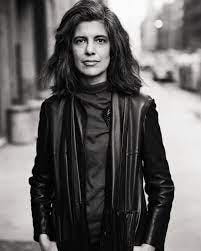
Separate from using Sontag’s death as a cautionary tale, the memoir contributes eloquently to the literature of death. Rieff’s prose can be delicate and searching. He’s uncertain—something Sontag seldom managed. He quotes lines from Philip Larkin’s poem “Aubade,” which rejects the notion of consolation in the face of death, and he sees his mother’s “wild black-and-white mane of hair and the intensity of her dark eyes.” Continuing, he says, “I want so badly to temporize with her: ‘Don’t love life so much,’ I want to console her, all the while knowing that she was no more consolable than Larkin was, or than I am for that matter. But I want to try, and, as I imagine it (irrationally), grant her some tiny sliver of acceptance of death, or, if not that, perhaps confer upon her some flake of Buddhist indifference to extinction.”
Swimming in a Sea of Death allows us to see Sontag’s experience, which we don’t have to judge. We can adopt the strategy Sontag proposes in Illness as Metaphor: to witness extreme moments in existence without blurring them with interpretations. Rieff reveals the way his brilliant mother faced the last part of her life—while she was still herself, still like us, and at her most vulnerable, a fragility she may not have been able to engage with as an artist but which aids our understanding of dying. Revealing her death also attaches it to the world she so cleaved to. She saw death as a form of murder, her son explains, a view that needs an apology only if you believe there is a right way to die and a wrong way to die, an infantile way to die and a mature way, an ugly way and an aesthetic way, a clean way and a messy one. There is not.
At the core of Rieff’s distress is Sontag’s refusal of consolation. Neither love, nor reason, nor memory, nor the sense of a life lived richly made a dent in her rage against mortality. She could not become interested in her death as a subject, but does that matter? There is something extravagantly, even comically consistent in her radical questioning of life’s orthodoxies, her viewing of death as an authority structure she would have to defy. Rieff nails the everlasting why? in his mother, the belligerent, Jewish, dukes up, who says? in her when he writes: “[N]o one who knew her more than casually was surprised that my mother, who had never reconciled herself to any essential thing, would die unreconciled to her own extinction . . .” He is never more gallant than when naming her contradictions: “She thought the world a charnel house and couldn’t get enough of it. She thought herself unhappy and wanted to live, unhappy, for as long as she possibly could.” And he is never more his mother’s son than when, trying to see things from her perspective, he reflects on the obdurate nature of magical thinking: “There is such consolation in unreason, which in all likelihood is why the world will always be a charnel house.”
I don’t believe that, but hey.
Rieff wants to protect Sontag from herself and from us, wishing her—futiley he knows—a less greedy and sluttish clutching at life. With not entirely unintentional humor, he wishes her a dignified death, as if there could be such a thing as dignity in moments of peak intensity. Had Sontag survived her death, she might have written an essay called “Against Consolation,” and she might have followed it with an essay called, “Against Dignity.” In some of her diary entries, she seems to be questioning whether dignity is just another term for closet existence, where the uncontrolled and uncontrollable parts of life and sex are kept hidden.
Rieff comes down hard on only one figure in Sontag’s life, and that is Annie Leibovitz. He refers once to their having an intermittent relationship and another time to describe his mother as “humiliated posthumously by being memorialized that way in those carnival images of celebrity death taken by Annie Leibovitz.” He’s so uncharacteristically angered, you suspect they clashed for other reasons Rieff doesn’t go into. Discussing her relationship with Rieff, Leibovitz told San Francisco Chronicle reporter Edward Guthmann that they didn’t speak any longer. She said: “Everyone deals with death in a different way, and it didn’t end well with David.”
Still, some of Leibovitz’s pictures are vivid companions to Rieff’s account, and Leibovitz deepens Sontag by presenting the sexual body and the ill body as simply a single body. Sontag and Leibovitz met in 1988, when she shot the author photo for Sontag’s book Aids and its Metaphors. In interviews, Leibovitz has credited Sontag with spurring her to sharpen and personalize her work. When Leibovitz shot the famous nude photograph of the pregnant Demi Moore, for example, Sontag was the one who phoned Tina Brown, then editor of Vanity Fair, and urged her to run it on the cover. In the photographs Leibovitz took of Sontag ill and later dead, she feels she was answering Sontag’s call for candor.
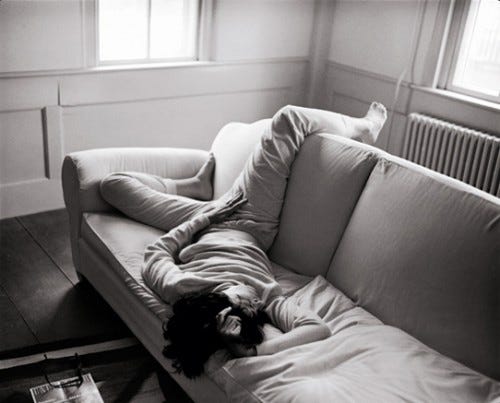
A Photographer’s Life advances roughly in chronological order, so before we see the final images of Sontag, we see her moving trough the world. In Petra, Jordan, she stands beside rocks that dwarf her. In Milan, she’s on a bed in a hotel with papers, books, and notes fanned around her. Her long, elegant fingers brace her knees. In 1994, under a hot sun in Mexico, she sits in a car, wearing a gleaming white. The same year, she’s captured on a bed, a pillow thrown across her chest, her arms crossed over her head, her naked torso and thighs posed in the manner of a classic odalisque.
The photographs are scenes from a marriage. We can smell the morning toast and coffee, and we see the specificity of a living woman that’s missing from her son’s book. Sontag is shy. She seldom smiles or meets the gaze of the photographer, her lover. She’s beautiful and awkward, vital and scarred by her brushes with death. We see her in a bathtub, her head partially cropped in some images, holding a hand over the place where her left breast was removed. In 1998, the barest smile washes across her lips as she lies in a hospital bed, receiving chemotherapy, her dark mane, with its famous white plume, swirled across the pillow.
Seeing Sontag’s vigor and vulnerability—and the beauty of the combination—prepares us for the last shots of her. Three photographs show her on her hospital bed in Seattle, where the bone marrow transplant was performed. Pillows prop her swollen feet. Tubes extend from catheters in her neck and another larger tube—probably for her urine to drain—is taped to an exposed, swollen thigh. Fluid has built up in her belly, which protrudes under the sheets. In two of the pictures, her head is elevated, her eyes closed, her mouth slightly ajar, her hair short and white like a Roman senator’s. Another shot shows her on a gurney, about to be boarded onto an air ambulance that’s headed back to New York.
Next we see a double page of contacts, showing Sontag layed out at her funeral. On the following page is a black and white version of the same image. She looks like Gertrude Stein, with her short white thatch and full cheeks. Her expression is peaceful, an almost smile curling about her mouth. At the time of her death, she and Leibovitz were no longer in a primary relationship, although they remained close. Leibovitz writes of dressing Sontag’s body in the introduction to her book: “I chose the clothes she would be buried in and took them to Frank Campbell’s funeral home myself. The dress is one we found in Milan. It’s an homage to Fortuny, made the way he made them, with pleated material. Susan had a gold one and a green-blue one. She had been sick on and off for several years, in the hospital for months. It’s humiliating. You lose yourself. And she loved to dress up. I brought scarves we had bought in Venice, and a black velvet Yeohlee coat that she wore to the theater.”
Others in addition to Rieff have been riled up by the pictures. The images are shocking, for one thing, because people don’t take photographs at funerals. Sontag was such a private person, the arguments went, this kind of exposure disrespected her stance in life. Another problem: the mixing of celebrity photographs with images of suffering and death—including a naked, wounded soldier in Sarajevo. Essayist Eliot Weinberger, writing in The New York Review of Books (“Notes on Susan” 2007), calls Leibovitz’s work “grotesque” and believes Sontag would have been horrified by it, based on statements in her book Regarding the Pain of Others (2003), where she contemplates “the modern experience of being a spectator of calamities.” Weinberger writes: “One reads it again now almost as a creepy prophesy, knowing that Sontag’s own suffering would be turned [into a spectacle], via Leibovitz, in a media mix of photographic images to be displayed next to images of half-clothed movie stars.”
Would Weinberger have been less ruffled if the movie stars had been wearing clothes? Is it the juxtaposition of their healthy bodies next to Sontag’s body with its bruises—the mixing up of sex and death—or is it the exhibition of sex on one hand and of death on the other in the public space at all?
Leibovitz writes in her introduction that she intended A Photographer’s Life, spanning 1990 to 2005, as an autobiography of sorts, splicing in scenes of domestic comfort and images of extreme experiences with the cleverly staged celebrity portraits she made her name with. She means to show how, within a given period, she is one moment with her lover, who is aging, and the next moment with famous actors she wants to capture in surprising ways.
It turns out to be a bad idea. You think a collage of different elements is going to migrate into a fuzzball unity for the observer, but it doesn’t always work. The celebrity images, although pointed in their magazine contexts, look trivial and distracting beside the rest of what’s shown. About the final images of Sontag, Leibovitz writes: “I forced myself to take pictures of Susan’s last days. Perhaps the pictures completed the work she and I had begun together when she was sick in 1998. I didn’t analyze it then. I just knew I had to do it.” Referring to the funeral, she says, “I was in a trance when I took the pictures of her lying there.”
Anyone who has attended the protracted hospital death of a beloved person knows how the eye becomes strangely adjusted to horror and disintegration, while at the same time goes on seeing the wholeness of the person. If you continue to look, you find beauty in the most unexpected places. Leibovitz offers a similar thought in response to New York Times reporter Janny Scott, who questioned her about the controversial photographs. Leibovitz said: “You know, you don’t stop seeing. . . . One doesn’t stop framing. It doesn’t turn off and on. It’s on all the time.”
Sontag herself, in Regarding the Pain of Others, reminds us that photography and death have been linked since the camera’s invention in 1839: “Because an image produced with a camera is, literally, a trace of something brought before the lens, photographs were superior to painting as a memento of the vanished past and the dear departed.” Comparing photographs to other media that document life, she concludes: “the photograph has the deeper bite. Memory freeze-frames; its basic unit is the single image.”
Leibovitz’s photographs of Sontag—in the bath and in the hospital during her cancer treatment in 1998—suggest that Sontag was becoming a less private person as she went along—that she was feeling less need to protect herself from showing who she was. In many ways, she paved the road to the revelations in Leibovitz’s pictures and Rieff’s memoir, explaining in Illness as Metaphor (1977) that comparisons of illness and the ill to other things—describing a corrupt political regime as a cancer, for example, or declaring war on cancer as if it were a conscious, malevolent entity rather than a natural occurrence—make it difficult for the ill simply to have an illness. She was making a case for the ill (and she might have added the sexually active) to be seen as they are. She was inviting contemplation of these aspects of life into the public space, even though, at the time, she didn’t talk about her own ill body as a case in point.
In subsequent writings, among them in Regarding the Pain of Others, she considered what happens to actual suffering when it’s represented by another medium. Inevitably, it becomes aestheticized—an expression of the photographer’s vision—which may or may not be a bad thing. She was concerned with whether the pileup of images in different kinds of media generates connection between the relatively safe person looking at an image and the grievously imperiled person represented, or does it lead to disconnection and compassion fatigue.
It could be argued that photographic images remind us of the aesthetic dimension that exists in anything humans see as well as the titillation aroused in us by the act of looking, whether through our eyes or through a camera. Seeing is an erotic activity. The photograph makes us aware of this, but the photograph is only the messenger of the complexity of seeing. Sontag wanted to free things from interpretation, to allow them to be viewed as they are, knowing that this is impossible, that in the unconscious minds of human beings sadistic and voyeuristic responses are hard wired and are another form of things as they are.
She argued for bearing witness with the suffering of others as well as with the joys of life, even though the act of witnessing remains at least in some measure out of the control of either the viewer or the person seen. The ill and dying do not want to be shunted out of sight, and so it is up to the individual viewer to decide whether Rieff’s account and Leibovitz’s images do or do not make you feel more connected to Sontag’s death and therefore to your own.
Main books discussed:
Swimming in a Sea of Death, a memoir by David Rieff.
Reborn, Journals & Notebooks 1947-1963, the first volume of private writing by Susan Sontag, edited by David Rieff.
A Photographer’s Life: 1990-2005, by Annie Leibovitz.
___________________________________________
Stackland
I love writing the stack. Paid subscribers are the only way it continues. I don’t have a paywall. I will never stop you from reading a post. If you enjoy what you read and have not yet taken a turn at support—it costs very little to jump in!—please consider joining today. There are lots of benefits you can read about in the next section. And please make sure to use a browser on your phone or computer, and not the Substack app.
___________________________________
Happenings for paid subscribers
UPCOMING GUEST ARTISTS on ZOOM, always on Saturdays from 3 to 4 EST To RSVP: lauriestone@substack.com
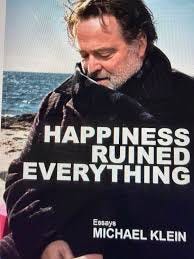
MICHAEL KLEIN, brilliant and beloved poet, prose writer, performer, and teacher on MARCH 28. His new book is Happiness Ruined Everything.
Here’s a bit from a piece he wrote about the actor Michael Jeter: “We had dinner somewhere, and on the way back to his apartment afterwards we were talking about someone we both knew who wasn’t very bright, and Michael said, ‘He’s dumber than a box of hair’, which was very close to the funniest thing I ever heard anybody say. It was so funny that I fell in a heap at a crosswalk on Riverside Drive. God, he was funny, which also made him angelic.”
MARGA GOMEZ, utterly original actor, standup, and writer, April 25.
To RSVP to these events, please email me at: lauriestone@substack.com.
To attend one event or receive one recording, with no future payment obligation, you can buy a “coffee” for $4 at ko-fi.com/lauriestone
Breakout sessions following the Zooms with guest artists
The BREAKOUT SESSION following Michael’s Zoom is on SUNDAY, MARCH 29 from 3 to 4:15 EST. There is a cap of 10 at each breakout. You are invited to share a piece of your own writing around 400 words. The fee is $30. To sign up please email me at: lauriestone@substack.com.
To request recordings of past Zoom Conversations
with Steven Dunn, with Margo Jefferson and Elizabeth Kendall, with Emer Martin, with Perry Yung, with Francine Prose, with Sophie Haigney (of The Paris Review), with David Cale that includes a reading from his hit solo theater piece Blue Cowboy, with poet David Daniel, and with Daisy Alioto, please email me at: lauriestone@substack.com.
Working together one to one on your writing or starting and growing a Substack publication.
If you would like to book time to talk one-on-one about a project you are working on or for guidance in gaining confidence and freedom in your writing practice, please email me at: lauriestone@substack.com.
If you would like to book time to talk one-on-one about STARTING AND GROWING a Substack publication, please email me at: lauriestone@substack.com. I can help you through the software, choosing a title, art design, and ways to gain readers.
Your missive here is astounding. The way you delve into mother, writer, lover, son, intimacy, dignity, death, and yet leave the reader free to keep reading to the end in this whirlwind of points to be considered without interpretation. This is such a smart piece, thorough and penetrating. And at the end, slapping us with “as if there could be such a thing as dignity in moments of peak intensity…just another term for closet existence, where the uncontrolled and uncontrollable parts of life and sex are hidden.” Brava!
Superb piece. I'm fascinated by Sontag's writing and thoughts and it seems that so much of what she wrote about the artform of photography was played out and perhaps recast in the photographs Leibovitz took of her in illness and death. I love the exploration of there being no right way to face death. As with illness -- the metaphors and abstract descriptions can so easily become ways of not letting pain and mortality be what they are. You've given me so much to think about here -- thank you.