
Spalding Gray
The time of his life.


Note on why you are seeing an amaryllis instead of Spalding Gray. I received an email that the image of Spalding I had originally posted infringed on a copyright, and it was deleted. It’s the first time this has happened to me, although perhaps not the first time I have infringed on a copyright. I love art directing the posts. I’m not sure how to insure the images I use do not infringe on anyone’s copyrights. I apologized to the complainant in an email. For the time being, a safe way to go is using pics I’ve taken. Maybe I will become a better photographer. Right now, with the loss of my Facebook account, I am feeling rocked, shall we say, in tech land and media where am I? Love to you all. xxL
Dear Subscribers,
On August 9, Stackie celebrated anniversary number four, and we have now begun year five! This morning, I woke up to the news FACEBOOK had suspended my account. A few hours later, FACEBOOK wrote to say my account had been permanently deleted for reasons it didn’t give, and there was no means of further appeal. That’s it. All the writing from 2009 until yesterday, all 5000 “friends,” all of it disappeared.
Here is the best thing about writing Everything is Personal on Substack: No one can censor or cancel or rephrase or delete a word I write.
I will be writing more on Substack “Notes.” If you used to read me on Facebook, please find me on the feed!
A substantial number of paid subscribers moved here from Facebook. They wanted to offer a “tip” or a gift of “thanks” for all the writing they had read for free. I needed them. I appreciate them. And this pool of possible subscribers is now gone. This may mean a serious loss of revenue. I am hoping that you—loyal readers who still read here for free—will convert to paid and step in.
There is a 50% discount for new subscribers and gift subscriptions, meaning a year is $25 with all benefits and a month is $2.50. There is no paywall. There has never been a paywall. There will never be a paywall. I don’t like them.
What’s happened in four years.
Number one on my list is the gorgeous community we’ve formed. I see it in your faces at the Zoom conversations. I feel it coming through your smart and funny comments on the posts. You have gotten to know each other. We watch the dawn slowly light up Marian’s room in Australia. We see a bit of yawn as the Europes bend toward sleep during their evenings. Last weekend, we met the Amsterdams (you know who you are) and fell in love with them.
Richard and I have so far hosted 40 conversations about the craft of creative writing and hosted many brilliant guest artists, among them Margo Jefferson, Elizabeth Kendall, Francine Prose, David Cale, Marga Gomez, Errollyn Wallen, David Daniel, Perry Yung, Sophie Haigney, Michael Klein, Steven Dunn, Emer Martin, and Daisy Alioto. The next guest artist on September 26 is Cassandra Neyenesch, who’s new book A Little Bit Bad is killing it with readers and reviewers. It’s a first novel, and Cassy will tell us how she got her book written and arrowed it into the world. When you think about it, a one-year subscription includes 12 Zoom conversations, and new subscribers can come for the price basically of a coffee and a fat (quite fat) croissant.
I recently learned only 5% of people who start a Substack publication continue for four years and only a tiny fraction of that number have never missed a deadline. I am part of that tiny fraction. So far, there are 330 posts. Paid subscribers can read them at any time. Free subscribers can read the most recent 15 posts. There are 428 recommendations from other Substack publications. Everything is Personal has been in the leaderboard in Literature since the leaderboards were started.
All paid subscribers will be offered a discount link to my next book due out in February 2027, The Marriage Dividend, Stories from the First Year. (This, too, will be around the cost of a coffee and a croissant.) The book has partly been formed from the Substack posts. Meaning you have made the book possible. You make all the writing I do here possible. I write for you. I think about what might give you pleasure.
Feminism
Before starting the stack in 2022, I wondered how much feminism readers would want. It turns out, you want tons of it. Stackland is an absolute hot bed of hot girls hot under the collar about “the pass,” otherwise known as men can and women can’t, or men must and women must not. Feminism is thriving in Stackland—it’s a movement. This writing is part of it.
________________________________________
Spalding Gray
Why this piece today? I don’t know. It’s always a crap shoot, and then I think about things in the moment I love. I love how much I learned from Spalding about writing as improv, and thought-in-action, and creating a clown who knows sadness plus time is comedy. In this piece, you get a whiff of the Downtown art and performance scene that’s gone and that was a big part of my life when I wrote for the Village Voice. Can you see the great theater people, hustling through the streets of the Lower East Side?
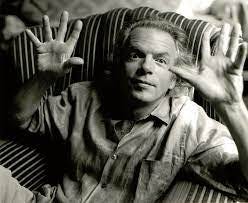
I HAD LUNCH WITH SPALDING GRAY the summer of 1996 when I was writing a column for the Village Voice. He chose Spring Street Natural Food, and we sat beside a large picture window. The day was sunny, and he squinted, the glare bothering the eye he had chronicled in Gray’s Anatomy (1993). I had praised the monologue, and maybe that’s why he came out.
In Gray’s Anatomy, he develops a macular pucker in his left eye, meaning the vitreous humor has liquefied and pulled away from the retina, leaving behind a piece of Saran Wrap-type tissue that causes words to slide off the page. An operation is recommended, but Spalding chases after alternatives such as “nutritional ophthalmology” and psychic surgery. The performance is bravura stand-up. In one sequence, feeling helpless and depressed, he wanders to the Bowery. He’s wearing a shabby overcoat and he’d got a day’s worth of stubble, and he fits right in. A car pulls up, a car full of Hasidic Jews, and they invite him in, and he accepts the ride. They drive him to Williamsburg to clean the yard of their synagogue, and he does the job. He does it so well, he’s asked back, and he’s happy. He’s entered a porthole out of fear.
At the time of the lunch, I didn’t realize how difficult life could feel to off-stage Spalding. I knew the figure from the monologues who might describe becoming a hedgehog rolling around on the floor, but the hedgehog didn’t tell his stories. On stage, the narrator spoke in measured tones, and his delivery was low-key in contrast to what he was revealing. He could get you to feel something or understand something from a sip of water, or the slight rearrangement of his feet under his wooden desk, or a tiny shift upward of one of his circumflex eyebrows. His plaid shirt was his clown costume. The hedgehog was the one who came to lunch.
He was squinting from pain, I now understand. To have registered it then would have felt presumptuous, and I was excited to be with him. He had an aura, some kind of energy field that invited play and intensity. He always had a story. Maybe he thought it was expected. That day he’d gone to the post office, having been away from New York for six months, and he didn’t know the price of a stamp. He approached several people, and they shrank back. He said, “as if I were imposing on them or was a madman about to go off.” Finally, he shouted the question into the room, and a few tepid bleats came back, “Thirty-two cents.” He wondered if he’d become more wild-eyed or if the city had grown angrier. Maybe it was a little of both.
We had salads with carrots, sunflower seeds, and sprouts. On the side were pitchers of tahini and hunks of seven grain bread. He spread butter on his bread and ate hungrily. He looked thin and worn out. Traffic crawled along Lafayette Street. Gym rats with tattoos lazed by. A waitress poured coffee. She recognized Spalding and didn’t hover. Everyone knew him downtown, and he liked being seen. It helped him not bleed into the sidewalk. In his neighborhood, people gave him slouchy and casual space to ghost around with drifters, hookers, and anyone who caught his fancy After September 11, he wrote a love letter to New York, saying the the city’s absurdity had given him a sense of humor.
At the time of the lunch, he was working on It’s a Slippery Slope (1997), a monologue about learning to ski at fifty-two and starting an affair with a woman named Kathie Russo he meets at a gig. She gets pregnant with his child, and after seeing the boy, who is eight months old by then, he ends his marriage to Renée Shafransky, with whom he’d lived and worked for a dozen years. The monologue troubled him. After twenty years of autobiographical shows, the ethics of the form still felt shadowy. What would the audience take away from the story? How would the real people feel? He believed, as an artist, he was entitled to the materials of his life, but did he have license to portray others? Renée directed several of his monologues, and while they were collaborating, she okayed his portrayals of her. Slope, however, depicted her suffering at his hands. How could he profit from hurting her? Now that he was a parent, how much of his child’s life would he publicize? He shook his head slowly, staring at the lettuce on his plate.
The conversation stayed with me. The doubt felt sincere—the hollowed eyes and questions that couldn’t be answered. Spalding often said he was living his life in order to perform it—performing was the part of life he was waiting to get to. In Slope, he reports that during the period of our meeting he went a little crazy. He chose his son over Renée, but he didn’t stop missing her and their vagabond partnership. He found himself muttering on the streets and barking like a dog in the manner of his mother when she was mad, and he thought he was joining her, or becoming her, or just too weirded out by his emotions to contain them. He couldn’t tell if he was acting crazy or really was crazy, but he figured that not knowing was a kind of crazy, too. In his writing, you don’t feel him falling in love with women. Most often in his stories he is swimming away from a woman to a place where his body can dissolve. When he embraced his son, he could not get his fill of little-boy squirm, and smell, and curiosity. He chose to stop choosing and let life take him like a wave, but that doesn’t mean domesticity suited him or that the wish to be in two places at the same time was ever quieted.
In June 2001, on a trip to Ireland to celebrate his sixtieth birthday, Spalding, Kathie, and three adult friends were driving back from dinner. It was raining. Kathie was at the wheel, stopped on a country lane and about to make a turn when a speeding yellow van crashed into them head-on. Spalding, in the back without a seatbelt, sustained a broken hip and a skull fracture. His hip would need to be held together with a metal plate, leaving his right leg almost immobilized. He had to wear a brace up to his knee for a condition called drop foot. Due to nerve damage, he couldn’t feel the top of his foot. The skull fracture went undiagnosed for a month and left hundreds of bone fragments in his brain as well as a jagged scar across his forehead. Metal plates needed to be inserted into his head to prevent infection from entering his brain. In a flash, he believed, he’d lost his mobility and physical attractiveness, although directly following the accident he took notes on what was happening to him and found humor in spooky confluences that had led to the crash.
In time, his sciatic nerve was scraped to remove scar tissue, which might have restored feeling to his foot and improved his walking, but the healing takes eighteen months, and he didn’t live long enough to see its effects. He had intended to kill himself in 2002 by jumping off a bridge, but he had been talked down by a passerby. He consulted with therapists, including Oliver Sacks, about a black depression that swallowed him into a fog. At his memorial service, his stepdaughter Marissa described him after the accident, stationed in an armchair and feeling his losses. He believed brain damage kept him from writing, although, nearly until his death, he continued to perform Life Interrupted, his monologue-in-progress about the accident. On January 10, 2004, he jumped off the Staten Island Ferry and drowned. On March 7, 2004, his body was discovered floating near the shore of the East River.
Why did he jump that morning? The day before his disappearance, he’d seen Tim Burton’s film Big Fish that ends with the line, “A man tells a story over and over so many times he becomes the story. In that way, he is immortal.” Kathie told a reporter from New York Magazine she thought the movie had given him permission to end his life. In an interview with Fresh Air host Terry Gross, on March 2004, Kathie speculated, “the point of no return” was the family’s move in February 2001 to a big house a mile outside the village of Sag Harbor. He obsessed about it, felt trapped out there. “It was this, not the accident,” that killed him, she thought.
Even if we could understand his end, what would it change? The work is what stands. The important question to ask for any artist is: What are the conditions that enable the art to grow?
How did it start?
He discovered acting at prep school when he was nearly twenty. He had flunked several grades earlier. Cast as a psychotic in The Curious Savage, he improvised a hop scotch across a rug during the performance, and when the audience laughed he woke up. You have to remember he was ten when his mother had her first mental breakdown. You have to think that witnessing her wild-eyed ranting turned on some switches in him and shut down others. You have to factor in that reading and writing were difficult for him and his dyslexia had gone on unnamed and untreated. The first complement he remembered receiving was from his English teacher, Ruth Hartz, who directed the play and said he had excellent timing. In an interview, he said: “I had never heard the word ‘excellent’ applied to me in any way.” So acting it would be, work he conceived of as a substitute for having a life. As a young actor, he yearned to play Konstantin in Chekhov’s The Seagull because the character kills himself at the end of the play and the actor gets to come back and do it again every night. He was never cast in the role.
The Wooster Group
It would take another fifteen years before he and Liz LeCompte would begin devising Three Places in Rhode Island, plays that explore his mother’s suicide, introduce the character, “Spalding,” and launch his direct address to the audience. Spalding dedicates his novel Impossible Vacation, “To my mother, Creator of everything and destroyer of everything”—an homage to the Indian goddess/god Shiva. His solo shows are road trips to Death, the theme park. Our guide, a man who thinks he can’t have fun because his mother might kill herself, journeys to the mouth of nothingness, pushes past the cave of regret, tracks Mom to the precipice of gloom, and leaps into the sea of forgetting. He tries to escape the story by seeking refuge in the arms of strong, male guru types and shrinks. Often they are versions of his father Rock Gray. At the end of each story, Spalding returns with the tale, and he is laughing. “We should call every truth false which was not accompanied by at least one laugh,” Nietszche wrote.
When Spalding is on stage, you have to watch him, preening and relaxed, the way an actor needs to be. His face is sly and expectant, enjoying the feel of your eyes. At some point in a monologue, he will roll up his sleeves and reveal his toned forearms. He dominates the pieces he devised with the Wooster Group, not only because his biography is their source material but because when he opens his mouth he speaks to you. He’s knowing and innocent. How does he do it? He’s Puck, feeding you inside dope. Under the spell of his broad, New England vowels, you smell salt beaches and pine trees, you hear gulls crying overhead, you feel the sharp Atlantic wind cutting your cheeks. In his deadpan delivery, nothing is unsayable. Playing the doctor in Nayatt School (1978), which slices up T. S. Eliot’s The Cocktail Party, he says archly of a character who dies painfully, “If she chose the life that led to her death, it’s a happy death. If that is not a happy death, I don’t know what is.”
I am speaking to you.
In this play, he begins speaking directly to the audience, discarding the pretence he is talking to another actor. Building his solo pieces, he develops an art of bricolage. Scenes and images are juxtaposed to each other, and meaning leaps across their edges the way, through a montage of images, films tell stories. In the introduction to the published version of Sex and Death to the Age 14 (1986), he describes keeping a notebook. He practices looking out, at people and events, rather than looking directly at his emotions. How he feels is revealed by the way he tells a story about something other than his feelings. Something captures his attention. It reminds him of another moment, and the sandwich of present and past prompts an emotion or a reflection. It’s thought-in-action as much as a character moving from point A to point B.
He told an interviewer he could never run out of material: “There is no such thing as nothing because as soon as it’s observed, it’s something. So when I sit down to speak I’m really recounting a kind of memory film. And I’m trying to do it in as much detail as I can. There’s no way I will ever go blank unless I have Alzheimer’s or something like that.” In another interview, he said there was nothing he hadn’t talked about to someone: “Either with the woman I’m living with or the therapist or the audience. Everything that has come into my fantasy and consciousness that I can articulate I have talked about. But not all of it to an audience.” These two elements: finding potential interest in any subject and approaching it with drop-dead candor are the lynchpins of his art.
Pretending to remember.
The early monologues: Sex and Death to the Age 14 (1979), India and After (1979), A History of the American Theater (1980), and 47 Beds (1981), among them, are play lists of memories he shuffles and mixes like discs in a jukebox. In A History of the American Theater, Spalding sits at his desk. In front of him is a box of cards with the titles of the plays he’s acted in. Some cards prompt a mere sentence. Other cards link to a worked-out scene. We see the names of the plays through a glass panel, but having shuffled the cards before each show Spalding doesn’t know their order, and so every performance is different and the emotional meaning of a story changes, depending on where it winds up in the whole performance.
In India and After, he cuts up seven narrative strands into segments that range from thirty seconds to four minutes, and he shuffles them. The stories include: spending a week in a Las Vegas jail for refusing to give his name to an arresting officer, falling in love with a hippie child in California, and performing Mother Courage in remote parts of India where, in one village, the corpses of the poor await the collection of coins to pay for their cremations. A bit of one story is told and then a fragment of another comes without regard to the chronology of any of them. Some stories start with the ending, others with a moment of confusion, or humor, or regret. No story unwinds in its entirety, and every performance is incalculable, although by playing with the combinations night after night, Spalding learns to heighten drama, no matter the order of the sections.
Working this way, he creates theatrical immediacy. He’s after emotional truth, not literal truth or firm facts. For example, the anecdote about cleaning the synagogue in Williamsburg did really happen but not when he was approaching eye surgery. From the start, his comedy-as-pain and pain-as-comedy are matter-of-fact. In A History of the American Theater, recalling his performance in The Knack, he says, “My father brought my mother to see this play while she was having an incurable nervous breakdown.” Pause. “She thought she was going to see Long Day’s Journey into Night.” Pause. “But this was the play that sent her over the edge.”
Everything is political.
From the start, too, he sees personal experience as shaped by historic forces and he interprets the zeitgeist as a collection of individual energies. Big and little, the political and the private, are not opposites to him. When he performed in Richard Schechner’s Commune (1970), which treats the Manson family murders and the Viet Nam War, he reports that at some point in the show the audience was ushered onstage and directed to play the villagers who were massacred at Mi Lai. If they balked, the performance was halted and the doors of the theater were locked. He recalls, “One woman called her lawyer to get her out.” The early monologues are witty, bold, freewheeling, and entertaining, although Spalding hasn’t yet learned to make the parts sing as a greater whole.
A kit for writing a play.
He did not start a monologue by writing it down. He would speak bits into a tape recorder and workshop them in skeletal performances. A piece was constructed over as many as two-hundred shows. He used to present an evening called “Interviewing the Audience,” which he’d start by fishing for lively specimens outside the theater. Then he’d call each person up onstage and improvise an evening from the exchanges that got going. He thought of his monologues, too, as conversations with the audience. He’d tape performances, listen for laughs and music in the flow, and adjust the text and delivery. When a piece was “set,” it became the published version, but even then he didn’t memorize a script. Sitting at his desk with notes before him, he’d evoke the memory of past performances, wanting to create the illusion (though it was also the reality) of events recalled on the spot. He made himself visible only to make himself invisible again, so that the work would show—the way we see the beating heart of a guppy through its translucent skin.
He knew a memory had become a story when it generated uneasy laughter and snaked in and out of big and little themes, such as, in Gray’s Anatomy, the comedy of failing eyesight in a world where AIDS is taking out a generation, and in Swimming to Cambodia, the vertigo of personal arousal on a landscape of global horror. What makes a subject feel trivial or large, he discovered, isn’t its historic dimension or lack of one but whether or not there are stakes for the teller and the amount of complexity a story unfolds. No one really cares about the real life of the narrator, he understood. We care about stories we’re made to feel are about us, and this happens when the narrator isn’t trying to protect anything or ask for anything it needs. At the top of his game, Spalding goes on seeing, no matter the consequences and the amount of continuing doubt. He knows that the power position in comedy—in all art, really—is the place of no power, where the teller is stripped of protection and keeps investigating anyway. In each story, he journeys out beyond his depth, wanting to be catapulted past the boundaries of a self that he knows, too, is his only home.
The okay to speak.
In the family that Spalding started out in, you weren’t allowed to mention the elephant of Bette Gray’s madness. You weren’t allowed to reflect on it even after she was dead. Theater is Spalding’s great uncorking: first swirling and sweating in the Schechner playpen, then opening his chakras in his monologues. Like Jonathan Swift, Spalding Gray is a great, excremental comedian. In Vacation, on a fad diet of soybeans, Brewster North drops silent-but-deadly slow burners on unsuspecting enemies. Bette, too, unleashed by her madness, farts rebelliously at the dinner table, sending Rocky, Sr. to the living room and his newspaper. Monster ends with the description of a performance of Our Town in which a child actor projectile vomits on cast members, one of whom is supposed to be dead.
Downtown is Spalding’s art home. The framework for seeing, the street rhythm he speaks in, the sound of thought in his head, the feeling of his mind shaken by what passes by. Peeling yourself open is your job. The boundary between private experience and public life is shredded. Ellie Covan opens her living room as the performance space Dixon Place. The Hungarian troupe Squat Theater live and work in a storefront, and people passing by become part of the performances, where life and art melt into a slippery, punk gob. Solo work explodes in hole-in-the-wall clubs like WOW Café, 8BC, Limbo Lounge, and the Pyramid, wafting a democratic, unregulated atmosphere in which anyone can publish fantasy and opinion, anyone can broadcast a version of Wayne’s World from their bedroom. Part of the surge is economic. Solo pieces are cheap to mount and transport, and they don’t depend on producers. It’s no accident they explode while public money for theater companies is drying up and New York City’s Mayor Koch, rather than subsidizing small theaters, enables developers to gobble their property.
In 1984, Spalding is cast in Roland Joffee’s film The Killing Fields, depicting the US bombing of Cambodia and that country’s genocide at the hands of the Kymer Rouge. The experience inspires his crowning achievement, Swimming to Cambodia (1987), and the film version, directed by Jonathan Demme, debuts the next year as well as the HBO broadcast of his monologue, Terrors of Pleasure. He becomes famous and tours the world. He’s cast in more films—there will be over thirty in all—and in 1989 he plays the Stage Manager in a Broadway revival of Thornton Wilder’s Our Town.
In his best efforts, Spalding resolves nothing, apologizes for nothing, and translates nothing. He may be surprised by life’s strangeness, but he isn’t shocked. He liked to tell a story about how one time he asked his father why, of his three sons, he was the only one not circumcised, to which Rock responded, “You’re not?” But this is not the whole of Rockwell Gray. In Rumstick Road (1977), Spalding reads a letter Rock Sr. wrote to him in 1966, a year before his wife’s suicide.
Rock has returned from seeing Bette in the hospital, and he’s beginning to despair: “I did talk with her last Tuesday, but it was very discouraging—she is now certain that she is insane and that she can never recover. This is a very difficult frame of mind to recover from. While I keep avoiding the thought, I find myself more and more wondering if maybe this is so—it does happen to people—but I can’t believe it is really happening to us. . .. Friday night when I came home I went into the bedroom and found glass all over the floor—then discovered that the storm window and one 8 by 10 pane next to mother’s little shelf corner in the front had been smashed. I was about to call the police and looked around for a stone or other object, but found nothing—then discovered feathers and after looking further found a partridge, dead on my bedside table. It’s hard to believe that a bird which weighed one and a quarter pounds could go through two windows, brush through the curtain, knock over the TV aerial, without losing any altitude, zoom across the room hitting the corner and dropping dead on the table without even disturbing the lampshade. It took me about two hours to clear up the mess and, I might add, dress the bird for the ice box. Gram Gray came for the weekend and we had a delicious partridge dinner Saturday night.”
To the members of the Wooster Group, the bird seemed to figure Bette Gray. But the letter is more remarkable as a porthole into her husband, who emerges, of all things, a writer. Note the detail of the bird’s flight and the macabre relish of making a meal of the little martyr, a comic ending worthy of Hitchcock—or Spalding. Touchingly, Rock seems to want to entertain his son, and in this space father and son are united.
How dear that aligning must have felt to Spalding and how treacherous to want it, since it flashed only to fade many times. Anyone with a seductive and unreliable parent knows the hiccuping affect of their allure and the way, if you see it, to make comedy out of the disappointment. Spalding frequently draws “the power of no power” by casting himself as a willow bending toward an in-charge man. In 47 Beds, on a plane to Greece, he meets a stranger who is gay. They go to a hotel and take separate rooms, but Spalding wonders why his new friend doesn’t make a pass at him. Should he lose the inch he can pinch around his waist? He knocks on the man’s door and says, “We have to do something.” Aside to the audience: “I mean, who would ever know?” The man asks, “What do you like to do?” And Spalding isn’t sure. “The next thing I knew I was in bed with him, and I went right down on him, and I thought, ‘I’m a homosexual.’ It’s like sucking on a rubber hose.” The man says, “Spalding, you don’t have to do anything you don’t want to do,” but Spalding doesn’t know what he wants. Alone again, he wonders what Ernest Hemingway would say about his masculinity. “What would the Village Voice say.”
Spalding, man.
Romance with a man drives Swimming to Cambodia, as well. In this case, the object of desire is Ivan “devil-in-my-ear” Strasburg, the handsome, Mephistophelean South African who goads Spalding toward risk. And Spalding, to prove his worthiness, braves the dangerous currents of the Indian Ocean. Their exchanges have the feel of Shakespeare’s comedies of sexual confusion, where, at the drop of a handkerchief, girls turn into boys and boys into girls pretending to be boys.
Ivan likes seducing as much as Spalding enjoys being swept away. “He was a bit of a sadist playing into my masochism,” Spalding tells us, and our narrator loves imitating Ivan’s flirtatious baritone. “He said, ‘Well Spalding, Spalding, listen man. On our next day off I’m going to teach you how to scuba dive. You’ll see fish you’ve never seen before, you’ll have Rapture of the Deep, man, and it will be incredible.’ And I said, ‘Oh my God, at last. It’s like an initiation. I’ll become a man.’ I’ve always wanted to overcome my fears with another guy, you know, skin diving and all that. I’ve always wanted to try scuba diving but I was afraid of sharks coming up from behind. And now Ivan would help me through my fears and become my scuba-guru. Ivan said, ‘We’ll go. And Spalding, you will see fish of all colors—you have never seen anything like it . . . but there are these Stone Fish . . . and you don’t want to step on one of them Spalding, because you’ll be dead in seven seconds. There’s no remedy, so wear your sneakers.’”
Years before his death, Spalding had moved far from such adventures with the Ivans of the world. After writing a monologue about family life, he told interviewers he wasn’t sure there would be another piece in him. And then the accident shook him in its fist and flung him back into the world. The first thirty pages of Life Interrupted present him back in form with his observing juices flowing. There are strangers to mingle with. Oh, joy! And premonitions, and a cross dresser in the hospital, and the Irish temperament to think about. His ancestors are Irish. He doesn’t know what the story of the accident is about, but he is shaping events to look like clues to a mystery.
Terrible things are happening in the world and to his body. Terrible things are supposed to happen in a Spalding monologue, and it’s his job to return with the bloody pages. He’s hurting and scared but also excited. He’s excited to get a good deal from Dr. John McElwain who will operate on his hip for under a thousand dollars. Constipated in the hospital, he can finally go. Oh, joy! “They close the curtains and somehow, in a bedpan, they deliver this long brown snake. It’s the oddest angle I’ve ever taken a shit at. Then they open the curtains and everyone just put down their forks and drinks and stared at me. I’m so excited that I get my notebook out to write about it, and the other people are looking over at me as if to say, ‘Oh, another James Joyce have we here? Leave it to a Yank to take a shit in the middle of lunch and then write about it.’”
Back in New York, awaiting the operation on his head, he’s still carving details and jokes, but during the procedure bone splinters are released into his frontal lobe. “I think they have to try to pick them out,” he writes. Afterward, hysteria swamps him. In the piece, You can hear it blowing down a long, winding corridor, and you know it’s not going to stop.
As much as he can manage, he will perform his work-in-progress, but mostly, inside the house, he will stop writing and go over the details of the accident. If only he and Kathie had left the pub a few minutes earlier or later. If only it hadn’t been raining. Life Interrupted stops abruptly, and the reader is told it’s the last line he added to the text, and you wonder how the terror took over when, up until then, he had been able to balance salt against pepper, vinegar against oil, booze against a brisk walk, the wind whipping his hair and face, his body steadied in the chaotic streets of New York. But he can’t walk, and he won’t wait to see if his scraped sciatic nerve can improve his mobility. Is the release of the bone fragments the crucial event? Do the splinters damage him beyond a fix or does knowing about them do that? He will believe he’s going mad, and he will want to spare his children a spectacle he knows first hand. Does he realize his concern for them means he hasn’t slipped away entirely? Does it make him feel he must act while he still can?
The day he died, he wrote, “This is my last journal entry Kathie. It’s an old story you’ve heard over and over. My life is coming to an end. Everything is in my head now. My timing is off. In the last two years, I’ve had at least 10 therapists and all those shock treatments. Suicide is a viable alternative for me instead of going to an institution. I don’t want an audience. I don’t want anyone to see me slip into the water.”
Why he chose to die then, why at all, we cannot know. His performances remain, and they are joltingly alive. Spalding’s work helped clear a path for many other comedians of ambivalence, among them: John Leguizamo, Holly Hughes, Jonathan Ames, Deb Margolin, and Danny Hoch. His texts have earned a place beside enduring memoirs that include My Dog Tulip by J. R. Ackerley, Stop Time by Frank Conroy, Bronx Primitive by Kate Simon, Maus by Art Spiegelman, This Boy’s Life by Tobias Wolff, Fierce Attachments by Vivian Gornick, Autobiography of a Face by Lucy Grealy, The Liar’s Club by Mary Karr, and The Blue Suit, by Richard Rayner. These are artists who don’t believe they can be fixed or straightened, and they don’t want to be.
Swimming to Cambodia.
Let’s leave Spalding at the top of his game—on the lip of a wave in the Indian Ocean, going up, up, reaching for a perfect moment. Ivan has been luring him to druggy bashes and dangerous rip tides. Spalding decides to leave his money on the beach and jump in the water, even if there are sharks. The memory of this freedom will seep into moments of fear. Like when he meets a CIA agent on a train with his finger on a green, doomsday button, a man who spends his days stoned on blue flake cocaine that is undetectable by urine analysis. In the water, Spalding is still looking for an exit from consciousness, knowing there isn’t one.
He’s out of his depth, where he always wants to be, floating in water off the island of Puket, and it looks more beautiful than anything he has ever seen, like beauty that could swallow you whole. “An oriental Hudson River School painting,” with towering waves, and monsoon skies, and sailing white birds, and shivering palms. He’s thinking about the way he can’t stop thinking, and yet for moments he can. He’s a creature unlike anyone else and in that separateness he’s exactly like everyone who exists.
He sings and soars and coos about losing the boundary of that difference. “Suddenly, there was no time and there was no fear and there was no body to bite. There were no longer any outlines. It was just one big ocean. My body had blended with the ocean. And there was just this round, smiling-ear-to-ear pumpkin-head receiver on top, bobbing up and down. And up the perceiver would go with the waves, then down it would go, and the waves would come up around the perceiver, and it could have been in the middle of the Indian Ocean, because it could see no land. And then the waves would take the perceiver up to where it could look down on this great wall of water, to where Judy Authur and John Swain were body surfing—like on a Hawaiian travel poster—far below, and then—‘Whoop!’ The perceiver would go up again. I didn’t know how long this went on. It was all very out of time until I was brought back into time by Ivan’s voice calling, ‘Spalding! Spalding, come back, man! I haven’t tested those waters yet!’”
How does he do it each time? Create a drama of experience without innocence shattered? This is no Lenny Bruce trying to gross you out. He isn’t protecting the velvet rope across the fringe—rather, he’s ushering everyone inside it. Our Puck, our Pied Piper with the caramel, Waspy voice that’s almost genteel, that reminds you it will be civil even in the midst of conflict, making strangeness not so strange, and yet it is strange. Funny. You could be minding your own business and find yourself cleaning the yard of a temple in Brooklyn or performing Mother Courage in a fishing village in India. Yes, you. Funny thing.
A tribute that rises to its subject and dances with him.
No reason given.