
Space travel
On foot.

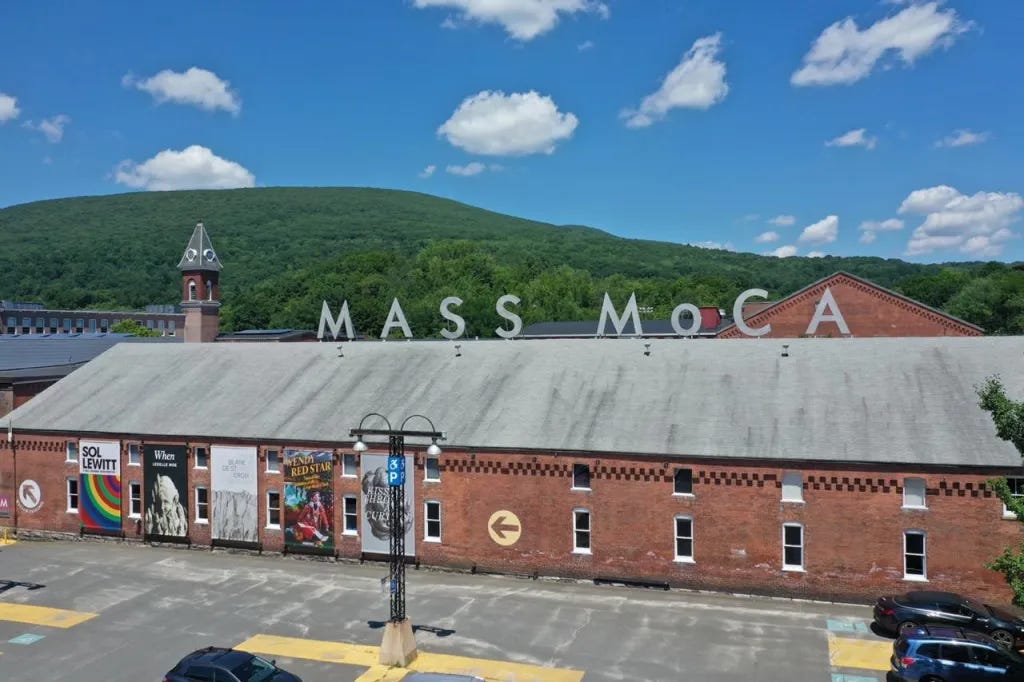
LAST WEEK, WE VISITED MASS MoCa, a giant museum in North Adams Massachusetts that was formerly the Arnold Print Works, a textile mill and plant for printed fabrics. Twenty-six enormous buildings are set around acres of land. Imagine a giant space that, both inside the galleries and outside on the property, reduces you in scale to the size of a mouse.
I have no problem with the scale or the type of animal. I am growing smaller every day, owing to shrinkage by age and a spinal injury from six years ago, when I was pulling a mattress going backwards, unaware there was a step behind that could trip me. As for the mouse, many years ago when I was visiting a friend in California, she pointed out we had similar, ferrety Jewish faces. We looked nothing alike, but the rodent image has stuck. Looking back, I’m proud I didn’t try to wriggle away from her comparison. It’s so uncharacteristic of me to go along.
When Richard and I decided to leave the museum, we were on the third floor of the main building and went through a hall that said EXIT. It led to a door and stairs, and down we went, only to find another set of doors that looked like they wouldn’t open. The door we’d gone through said you couldn’t get back in. Both doors in front of us had signs with cautions and restrictions. I opened the one that said Museum Personnel Only. I mean, what could they do, throw us in jail for impersonating a curator?
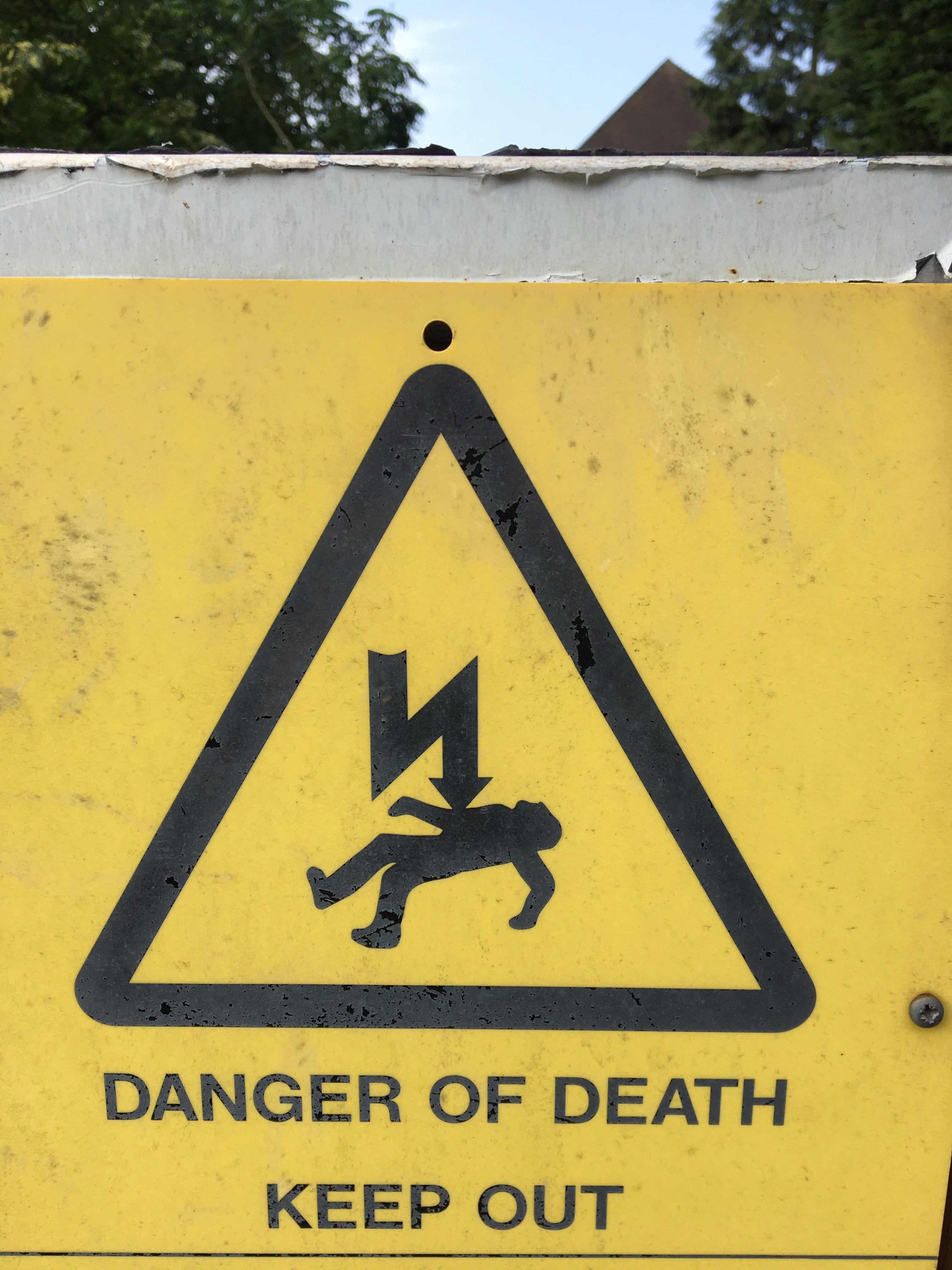
The opening of wrong doors discomforts Richard. First, he wouldn’t be caught dead impersonating a curator. His stance as a scholar of museums is pitched against what he sees as the snootiness of curators, who hold themselves above the interests of visitors. Whether or not this is true and whether or not this is true at MASS MoCa is something you need to put out of your mind, the way I do, because if you put it in your mind, you find yourself the size of a mouse, roaming around and never getting out of the cavernous thoughts of Richard Toon.
Through the illegal door, we found ourselves outside the museum. On one side were the towering brick walls of the building and on the other side was a concrete barrier beside a rushing river. The sound was beautiful. I had an impulse to record it on my phone. We were now, in our lost state, creating our own art performance, in which we were also figures in an installation called, “Lost Beside Water and Bricks.” I said, “Let’s walk. Cars are able to drive along this path. We’ll have to come to a place where the cars enter, and we’ll be able to get out.”
Richard doesn’t like to be lost. Not anywhere. He once wrote a piece about museum maps that say, “You are here.” His argument against this is that when people look at a museum map, for the most they are already lost and have no idea where “here” is. I don’t mind being lost. Maybe I even like it. Maybe I like it because I imagine, as a mouse, I will be able to squiggle out of any enclosure. Maybe I like the comedy of encouraging Richard on. Richard is not a mouse. He has no mouse in him. If I had to select an animal for him, I would stop trying to think of one because as soon as I’d suggest it he’d say, “Certainly not.”
It was a day we hadn’t walked much yet, and here we were, exploring the grounds, except we weren’t really exploring anything because we were in spaces people aren’t supposed to be in. We came to gates you couldn’t open and gates you could open with more paths and fences beyond and still no way out.
We started to think about the people who had worked in the buildings when they were used for manufacture. MASS MoCa is an example of what architects and geographic planners call “adaptive reuse,” where buildings that were once sites of commerce are transformed into spaces for culture and art. Dia Beacon is another example. So is Tate Modern. The thing about these spaces is that the reality of the industrial past and the lives lived in that past tend to be erased, even as the structures remain. Where, indeed, is “here.”
It turns out more women than men worked in the Arnold Print Works. In the late 19th century, these women typically earned 91 cents to $1.00 per day, and if they stayed on the job about $300 a year. And the men? Women consistently earned about 58% to 60% of what adult male textile laborers earned. Was any of this visible in the art museum? It’s visible here.
Richard and I kept trying to get back into the museum, so we could properly leave the museum, but all the doors were shut. I stayed cheerful. It’s my best quality in times of dislocation for Richard. I love the fact he doesn’t trust my judgment at all and at the same time will go through a door that says, “Do not enter.” He will also eat a piece of cake with a note that says, “Eat me.”
______________________________________________
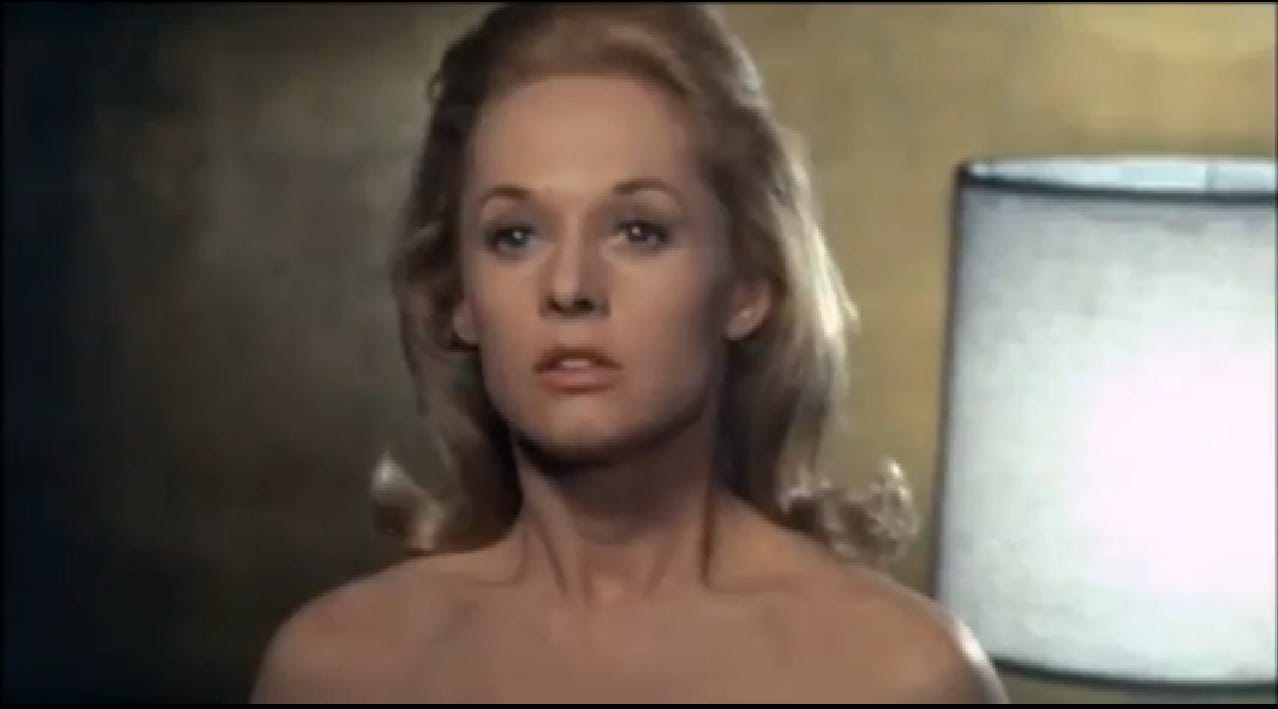
ONE NIGHT YEARS AGO, a friend invited me to a screening of Marnie, the Hitchcock film released in 1964. Tippi Hedren plays a woman termed “frigid” and “a kleptomaniac,” and I was reminded of the innocent past when Freud was taken seriously and people in casual conversation quoted from the Diagnostic and Statistical Manual of Mental Disorders. Sean Connery also stars. His character falls in love with Marnie, even though she can’t stand being touched. He blackmails her into marrying him and sets about sorting her out. I thought the best line in the movie was the last one, when Tippi says to Sean: “I’d rather be married to you than in jail.” It was as much as she could cough up, although she didn’t sound like she meant it.
The most disturbing part of Marnie is when Sean Connery’s character forces himself sexually on Marnie. It’s a complicated scene, partly because Connery is a walking piece of sex, and part of the frustration the film builds is denying this man erotic success. Marnie doesn’t fight him off but the next day tries to drown herself in a pool. Two writers quit working on the screenplay, unable to convince Hitchcock to cut the scene, explaining the audience would lose sympathy with the male lead. Hitchcock, who could not escape the poignant bitterness of his obesity and who was famously obsessed with Hedren, who refused him, sacrificed his film to a personal thrill. The movie is a child sent to camp with all the wrong clothes.
The friend I went to see the movie with is younger than me. After the screening, she said she’d lived every moment of the film. We stood beside a piano. Slabs of blond hair curtained her face. Her lips were full and symmetrical. They looked like the wings of a moth. She asked what I thought of the film. I said, “It got tiring for me.” She looked sad. We left the theater and went to a bistro, where a man she liked was the chef. She said he had bought her a slice of pizza on a recent visit. She said, “Does that mean something?” I said, “Definitely.”
When we arrived at the bistro, the chef was spooning a reduction over grilled lamb. He saw my friend and flashed a big smile. He was very attractive under a giant beard. When we were seated, I said, “He’s beautiful but not so much the beard.” She said, “I love the beard!” I was happy we would never want the same man. The chef sent over small plates of food for us to taste. I ate a shrimp wrapped in a tiny crepe, topped with crème fraîche and tied together with a sliver of chive, and I was reminded of a remark by Raymond Queneau. He said imaginary stories deal with love, true stories deal with hunger.
____________________________________

ON JANUARY 7, 2020, ElIZABETH WURTZEL DIED OF CANCER AT AGE 52. Shortly after, I was asked to write a brief tribute to her. I was struck by the way she often feared she would be punished for feeling pleasure. I continue to be struck by the marketing to women, especially, of “adult life”—which is code for open your hand and let fly away all your hopes and dreams for yourself. It’s code for have a baby, become a mother, shut up unless you are suffering and we can enjoy it, and even then shut up. Here’s what I wrote about Elizabeth:
Among her accomplishments, Elizabeth Wurtzel was proud she’d never so much as kissed “a man for any reason besides absolute desire.” This isn’t really possible in the life of a female human, but hats off to her for the aspiration. And for admitting she lived for pleasure, despite the pressure to hate herself for still sleeping on a futon. She saw that the hyping of “maturity” and “adult life,” especially to women, meant the exchange of restlessness for “a padlock of security” and “Tiffany silver you never use.” The world is a scare machine for women who stay girls, and Wurtzel sometimes felt scared she had lived the wrong way. At her best, she knew life was more fun staying skeptical as long as you could, and everyone was going to die, anyway.
An additional thought: It’s interesting, I’ve lived so much longer than Wurtzel got to live and the older I get the more confirmed I feel without ambivalence about claiming as much freedom as I could from the social changes ushered in by the women’s movement.
__________________________________
RICHARD AND I WILL CONTINUE OUR ZOOM CONVERSATIONS ON WRITING for the next several months, focusing on elements of craft and form you can add to your toolkits as creative writers.
Last Saturday, the focus of the conversation was the difference between “story” and “memory.” What is the difference? I made the claim (I thought of in the moment) that a memory could well qualify as material for a “story” if the story was about rethinking the memory. Maybe it didn’t happen that way. Using the baby prompts of “sometimes,” “what if,” and “on the other hand.”
The next ZOOM CONVERSATION is on Saturday June 27 from 3 to 4 EST, and it will be about layering. Something happens in sentence one. “I drove up to the house that looked haunted.” Or “I went into a deli and ordered a pastrami sandwich.” Or “The first rabbit he saw asked him what time it was.” Sentence one reports an action. Layering happens when a sentence that reports an action works as a baby prompt for the narrator to tell the reader what the action made them feel or think or reminded them of. In this way, the narrator is seducing the reader into interest in the narrator’s mind and associations.
Another way to put this is narrative layering follows the requirement of IMPROV COMEDY, that is “YES, AND.” Yes, this thing happened, and it reminded me of and made me feel . . . and then it’s possible to report another action because the story has moved to wherever it’s landed. It’s not planned ahead. It’s being invented in the moment of writing. That’s why it’s fun.
TO RSVP: email me at lauriestone@substack.com.
__________________________________
Please help the stack continue.
Do you have it in you to turn down this punim?
To all paid subscribers, thank you for making this possible and taking a turn at support.
Everything is Personal (because everything is also political) is among the least expensive publications to join. Click on the subscribe button, and see.
I know money is tight for many people, and if you want to subscribe and need a further discount, just email me, and I will work out an arrangement with you. Don’t hesitate. I mean it: lauriestone@substack.com
NOTE!! To start a paid subscription on your phone, you need to switch out of the Substack app and use the Substack website on your phone through a browser such as Safari or use your computer.
____________________________________
Happenings for paid subscribers:
UPCOMING ZOOMS, always on Saturdays from 3 to 4 EST To RSVP: lauriestone@substack.com
LAURIE & RICHARD, on the difference between MEMORY and STORY and layering in narrative as “YES, AND.” SATURDAY June 27, from 3 to 4 EST To RSVP: lauriestone@substack.com.
To attend one event or receive one recording, with no future payment obligation, you can buy a “coffee” for $4 at ko-fi.com/lauriestone
Breakout sessions following the Zooms with guest artists
The BREAKOUT SESSION following the Zoom conversation about MEMORY and STORY is on SUNDAY, June 28, from 3 to 4:15 EST. THERE ARE STILL PLACES. There is a cap of 10 at each breakout. You are invited to share a piece of your own writing of around 400 words. The SLAM readings are thrilling impovs—we make a work together larger than the parts! The fee is $30. To sign up please email me at: lauriestone@substack.com.
To request recordings of past Zoom Conversations
with Steven Dunn, with Margo Jefferson and Elizabeth Kendall, with Francine Prose, with Sophie Haigney (of The Paris Review), with David Cale that includes a reading from his hit solo theater piece Blue Cowboy, with poet David Daniel, with Daisy Alioto, publisher of Dirt , Michael Klein, and Marga Gomez, please email me at: lauriestone@substack.com.
Working together one to one on your writing or starting and growing a Substack publication.
If you would like to book time to talk one-on-one about a project you are working on or for guidance in gaining confidence and freedom in your writing practice, please email me at: lauriestone@substack.com.
If you would like to book time to talk one-on-one about STARTING AND GROWING a Substack publication, please email me at: lauriestone@substack.com. I can help you through the software, choosing a title, art design, and ways to gain readers.
__________________________________
Please “comment,” ”like,” and “share” below. Your engagement helps the algorithm notice the stack and gain a presence here for feminism and literary writing.
______________________________
What is your name? Iris. Iris what? Iris Murdock.

I’m very pleased that ‘you are here’ and we are all together.
"Looking back, I’m proud I didn’t try to wriggle away from her comparison."
"The movie is a child sent to camp with all the wrong clothes." Thank you.