
Sexual healing
Lost and found at the movies.


THE OTHER NIGHT, WE WATCHED THE HUMAN STAIN (Kanopy), starring Anthony Hopkins and Nicole Kidman. It was made in 2003, and Nicole looks dewy and less self-conscious than she will come to appear before the camera. The movie is based on the novel by Philip Roth, and the plot is preposterous, involving a black man who passes for white and leaves behind his black family. This man is ultimately accused of making a racist remark (it’s not) in the college classroom where he teaches, a charge meant to expose the idiocy of campus language policing and thought fascism. Roth’s novel was published in 2000. It’s interesting to be reminded how long this atmosphere has taken higher education hostage.
None of that is important in the film. What’s important is the way this man’s erotic nature is returned to him in a late-in-life romance with a much younger woman. He quits his job. His wife dies. And now, freed from the trappings of the life he made as a “white” professor, he’s returned to thoughts of his first great love, a white woman he didn’t tell he was black until he brought her home to meet his mother. He’s been freed to think about that romance, the woman, their sex life, and his love of boxing as a young man. The boxing and the sex go together inside him as passions he thought he had to “clean up” to become “white.”
The “stain” on his life is that he continues to lie about himself, almost until the end, when he tells his young lover the story of who he is. In combining boxing with sex, Roth moves into the territory of Hemingway and Mailer, two male writers far more anxious about their sexuality than Roth was. Like them, Roth comes up with a story in which there is a woman on the planet who looks like Nicole Kidman and is happy having sex with a man who looks like Anthony Hopkins at age 66. This is the vanity of Roth and men like him—to invent female characters who could exist only in their erotic fantasies.
What’s interesting is, the actors make it work. You believe these two people could find each other and love each other. You believe in the ways our erotic natures come in to help us and soothe life. The back story, as they call it, for Nicole’s character involves even more pain and loss than Hopkins’ character goes through. She’s alone enough, scared enough by a menacing ex-husband (played by Ed Harris in his wild-eyed mode), and poor enough to be open to the tenderness offered by the older man. What makes the movie wonderful to watch is these two people—two actors, yes—who speak to each other and look at each other with so much nuance, we enter them.
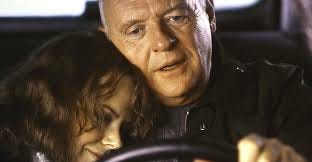
The sex is meant to be a life-altering experience for the man, but the movie doesn’t show them making love very much. It shows them in bed talking and reaching out a hand, conjuring more intimacy than we mostly see in sex scenes. This makes them seem more genuinely attracted to each other, the way attraction and intimacy work in real life, in small moments that build slowly rather than in bursts of sexual fury on desk tops, kitchen counters, elevator walls, and other desperately uncomfortable surfaces. Without speaking a line of dialogue, Hopkins can register six unfolding emotions on his face.
ROOM AT THE TOP (1959)
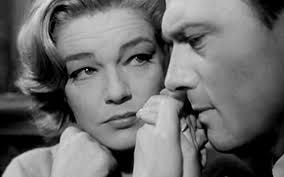
ONE NIGHT DURING COVID, WE WATCHED ROOM AT THE TOP, and it’s immediately mesmerizing and smart about how human beings are. Laurence Harvey is tall and beautiful, and he enters the scene as a knife. The title refers to class. The movie seems to be about class, and it is in a sense. It’s about what happens to a person who can’t feel who he is apart from his rage. His rage about a cheating system that has fixed the odds of a life like his.
He moves from his bombed out town in the north to a town in Yorkshire with more opportunities for work, and he sets his sights on the daughter of the richest industrialist in the area. He knows he is sex, and the daughter is his ticket up. Using sex to advance is more often a plot device attached to women than men, and it’s one of the ways that Joe, the character Harvey plays, is a complex outlier. Joe is 25. Harvey was 31 when he shot the film.
He was a Lithuanian Jew born Zvi Mosheh Skikne. His family had moved to South Africa, then, after the war to the UK, and something of the heat of learning plummy vowels warms his performance, which needs to be lightning as partner to the fabulous Simone Signoret, who is so fucking sexy and alive in her part, another social outlier in an unhappily marriage. The movie just wants to keep looking at them together.
Joe is callow and brutal, even sometimes with her, and too late he learns from her there’s no life in life without bowing to your erotic nature. The truth of your erotic nature is actually something the class system can’t touch, if you don’t let it.
It’s a great film—especially for knowing this. We watched it on Criterion. Jack Clayton directs. The screenplay is by Neil Paterson and Mordechai Richler (uncredited), based on the novel by John Braine.
Simone won an Oscar as best actress that year, the screenplay won for best adapted screenplay, and Harvey was nominated as best actor. Even when Harvey is as alive as it’s possible for him to be, with that caramel baritone, you can see how a few years later he will be perfect as the robotic assassin in The Manchurian Candidate (1962).
_____________________________________
I like talking to you.
Everyone who is already a paid subscriber, thank you for keeping the stack going and thank you for understanding it’s the work of a paid professional, not a free service or a gift. It’s funded entirely by paid subscribers—no angels or grants—and if new subscribers don’t take a turn at support, it will go away. This Substack is among the least expensive ones to join.
I know money is tight for many people, and if you want to subscribe and need a further discount, just email me, and I will work out an arrangement with you: lauriestone@substack.com
NOTE!! To start a paid subscription on your phone, you need to switch out of the Substack app and use the Substack website on your phone through a browser such as Safari or use your computer.
__________________________________________
The Next Zoom Conversation on writing craft (Saturday May 30 from 3 to 4 EST)
The next Zoom Conversation is on the difference between “Memory” and “Story”—on Saturday May 30 from 3 to 4 EST. To RSVP: lauriestone@substack.com
Richard and I will offer you ideas on how to free your writing from “heroes” and “victims.” We will do this step by step, no secrets withheld and all tricks of the trade revealed on how to keep engaging the reader and how to create the illusion of thought-in-action unfolding in real time. Questions about your own projects are very welcome.
__________________________________
A little while ago,
I CAME ACROSS THIS QUOTE FROM JUDITH THURMAN, speaking to Rhonda Garelick in 2022: “You are invisible as an old person. It helps to accept that. I like to be invisible. I was in India with my son and some friends, about seven years ago. And I was often alone in the dining room, since my son and the others would go off. And there was a loneliness that was interesting to me. People didn’t strike up conversations with you. Or they try to flee. Maybe they think you’ll latch on to them and bore them. I think the old woman sitting alone at the restaurant or the café table is in some sort of strange bubble of her own.” —New York Times
In the past, when I’d gone to artist colonies, I’d gone to meet people. We’d stay up drinking and flirting and wondering what comes next. A pack would form. I don’t know how it happens, a mix of people of different ages but no one I remember the age I am now. If I were at a colony these days, would anyone cool and younger want to talk to me? I don’t feel invisible, as Thurman says she does. I feel the opposite of invisible. If you are invisible, people want to talk to you, the way they want to talk to ghosts and to themselves.
I have nothing to tell younger people things they don’t already know or will learn in the ways people learn things moving through time and space. Their experience is theirs and should be, as mine is mine, shaped by who knows how many forces and cultural currents I was aware of and not aware of. There is only one good thing to want from other people, who cross your path or sit beside you at a meal. Can you make each other laugh. If you find the same things funny, even for a moment, time stands still and you forget everything but the moment you are in. This might be true.
_____________________________________
A few years ago, “The Paris Review”
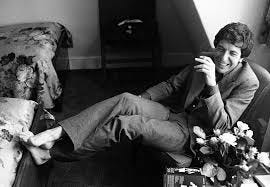
posted a link on Twitter to a piece I’d written about “I’m Your Man,” the song by Leonard Cohen. It was part of a series they ran on love songs for Valentine’s Day. A man, a Brit I could tell from his spelling, commented, “Is this what passes for music criticism at the Paris Review?” I wrote back, “I was wondering when the first prick was going to pipe up. Congratulations, it’s you.” He wrote a quick apology, and I left it at that.
Did the Brit think he needed to defend Bob Dylan? I had mentioned in the piece that Dylan addresses his songs about women to other men. The Brit thought he could be insulting and superior to me and no harm would come to him. Pretty much the way Bob is insulting and superior to women in many of his songs. No harm has come to Bob for that, either.
How many ways are there to tell a woman to shut up because you think no harm will come to you? A woman I know recently said to me, “You write so much!” She didn’t say what you write is garbage. She was saying make yourself less visible. She was saying, Your visibility hurts me.
I remember consciousness raising in the 1970s. I don’t remember what I got out of it except the pleasure of hanging out in a room with other women. What I remember in the room with other women is feeling part of something larger than me that also included me. Everything was personal for everyone and therefore everything was also about how the world worked, not just how you worked. I remember the scorn from others that attached to us like cat hair for this way of organizing. The scorn took the form of: “Is this what passes for politics?” And: “You say too much about yourself.”
People post on social media to feel less alone and to make public what we have been told to keep private. Where women are concerned, the word “privacy” is code for, “You, don’t open your mouth, no one cares what you think.” Also, it’s code for: “You should be ashamed.” The lives of poor people are seldom lived in privacy. They are picked at and scrutinized. The privacy of men and of people with money and power is protected. That’s what Jeffrey Epstein and Harvey Weinstein counted on. Another term for the protection of this privacy is “the pass.”
Is this what passes for public conversation? Is this what passes for social commentary? Yes, muthafuckas. Bite me.
_______________________________________
Rembrandt didn’t paint clouds.
Every morning I wake up, I understand I’m not returning to my former life as a human being. Every morning is a one-way door.
Yesterday, Richard and I got Covid boosters. When we got undressed, he peeled off his band-aid. I said, “I like to keep mine on.” He said, “I know you do.” If you have the nature of a child, you are going to grow old the way a child grows old, without prior experience.
Near where we live, sheep used to graze in a meadow. The sheep are gone. When we pass the meadow, we say, “I miss the sheepies.” This morning we woke up very early, the way we do most days, and I ran outside to look at the plants. Once you start to look at the plants, there is no end of yanking out weeds and deadheading flowers and cutting iris buds for a vase.
I see my father at the health food store on East 52nd Street, owned by my sister’s husband. My father would open the place early in the morning and serve smoothies and other breakfast foods to the customers. As a coat manufacturer, he’d worn hand-made suits. In the health food store, he wore Izod shirts with little alligators and sports pants.
He doesn’t care how much food I take and he pays for. I think my life to him, the writing and different men, was queer and acceptable in the same way I was. Before he knew my mother, he’d been a traveling salesman on the road, and I remember him telling me about women he’d had sex with. I remember this in a way that may not have happened, although I think it did.
I thought of him as tender and warm and sensitive. I don’t know how he wound up that way. I don’t know how I wound up the way I did or how Richard wound up the way he did, yet here we all are.
When I read stories set in a French chateau or an Italian villa, where meals are eaten on patios and lawns under striped awnings, where for every meal three courses are served on gleaming plates, vegetables from a nearby farm, eggs from local chickens, charcuterie sliced paper thin, cutlets sautéed with capers and butter, glasses of wine, mild breezes cooling summer days, a family and their guests or the young inheritors of wealth with a houseful of sexy, happy, bored, and terrified people, I think about the servers doing the work.

______________________________________
Happenings for paid subscribers:
UPCOMING ZOOMS, always on Saturdays from 3 to 4 EST To RSVP: lauriestone@substack.com
LAURIE & RICHARD, on the difference between MEMORY and STORY, SATURDAY May 30, from 3 to 4 EST To RSVP: lauriestone@substack.com.
To attend one event or receive one recording, with no future payment obligation, you can buy a “coffee” for $4 at ko-fi.com/lauriestone
Breakout sessions following the Zooms with guest artists
The BREAKOUT SESSION following the Zoom conversation about MEMORY and STORY is on SUNDAY, MAY 31, from 3 to 4:15 EST. THERE ARE STILL PLACES. There is a cap of 10 at each breakout. You are invited to share a piece of your own writing of around 400 words. The SLAM readings are thrilling impovs—we make a work together larger than the parts! The fee is $30. To sign up please email me at: lauriestone@substack.com.
To request recordings of past Zoom Conversations
with Steven Dunn, with Margo Jefferson and Elizabeth Kendall, with Francine Prose, with Sophie Haigney (of The Paris Review), with David Cale that includes a reading from his hit solo theater piece Blue Cowboy, with poet David Daniel, with Daisy Alioto, publisher of Dirt , Michael Klein, and Marga Gomez, please email me at: lauriestone@substack.com.
Working together one to one on your writing or starting and growing a Substack publication.
If you would like to book time to talk one-on-one about a project you are working on or for guidance in gaining confidence and freedom in your writing practice, please email me at: lauriestone@substack.com.
If you would like to book time to talk one-on-one about STARTING AND GROWING a Substack publication, please email me at: lauriestone@substack.com. I can help you through the software, choosing a title, art design, and ways to gain readers.
__________________________________
Please “comment,” ”like,” and “share” below. Your engagement helps the algorithm notice the stack and gain a presence here for feminism and literary writing.
Lyrics to “I’m Your Man”
If you want a lover
I’ll do anything you ask me to
And if you want another kind of love
I’ll wear a mask for you
If you want a partner, take my hand, or
If you want to strike me down in anger
Here I stand
I’m your man
If you want a boxer
I will step into the ring for you
And if you want a doctor
I’ll examine every inch of you
If you want a driver, climb inside
Or if you want to take me for a ride
You know you can
I’m your man
Ah, the moon’s too bright
The chain’s too tight
The beast won’t go to sleep
I’ve been running through these promises to you
That I made and I could not keep
Ah, but a man never got a woman back
Not by begging on his knees
Or I’d crawl to you baby and I’d fall at your feet
And I’d howl at your beauty like a dog in heat
And I’d claw at your heart, and I’d tear at your sheet
I’d say please (please)
I’m your man
And if you’ve got to sleep a moment on the road
I will steer for you
And if you want to work the street alone
I’ll disappear for you
If you want a father for your child
Or only want to walk with me a while across the sand
I’m your man
❤️❤️❤️
Delicious writing. Nourishing!!! Sparkling and evocative.
Thank you so much for this wonderful piece, Laurie. I put both films on our watching list and we‘ll watch them while I‘m here in London. Your film analyses are second to none in my book. And single lines shine like gemstones: “Without speaking a line of dialogue, Hopkins can register six unfolding emotions on his face.“ Yes!