
River
press "play."


WHEN I LIVED IN THE CITY, each morning I would walk down Broadway and up Columbus Avenue, and on Broadway guys sold things passed along to them by the supers. Things left in basements. Art, books, records, rugs, clothes. In this way, the city is a river. I knew guys I would talk to. One day, around 73rd Street, this Hockney is leaning against a wall of books. $10. It lived in my apartment on 99th Street, and now it lives in our house in Hudson. Richard's dad once made a linen jacket for David Hockney, who never sanded his Yorkshire accent. The story is Richard's dad made a linen jacket for a man who said he was David Hockney's cousin. We are all rivers flowing into each other.
A few years ago, on the day of a solar eclipse, a woman in the city said to me, "Try my glasses." I said, "I think I'm afraid of them." I have never been prepared for the eclipse of anything in life. She said, "They're totally black and safe," and she placed them over my sunglasses and said, "Look up." I saw a tiny sliver of moon. Like a cartoon moon. Like a banana. It seemed really far away. She said, "Wasn't that fun?" I said, "Yes." She was excited. We were in front of the Belnord, where I B Singer had lived. Everyone in Manhattan was there with a dog, and the dogs all had their heads turned at the same angle. Free food was offered, as at some point it always is on Broadway.
I had friends who didn’t eat in their apartments. I would open their refrigerators, and there would be leftovers from expensive restaurants. The bits of this and that they had scooped into aluminum tins would grow mossy topiaries because they didn’t eat in their apartments. It was a common way to be safely semi-anorexic. On the road I walk now, I pass a house that had been owned by a priest I met once, and on this property is a small house in addition to the regular house, a small house the size of a playhouse with a miniature front porch, and it is painted a shade of blue so dazzlingly unlike anything else on the road, I call it peacock blue, even though I don’t know if this color exists.
I take advice from people about what show to stream, and the despair of existence falls over me. On the other hand, I enjoyed CB Strike (HBO), a British private eye series starring Tom Burke and Holliday Grainger. The missing leg blown off in Afghanistan. The smoldering-soul-mate-married-the-wrong-guy romance between the leads. The London locations and pubs. I don’t understand any of the plots and don’t care, and you won’t care, either, although why should you take my word for anything? Every day I ask myself, Why can’t you be easier on people? Why can’t you be nicer? And every day I wonder, What are you really asking with these questions?
The summer I was 21, I hitchhiked alone around Ireland. It was always raining, either a fine mist or a splashing downpour, and I got used to walking on lonely roads with a towel wrapped around my head and one of those American raincoats cinched tight around the waist. I was wearing the worn jeans of a boy I had met in London and who had sent me on this adventure, so I would see more of the world than his flat in World’s End. Sometimes, when I was afraid on the road, I thought there was something soft about me. I didn’t have that much of a bourgeois life to slough off compared to the well-appointed girls I’d met at Woodmere Academy and Barnard. Still, I had something to escape, as does everyone, and that is where you find the fun of life.
The Wizard of Oz is one long argument against its stated message of seeking a return to home. No one believes anyone would prefer the black-and-white world Dorothy is rescued from. No one would believe she misses her aunt, who out of cowardice and fake piety hands over Dorothy’s dog to a woman with money and social power. No one would believe the three grown male farmhands are content to work for Em, who scolds them for not attending to their chores. The pleasure in the film are the performances by the great hams of Vaudeville, given set pieces in the movie, chiefly Bert Lahr as the cowardly lion with a Brooklyn accent. That accent is the truth of the movie, the smell of Times Square and urban life, where every kind of misfit missing a heart and a brain and courage sit in the same bar, wanting the night never to end.
Four years ago, I decided to give up my apartment in New York. It meant I would not be able to live there again. New York is where I was born and where I had lived most of my life. I didn’t care if I never lived there again. The apartment itself had been a marriage of convenience.
What I miss about the city is falling in love with strangers. It’s easy to fall in love with a person you don’t know. What you have fallen in love with is the belief that the tiny bit you have learned is who the person is and that you will speak the same language.
I was excited about being a person who didn’t live in New York because I didn’t yet know how it would feel. It was like waiting for the buzzer to ring before a date, and you danced around to Jimmy Cliff singing “The Harder they Come, the Harder they Fall.”
I was thinking about my belongings with giddy anticipation. When I cleaned out the space, it made me feel I was adding time to what I had left. I think what I was imagining is that tossing out boxes of this and that would make me lighter, and the thin rats have a better chance of succeeding in the tests they are run through. It was the opposite of building a garden or writing a piece—or maybe it’s the same.
I remember watching my mother roll nylons up her slim thighs and attach them with little garters that hung from her hips. The hands of humans are converted fins. Our hiccups are relics of breathing through gills.
In “A Journey into the Animal Mind” (The Atlantic, March 2019), author Ross Anderson writes: “We last swam in the same gene pool with the animals that evolved into fish about 460 million years ago, more than 100 million years before we split from birds. The notion that we are kin across this expanse of time has proved too radical for some, which is one reason the ever-changing universe described by Darwin has been slow to lodge in the collective human consciousness. And yet,
“Many invertebrate lineages never developed anything beyond a rudimentary nervous system, a network of neurons dispersed evenly through a wormlike form. But more than half a billion years ago, natural selection began to shape other squirming blobs into arthropods with distinct appendages and newly specialized sensory organs, which they used to achieve liberation from a drifting life of stimulus and response.”
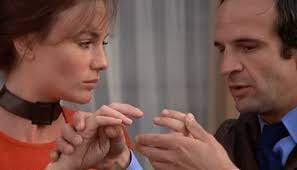
A few years ago, we rewatched Day for Night (1972), Truffaut’s love letter to making movies. Everyone in the film looks young. Even the characters meant to be old look young. Movies are the most important thing in their lives. I remembered having a most important thing I shared with other people—the women’s movement, the Village Voice. In Day for Night, Truffaut is saying goodbye to a certain kind of filmmaking that is freewheeling and financed by people who don’t need to get rich. A friend who is Russian is writing with knowledge and grief about Russia, and I think he is writing about a kind of disappointment that can’t be soothed. People talk about being kind. Maybe they mean give something of yourself away as often as you can.
On Columbus Avenue one day, I was outside a café when a woman approached. I told her I would watch her scooter. She was beautiful. A few minutes later she was back outside and said, “They don’t have what I want.” I said, “What do you want?” She said, “One of those room-temperature pizzas.” I said, “Oh, yes,” pretending I knew how they tasted. I was on a bench with coffee from another place down the street that was cheaper. The room temperature pizzas were made with puff pastry. The people who ate them were young and fit. Maybe they spent the day working off the calories riding scooter in pastel clothes. The woman said, “I need to pee, and they don’t have a bathroom.” I directed her across the street to where I peed. Her front teeth were prominent and sexy. I said, “I’ll watch your scooter." She said, “Really?” I said, “I’m here.” While she was away, I thought about a man who had asked me to forgive him for three years. He had done something shitty to me, and one day I didn’t care, anymore. The next time he called, I told him we could be friends, and so far I have not heard from him again. Maybe what I gave him was enough. Every time I fluff for Zoom, I spray on perfume, even though I think: Schmendrick, that was in a different life.
_________________________________________
I like talking to you.
And as much as I do, the stack needs you. It’s funded entirely by paid subscribers—no angels or grants—and if new subscribers don’t take a turn at support, it will go away. If you have not yet taken a turn, it’s super easy and this Substack is among the least expensive ones to join.
I know money is tight for many people, and if you want to subscribe and need a further discount, just email me, and I will work out an arrangement with you: lauriestone@substack.com
For everyone who is already a paid subscriber, I send love.
NOTE!! To start a paid subscription on your phone, you need to switch out of the Substack app and use a browser such as Safari or use your computer.
_____________________________________
Zooms conversations on craft.

RICHARD AND I WILL CONTINUE OUR ZOOM CONVERSATIONS ON WRITING for the next several months, focusing on elements of craft and form you can add to your toolkits as creative writers—and as readers.
At the last session, on May 30, the focus was on the difference between “story” and “memory.” I made the spontaneous claim that a memory might best qualify as material for a “story” if the story was about rethinking the memory. Maybe it didn’t happen that way, after all. Using the baby prompts: “sometimes,” “what if,” and “on the other hand.”
THE NEXT ZOOM CONVERSATION IS ON SATURDAY JUNE 27 from 3 to 4 EST, and it will be about layering. Something happens in sentence one. “I drove up to the house that looked haunted.” Or “I went into a deli and ordered a pastrami sandwich.” Or “The first rabbit he saw asked him what time it was.” Sentence one reports an action. Layering happens when a sentence that reports an action works as a baby prompt for the narrator to tell the reader what the action made them feel or think or reminded them of. In this way, the narrator is seducing the reader into interest in the narrator’s mind and associations.
Another way to put this is narrative layering follows the requirement of IMPROV COMEDY, that is “YES, AND.” Yes, this thing happened, and it reminded me of and made me feel . . . and then it’s possible to report another action because the story has moved to wherever it’s landed. It’s not planned ahead. It’s being invented in the moments of writing. That’s why it’s fun.
TO RSVP: email me at lauriestone@substack.com.
_______________________________
Happenings for paid subscribers:
UPCOMING ZOOMS, always on Saturdays from 3 to 4 EST To RSVP: lauriestone@substack.com
LAURIE & RICHARD, on the difference between MEMORY and STORY and layering in narrative as “YES, AND.” SATURDAY June 27, from 3 to 4 EST To RSVP: lauriestone@substack.com.
To attend one event or receive one recording, with no future payment obligation, you can buy a “coffee” for $4 at ko-fi.com/lauriestone
Breakout sessions following the Zooms with guest artists
The BREAKOUT SESSION following the Zoom conversation about MEMORY and STORY is on SUNDAY, June 28, from 3 to 4:15 EST. THERE ARE STILL PLACES. There is a cap of 10 at each breakout. You are invited to share a piece of your own writing of around 400 words. The SLAM readings are thrilling impovs—we make a work together larger than the parts! The fee is $30. To sign up please email me at: lauriestone@substack.com.
To request recordings of past Zoom Conversations
with Steven Dunn, with Margo Jefferson and Elizabeth Kendall, with Francine Prose, with Sophie Haigney (of The Paris Review), with David Cale that includes a reading from his hit solo theater piece Blue Cowboy, with poet David Daniel, with Daisy Alioto, publisher of Dirt , Michael Klein, and Marga Gomez, please email me at: lauriestone@substack.com.
Working together one to one on your writing or starting and growing a Substack publication.
If you would like to book time to talk one-on-one about a project you are working on or for guidance in gaining confidence and freedom in your writing practice, please email me at: lauriestone@substack.com.
If you would like to book time to talk one-on-one about STARTING AND GROWING a Substack publication, please email me at: lauriestone@substack.com. I can help you through the software, choosing a title, art design, and ways to gain readers.
__________________________________
Please “comment,” ”like,” and “share” below. Your engagement helps the algorithm notice the stack and gain a presence here for feminism and literary writing.
__________________________________
In other news
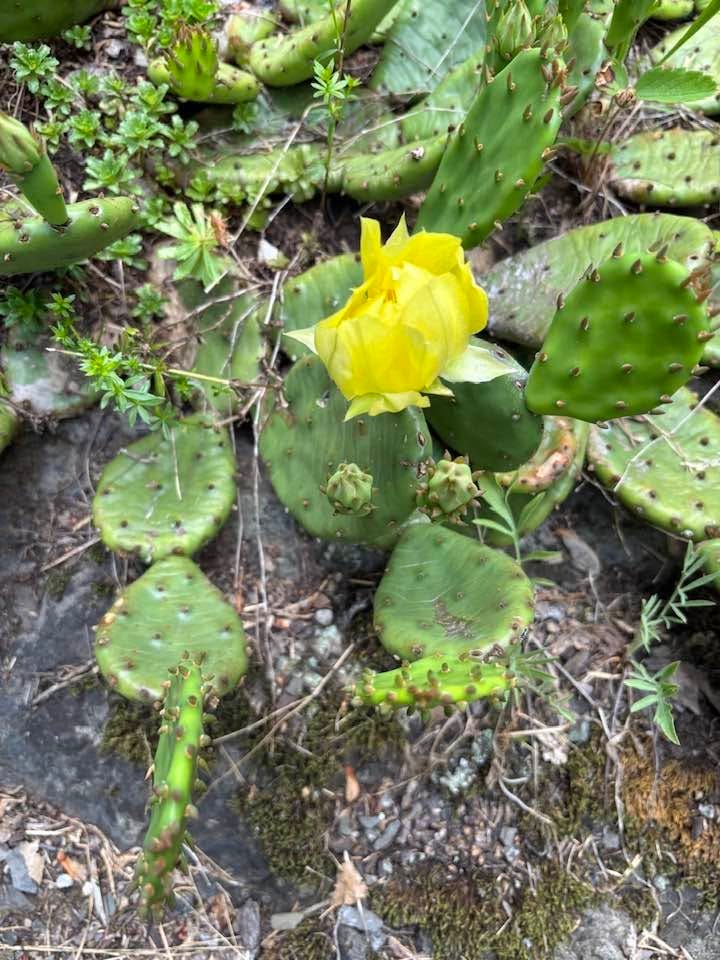
On Tuesday, Richard had the first of his cataract surgeries, and it went well. The second one is on Monday, and we are in eye care mode for a bit. The garden is doing well too, and R said he could see the outline of leaves for the first time in a while! Look what bloomed here. I don’t think we’re in Arizona, anymore.
Thanks for all the joy, David Hockney (9 July 1937—11 June 2026).
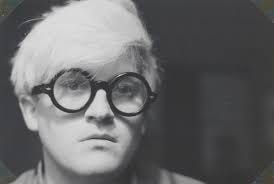
I love these meandering and dreamy conversations you are having with us, Laurie. That David Hockney is a treasure. HE was a treasure and all the light-filled beauty he gifted to us. Thank you!
A joy machine is a great way to describe your writing and my life with you. I like living it.