
Project Hail Mary
Georgia O'Keeffe, and my dog Sasha.

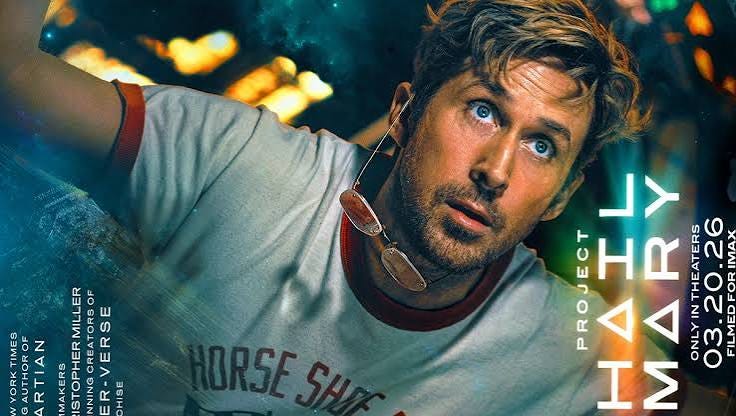
RYAN GOSLING’S HAIR. What a bunch of hair. The highlights. The back view swirl. The way it looks sexy and boyishly surfer dude even after pulling off a baseball cap.
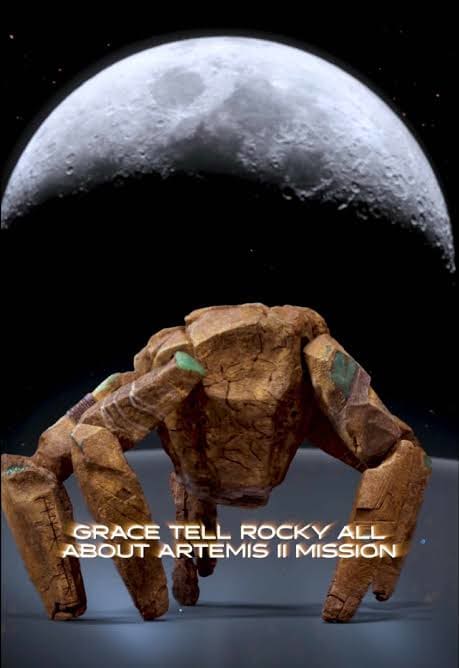
I loved Project Hail Mary because it’s a romance. A romance is basically what makes life worth living. The romance between Walter White and Jessie Pinkman is the reason Breaking Bad sustains itself. (A lot of other great stuff, too, not for here—Vince Gilligan is a genius visual artist/comedian). The romance between the characters played by Jean Smart and Hannah Einbinder is the pounding heart of Hacks. And the friendship bond between Grace (Gosling) and Rocky (a very smart spidery non-human from the planet Erid) is the beautiful delight of this film.
All the other mishegoss of the plot and saving planets is parsley on the plate. Project Hail Mary is directed by Phil Lord and Christopher Miller, with a screenplay by Drew Goddard, based on the novel by Andy Weir. This would be a boy movie (shocker!), with the gadgets and tinkering and techno-whatevers, and feats of courage and bravery involved, except it’s a romance. Once you have a romance, everything else falls away.
The love, the love! I cried. I cried the second time we watched it. Rocky is fab. His language is singing, like whale song. (Why do non-human creatures, meant to be appealing, frequently sound like dolphins? Because we know dolphins already have a language we can’t quite decipher and wish we could?) Not taking anything away from Rocky—he’s a puppet, not a CGI image, designed by Neal Scanlan and manipulated and voiced by James Ortiz. But I mean even a rock would fall in love with Ryan Gosling.
The film is more or less 2001, a Space Odyssey if Stanley Kubrick had not believed that violence and an impulse to subdue other beings as well as the natural world was the foundation of humanness. In Project Hail Mary, instead of the murder-hearted romance between Dave, the astronaut, and HAL, the space ship’s AI control system, there is school-teacher Grace and extraterrestrial and engineering nerd Rocky, locked together in a flying capsule on a joint mission to save their respective planets from sun-eating microbes.
In a sense, they are accidental room-mates, following the standard formula of the romcom, where, for example, strangers who will become lovers move in together, so one can get a Green Card, let’s say. They will annoy each other—Rocky turns out to be a very bossy Felix to Gosling’s messy, Odd Couple Oscar. They will have to learn each other’s language and habits. The computer system Grace devises to translate Rocky’s musical notes into words with a synthesized voice (Meryl Streep is considered), and to reverse the process for Rocky, is brilliantly inventive and exciting to watch. There’s a hilarious sequence where Grace is keeping a video diary of his frustrations, and no matter how softly he speaks, Rocky, with his super-powerful hearing, can detect the snark. They will be tested with separations to recognize the bond between them that has formed. They will do whatever it takes to hold onto each other and discover a new emotional vocabulary neither has had before. Each will become a hybrid being ever after.
The movie is a romcom, yes—and more. I can’t stop flashing to it. I think the film is a profound meditation on what love is. When stripped down to its essentials, what is required? Not a physical body with a face. Check. Not a shared culture, or spoken language, or planet, or atmosphere. Check. In the film, there are three things: a joyous curiosity about another being, a joint adventure with a common goal, and learning to tell a joke.
____________________________________
Dear Subscribers,
Here is the best thing about writing Everything is Personal: No one can censor or cancel or rephrase or delete a word I write here.
If you have been enjoying the stack for some time, please take a turn at support. It’s honestly the only way I can continue.
There is no paywall. There has never been a paywall, and there will never be one. Marketers insist there’s no way to grow or maintain a business here without a paywall. I don’t agree. I don’t want to limit what people can read as a way to capture their payment. Please make me right.
There is a 50% discount for new subscribers and for gift subscriptions right now.
____________________________________
Georgia O’Keeffe
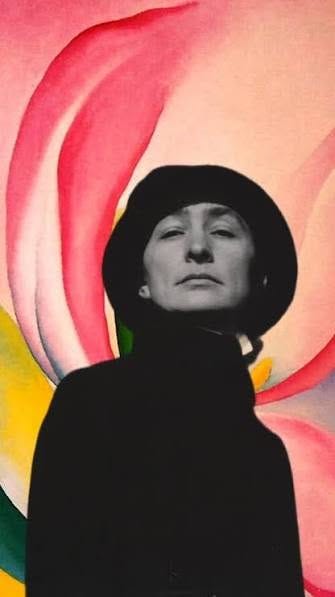
RECENTLY, WE WATCHED THE DOCUMENTARY Georgia O’Keeffe: The Brightness of Light” (2026), directed by Paul Wagner. He starts the film at an exhibition of O’Keeffe’s paintings in Basel Switzerland, and he asks visitors if they know much about her work, and they say they don’t, and you think—meaning I thought—why would you start a film about a great artist who is female in a place where she’s relatively unknown, unless you wanted to take her down a peg. You didn’t know you wanted to take her down a peg, but you did want to take her down a peg, and why would you want to do such a thing? I don’t know. Satan made you do it?
Imagine a doc about Pollock, let’s say, and the director travels to a remote village in the Amazon, and he asks the locals, “So these spatter paintings, what do you think?”
Wagner doesn’t know what he wants to tell you about the stupendous accomplishment of O’Keeffe’s art and the super distinct way she lived in relationships and alone, so he has a bunch of mostly female talking heads, who are biographers and art historians, situate her within modernism and as an original and independent painter.
The movie itself doesn’t have a point of view. We don’t learn what Wagner loves about his subject or if he does love his subject, and for that reason, in part, O’Keeffe doesn’t come across as loved in the film or particularly even there.
I loved watching it anyway. Claire Danes is the voice of O’Keeffe, reading from her letters to Alfred Stieglitz and others, and Hugh Dancy narrates the sweep, chronologically, of O’Keeffe’s life. As much as you want O’Keeffe embodied as someone to talk to, she’s there more as a ghost in her great paintings, in the many photographs of her by Stieglitz and other photographers, in the way she moved through time and space as a female human in the United States from November 15, 1887 to March 6, 1986.
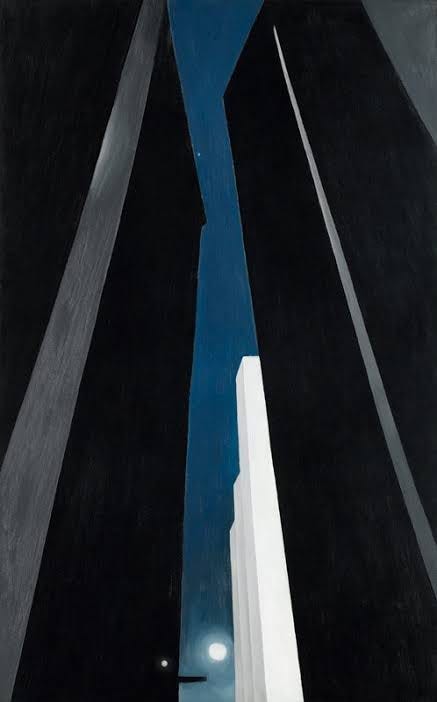
She painted the way she saw, not what was there. There is no “there” in any painting, even in landscapes and portraits. A painting, like a sentence, is the autobiography of it’s composer. It’s a story about the way the artist loves an aspect of aliveness.
Georgia doesn’t smile in photographs. Sometimes, we see her speaking in videos when she’s older, a woman on a stone ledge who has designed her look to express nothing of her insides, unless her insides are the same as whatever she is able to assemble. The pulled back hair. The plain and beautiful white shirts and black robes, and robe things and skirt things of colors like the colors in her paintings.
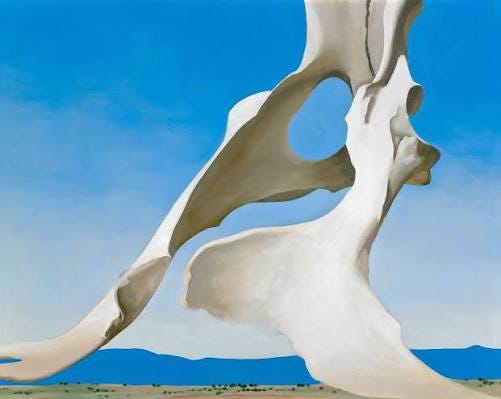
The great thing about the film is how much of her art we see, starting from when she begins to draw with charcoal. Does her style develop? Not really. It doesn’t have to. All she has to do is enter the studio, wherever that is, and her way of seeing will be at her disposal.
The other great thing about the film is the revelation of O’Keeffe’s erotic experiences with Stieglitz. She’s older than 30 when they begin fucking, and she loves it. She loves it the way her paintings like looking at edges and creases and doorways and skies. Up, over, and through. Again and again.
In 1979, Judy Chicago designs a ceramic plate for her at the head of “The Dinner Party.” She invites O’Keeffe to see the show, and O’Keeffe turns her down. It’s a ball O’Keeffe fumbles, and you think about why. The first thing that comes to mind is O’Keeffe doesn’t want to be represented by another artist’s view of her sexual parts or to have her artwork interpreted as portraits of lady parts, at all. Fair enough.
You also get that old whiff of the women of O’Keeffe’s generation, all of them going it alone in the world of men, with some women friends and some women lovers along the way, but really their focus is on men of substance to establish them in the world, to encourage them, to tell them they are worth something.
The great shift for women in the generation shaped by the women’s movement is we don’t have to center our lives on men or imagine they are the only source of opportunities for us.
O’Keeffe comes across as a strange, lonely bird with enormous abilities to keep creating great, distinct art and a way to live in the world with money, houses, and companions. That some of her weirdness has been turned into a kind of model of good-girl plainness and rightliving is ickier than what Chicago was offering her in the plate.
Did O’Keeffe like being a model of eating vegetables you grow in your own garden and wearing cool cotton shirts and looking like a sage posed against this rock or that rock? I think she did like it. She will live to be 98. When she’s 85, she can’t paint anymore because of macular degeneration. She meets Juan Hamilton. He’s 27, an itinerant potter and sculptor. He moves into her house, becoming her assistant, caretaker, and closest friend until her death. She will chop off anyone who disapproves of her choices. Boom, you’re out of my life, is the way she handles interference. It’s one way to go.
___________________________________
A time when suddenly a door opened.
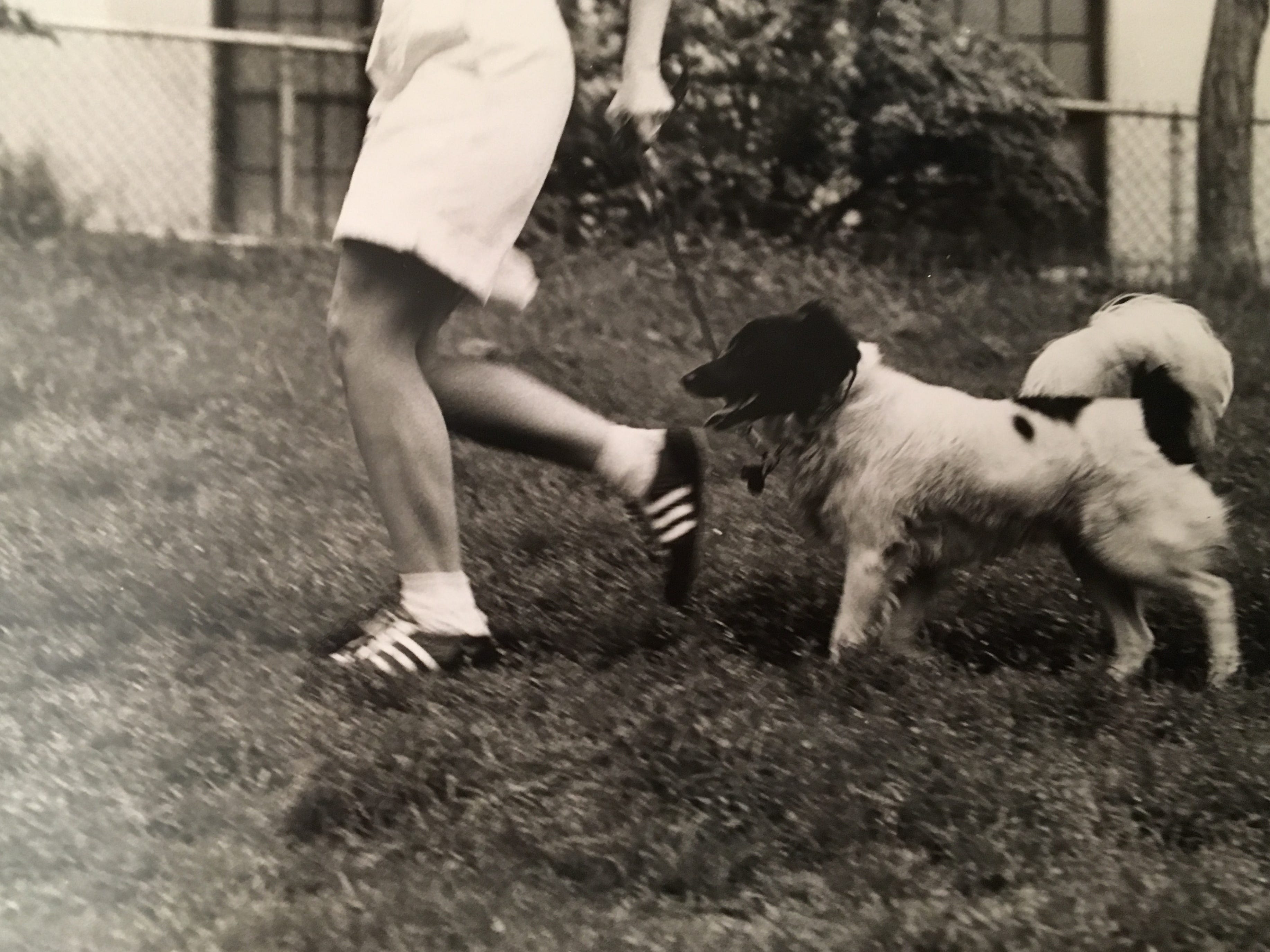
ON JANUARY 23, 1995, SASHA COULD EAT only a few meatballs from my hand. His breathing was choppy, and he couldn’t hold up his head. The next morning, at 6:30, I took him downstairs, and he tried to shake out his fur. I held him as he peed, then picked him up and tried to make him comfortable upstairs.
He couldn’t drink water. His kidneys were failing. I settled him on his bed, and he lay there, looking as he always did, his head dipped over his front paws, his back legs swung to the side. Every half hour or so he let out a weak bark of pain.
At 10:30, I laced up my shoes. I held the dog against my chest and kissed the top of his head. It had a furry, soft, summer smell.
Outside the air was cold and clear. In my arms, he was a bundle of limbs splayed this way and that. His head lolled. Half-way to the vet, I felt his body tense and release, and by the time I walked through the door he was unconscious, and his eyes were unresponsive.
He didn’t have any blood pressure. I didn’t think he was all the way dead. When someone dies, you see a form lift off. The vet was out with flu. I asked his assistant to give Sasha a shot, in case he felt pain. It was difficult for her to find a vein. A short time later, his heart stopped, and I stayed with him for awhile. It felt like having a new life with nothing in it.
In the months that followed, so many times I expected to see him on the couch. I thought about when to walk him and how far we should go.
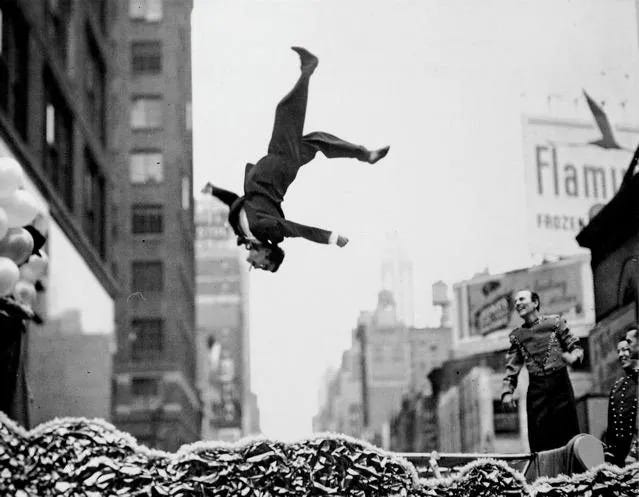
A month after he died, I was walking alone in the Village when I saw a man do a backflip on the street. He was wearing a suit. Up he went, into the air in an arc and landed on his feet. The cigaret he was smoking was still in his mouth. He was an acrobat. A small group surrounded him, and he juggled balls from a bag. In my mind, I was still holding Sasha’s leash. I was alone, with no one to tell how the flying man had gone into me.
He was every sudden moment that flips you out of yourself and into the world. When I got Sasha, I was with a man named Robert. The puppy was six weeks old. His mother had been a stray and had been picked up on a roadside and taken to a shelter.
I had been good to the dog because I loved him. He had been good to me because that was his nature. Everyone fell for him. Some dogs are like that. Some people are like that.
He’s been dead for more than thirty years. I still have his collar and tags. In his early years, we’d walked through the woods in East Hampton every day. We’d walked on the beach. We’d walked in the city. By the time Sasha died, Gardner had been dead for five years. When Gardner and I were in bed, Sasha would leap up between us, and we’d snuggle him. Why does this all remain fresh? Because I was good to the dog every day for eighteen years, and It’s a picture of myself I like.
____________________________________
The next Zoom conversation on writing craft is Saturday July 25 from 3 to 4 EST. To RSVP, please write to me at: lauriestone@substack.com
The focus will be on writing DRAMATIC NARRATIVE. What is it? How you can use it to write fiction, creative nonfiction, memoir, criticism, autofiction, travel writing, monologues, and just about any other genre people have named.
_____________________________________
Happenings for paid subscribers:
UPCOMING ZOOMS, always on Saturdays from 3 to 4 EST To RSVP: lauriestone@substack.com
LAURIE & RICHARD on writing DRAMATIC NARRATIVE in any prose genre: July 25, from 3 to 4 EST To RSVP: lauriestone@substack.com.
To attend one event or receive one recording, with no future payment obligation, you can buy a “coffee” for $4 at ko-fi.com/lauriestone
Breakout session/slam readings following the Zooms
The BREAKOUT SESSION following the Zoom conversation about DRAMATIC NARRATIVE is on SUNDAY JULY 26, from 3 to 4:15 EST. THERE ARE STILL PLACES. There is a cap of 10 at each breakout. You are invited to share a piece of your own writing of around 400 words. The SLAM readings are thrilling impovs—we make a work together larger than the parts! The fee is $30. To sign up please email me at: lauriestone@substack.com.
To request recordings of past Zoom Conversations
with Steven Dunn, with Margo Jefferson and Elizabeth Kendall, with Francine Prose, with Sophie Haigney (of The Paris Review), with David Cale that includes a reading from his hit solo theater piece Blue Cowboy, with poet David Daniel, with Daisy Alioto, publisher of Dirt, and others, please email me at: lauriestone@substack.com.
Working together one to one on your writing or starting and growing a Substack publication.
If you would like to book time to talk one-on-one about a project you are working on or for guidance in gaining confidence and freedom in your writing practice, please email me at: lauriestone@substack.com.
If you would like to book time to talk one-on-one about STARTING AND GROWING a Substack publication, please email me at: lauriestone@substack.com. I can help you through the software, choosing a title, art design, and ways to gain readers.
__________________________________
Please “comment,” ”like,” and “share” below. Your engagement helps the algorithm notice the stack and gain a presence here for feminism and literary writing. I LOVE YOUR COMMENTS!
__________________________________
Another way to lend one-time support
and gain an invite to the next Zoom conversation. Tip your server with a $4 coffee: ko-fi.com/lauriestone
My favorite part in this entirely enjoyable piece is the last two sentences of your story about Sasha: "Why does this all remain fresh? Because I was good to the dog every day for eighteen years, and It’s a picture of myself I like." What a good, dear, honest person you are.
Great piece, that provides a way of understanding this movie for those who have already seen it and a reason to see it for those who haven't. In an important sense, this film is not a sci-fi movie at all despite its trapping, but as you say, a romantic comedy.