
Mad Men
A diary.

We are rewatching Mad Men, created by Matthew Weiner, and I seem to be writing a diary. We are now at the beginning of Season 5. When the show first aired, I watched it in weekly installments and yearly seasons from July 19, 2007, to May 17, 2015. There are seven seasons and 92 episodes, set in the the fictional, advertising firm of Sterling Cooper, between March 1960 and November 1970. We know we’re at a fictional agency because no ad man in real life was ever as witty as John Slattery’s Roger Sterling, who does no actual work at the firm. Watching a show in the immersive way we are doing now, episode after episode, night after night, deepens your appreciation of its form, music, repetitions, and discoveries. Both in the show as it’s being created and in you as you watch it.
One of the great pleasures of this landscape is there isn’t a murder every five minutes. There is lots of pain. Mostly it’s not articulated. When, on occasion, a character speaks a simple uncensored truth, the dialogue leaps out like a surreal passage from an O’Neill play. It’s so starkly different from the Kabuki pantomimes people mostly perform with each other. When, in season three, a man’s foot is accidentally severed, and we see a window cleaner squeegeeing off blood, it’s shocking because otherwise there is no actual blood in these bloody realms.
Whatever else one could say about Mad Men, I find it a sustained and sustaining work of art. I find almost nothing comparable to watch made recently. Great shows are rare. Great shows that create characters who change and live inside you. Deadwood, The Wire, Breaking Bad, Better Call Saul, The Americans, Homeland come to mind. Recently, we rewatched Homeland and The Americans. I wouldn’t rewatch the others. I don’t want the violence. I know, I know, The Americans and the violence. I remembered when it was coming, and I covered my eyes.
Don Draper (Jon Hamm), no heroes no victims.
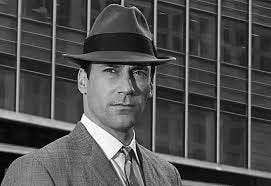
All of Don’s accomplishments and all the damage he causes are his and his alone. He moves through life on his animal gifts. He is beautiful. Beauty has given him confidence. At his core—and it’s the core of his charm, too—he’s more generous and accepting and kind than he is ruthless. Most defining, he can move swiftly from point A to point B. When Peggy Olson (Elisabeth Moss) is in a mental hospital, after giving birth to a baby she didn’t know she was carrying, Don visits her and tells her she has to get herself out. She has to keep going. Then he delivers this startling line: “It will shock you how much it never happened.” It’s the way memory works. He’s saying memory erases as much as it contains. Maybe more.
In season one, Don meets Rachel Menken (Maggie Siff), who runs a swanky department store founded by her father. She’s a type of woman—one who directs her own life—he will be attracted to over and over without knowing why. Partly because they resist him. Not sexually. No one resists Don sexually. They resist being swallowed up in his confusion. “What did you expect,” she says, when he tells her he’s married, “for me to run beside your life?”
He’s dazzled. He’s dazzled because he wishes he could say a line like that. It’s a brilliant reversal of the usual trope of a woman falling in love with the man she wants to become. Don wishes he had Rachel’s freedom to pursue his own ideas. And then he understands he doesn’t know what he wants. As an ad man, he’s learned to calculate what other people want and package it for them, but what is he moved by? What does he care about? These questions haunt the series because they are not only Don’s questions.
Jon Hamm plays Don as a gliding muscle, a man who isn’t conventionally macho, or else nothing would penetrate him. Gradually, during season one, we learn he was born Dick Whitman and had enlisted in the military during the Korean War. When his commanding officer was killed in an ambush and his face was burned, Dick, in a quick stroke, exchanged dog tags with the corpse without considering the consequences. What about the people in the real Don Draper’s life? Wouldn’t they search for him when he didn’t return home? The coffin with Draper’s remains is sent back to the Whitmans, although neither parent is Dick’s biologically.
Don’s pain is the show’s mesmerizing revelation. It makes him poignant, and it’s what Rachel and the other women in his surround respond to. In season 4, he’s living in an apartment in the Village. His wife Betty (January Jones) has learned his true identity, and they have separated. He’s taken to hiring a sex worker, who slaps him across the face and tells him to shut up. It’s a sort of a “No one puts Baby in the corner” moment—shouted to himself! He’s Baby. He’s the inobservant tyrant. He’s the sad loner he has always been, both as Dick and Don, wondering what life is.
Betty Draper, caught in an endless Douglas Sirk movie.
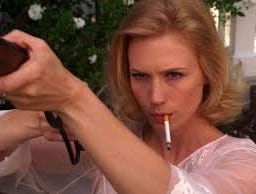
We are well into season two. I find myself increasingly interested in Betty Draper and in the bizarre performance of January Jones. When Richard and I first watched the show, he theorized the story was being told through the eyes of Sally (Kiernan Shipka), the little girl, looking back at her enigmatic parents—through the smoke of childhood infatuation and incomprehension.
Weiner’s paint-by-numbers picture of the sexual double standard of the fifties and sixties is so relentless and wide-eyed, it sometimes comes off another piece of the blindness it’s trying to document. Jon Hamm’s performance lifts the story out of its rhetorical trappings. The more specific a character is, the more everyone can find a room in that person to live in.
During this viewing, I see something similarly enigmatic in January’s performance. Weiner’s camera can’t stop looking at the two beauties, Betty and Don, shaded by different kinds of pain, or maybe the same pain. When Roger asks Don how he feels being separated from Betty, Don says, “I feel relieved.” So does Betty, in some ways. Her relationship with the weird child next door, Glenn, is a study in breath-taking strangeness. There are two ways to go in a story: make the ordinary strange or the strange ordinary. Both strategies are continually unfolding on the show.
Betty feels more understood by the little boy than by Don, and rightly so. Don chose Betty as a prop in a life he was trying to invent. Was he ever in love with her? It’s a problem when a prop starts delivering its own lines. Later, Don tells Anna (Melinda Page Hamilton)—who had been married to the real Don Draper—that Betty threw him out because she couldn’t love Dick Whitman. It’s not the truth. Betty didn’t love being treated as a prop. It’s a lie Don may have convinced himself is true. It justifies having pretended to be someone else during their entire marriage.
Dog tags
During the second season, we see the first meeting between Don and Anna. They become coconspirators because she falls in love with him, and we see that Dick didn’t need to become Don at all. As Dick, he still would have moved through life as a gleaming knife. It’s an insight the character isn’t going to have, and it makes you think about the tricks we play mentally to believe in the lives we want to go after. In reality, Dick’s physical beauty and charm are the gifts that count, not his background. No one even knows what his background is because it’s not his.
I keep thinking about the scene where Dick swaps dog tags with Don. Who would think to do such a thing? A person who has always been waiting to leave their life. How many steps ahead do you have to think to make the swap? We see Dick looking at the burned body, registering the man is dead, and for an instant feeling for him. They didn’t know each other long. They are in a foxhole, and they are alone. We will see Dick, who becomes Don, many times feel a moment of connection to another person before switching it off in order to act, and we will see him act with astonishing speed to advance to the next ground that momentarily looks stable. For example, after Lucky Strike, a huge account, quits the agency, Don will run an ad in the New York Times, decrying cigarette advertising, without telling anyone in his firm he is doing it.
Still, the decision to swap the dog tags. It’s not so much he will have to contend with a false name and a false history. It’s that he acts without being able to calculate the consequences, and I find it thrilling to think what’s involved in such an act. The creativity of it. Is that what creativity is? Is that what we’re talking about? An adventure that doesn’t know where it will land? Many times, Don will let life take him—the time he goes AWOL in LA with the jet setters, the hitchhiking couple who rob and beat him, the many women who open a door with a touch.
The decision to swap the dog tags works like a magical spell in a fairy tale. If you’ve done it once, you will have to keep doing it—like having the Midas touch or the ability to spin straw into gold. Over and over, Don will feel he must stay in a life or leave it. He’s able to switch off connection for the moments he needs to act. It’s like a radio frequency he must silence, and as soon as he’s somewhere else, his feeling self swims back, and his eyes soften. It’s his tell. And because he is soft and sometimes very hard, he is interesting to himself as well as to other people.
What’s the relationship between Dick’s quick thinking in the dog tag moment and becoming an ad man? The skill of such a person, supposedly, is to predict what people will want to buy. Don’s skill is in inventing wants for people they are then attracted to, the way everyone who meets Don is attracted to him.
Beauty alone isn’t his draw. It’s that he waits to see what people want before showing his hand. In season 3, he storms at Peggy when she signals her ambition. He doesn’t want to see her hungry. He’s her mentor, and he knows it won’t get her anywhere. I don’t think he’s being a pig in that moment, although he hurts her badly, and she doesn’t figure out what he’s telling her because he doesn’t explain it. He acts impulsively with her. He doesn’t show other people his quick anger often. It would be a disadvantage to him. He trusts Peggy. It’s their bond.
Peggy
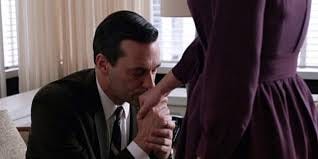
At the end of season three, when Don has the idea the partners should buy back Sterling Cooper from the upcoming merger, he speaks to Peggy as he has always spoken to Peggy, with the assumption that she is a dog in love with her master. Everyone in the vicinity of Don is a dog in love with their master. Peggy tells Don she’s done with the role. He’s thrown. His dog is speaking. First his prop, trophy-wife is speaking, and now the dog! What’s going on? Peggy isn’t coming.
Don doesn’t want to break up the band. The band is his family, or something that can serve as a family, emotionally. Betty has just defected, and the marriage is finished. It’s a blow, even though it’s a marriage he won’t miss. He wasn’t interested in knowing Betty, partly because Betty has been discouraged throughout her life from knowing what she wants. The life she has is not the one she wants, and something she might want is beyond her grasp.
Don goes to see Peggy at her apartment. He says he’s sorry for the way he has treated her. He admits he felt she was an extension of him. Being a man who can apologize is a tool of seduction, Don is well aware of. Peggy’s eyes fill with tears. He almost has her. From her perspective, it’s as if a giant gold brick of handsomeness has suddenly started speaking. She says, “What would you do if I still say no?” He says, “I would spend the rest of my life trying to hire you.”
She’s hooked. She wants to be hooked. She needs the band as much as Don. They are secret sharers, two upstarts from nowhere with no social leg up. It’s why their scenes are so charged. When Don is landing a seduction, he means every word. Or it wouldn’t work.
The Suitcase, season 4 episode 7, written by Matthew Weiner in 2010.
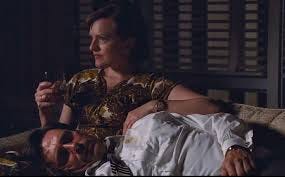
This is a stand-alone episode that works like a separate short story, an intake of breath, inside a sweeping novel. (Coincidentally, a few months earlier, “Fly,” a similar, stand-alone episode had aired in Breaking Bad.) “The Suitcase” is brilliant, and if you start watching it, you will not be able to turn away because great writing about anything, combined with crisp directing and jazz-flow acting, is supposed to take you hostage.
The episode is a duet between Don and Peggy set on her birthday, when she is 26 and about to leave for a dinner date with her boyfriend. Peggy’s boyfriend is a latka left on a plate. The only impression he makes is he wants her. He is there. He will be there. He is thereness without a specific geography. He is the concept husband Peggy is supposed to feel grateful for because he will relieve her from the burden of her freedom.
Don is in his office after everyone else has left. Peggy and her team have presented ideas for a Samsonite luggage campaign, and he’s turned them all down. What is Samsonite known for? You can’t break it.
Can you break Don? Not really. Don can feel he’s being broken and turn in a different direction. It’s the night Anna will die, and he’s unable to return a call from her niece before Anna stops breathing. The last time he saw her, he knew she would soon die of cancer.
Don is a runner. He is all geography and no there, and he knows he can keep Peggy with him so he isn’t entirely alone. When Anna dies, so will his connection to anyone who knows who he is and continues to love him. Peggy isn’t that. Not then, anyway, and Peggy doesn’t know the story of Don’s origins as Dick Whitman.
In this episode, Don is the macguffin, really—the device that shows Peggy to herself. She can’t leave, not because Don commands her to stay. She can’t leave because she doesn’t want to leave. She is feeling what she wants. It’s becoming clear to her. She’s a female human with a picture of her own desires, and in this way she is different from Betty and Joanie (the head secretary), who don’t ask themselves what they want. It’s not a question that’s occurred to them.
Peggy wants the life made possible at the agency. She doesn’t want her boyfriend and the dinner he’s planned—actually, a horror-show surprise. He’s invited her whole family to the restaurant, a family she doesn’t love because they judge her rather than see her. She tells Don she feels nothing about the life she’s been told she should want. He’s the right person to say this to.
The episode is a nod to the “Night Town” chapter in Ulysses. Don and Peggy can’t find the right images for Samsonite. Their new ad company has to be witty and in-the-moment for its sheen. They go out. They drink. Don is in one of his kill-me-now bender phases, plus he’s avoiding the pain of Anna’s death. Don and Peggy tell each other stories about their lives. Peggy loves Don, but that’s not the understanding she forms. The deeper romance is with being a creature who circulates freely and uses her own words to describe herself.
Finally, Don makes the call to LA. Anna has died. Her niece tells Don Anna has left her body to UCLA medical school—”She wanted to go there without paying tuition.” Don finishes the call and sobs. We have never seen him this way. He’s showing Peggy a side of himself he may not have known existed. Not the pain, the freedom. That’s what they give each other. In the presence of the other, they like themselves.
_______________________________________
Support
I loved writing this piece. I love writing everything I write for you. The stack will continue as long as paid support continues.
A paid subscription right now costs less than a book. You should still buy books. I’m just offering a comparison.
You get access to the complete archive of 283 pieces—no marginal notes, no out-takes.
You get a free 15-minute phone consultation with me about your writing.
You get invitations to monthly Zoom conversations with guest artists, as well as recordings of the events. So far, we’ve presented Margo Jefferson, Elizabeth Kendall, Francine Prose, Perry Yung, Emer Martin, Steven Dunn, David Daniel, Sophie Haigney, and David Cale.
Our next guest on January 17 from 3 to 4 EST is ERROLLYN WALLEN, a Belize-born, British composer and performer, working in opera, orchestral, and vocal genres. She was appointed Master of the King’s Music in 2024, the first Black woman to hold the position. To RSVP, please email me at: lauriestone@substack.com.

_________________________________________
Happenings for paid subscribers
Upcoming Zoom Conversations with guest artists include: composer and writer ERROLLYN WALLEN (January 17 2026 from 3 to 4 EST), DAISY ALIOTO founder of Dirt, the media empire-in-the-making (February 28), poet MICHAEL KLEIN (March 28), and brilliantly funny standup, writer, and actor MARGA GOMEZ (April 25). To RSVP to these events, please email me at: lauriestone@substack.com.
To attend one event or receive one recording, with no future payment obligation, you can buy a “coffee” for $4 at ko-fi.com/lauriestone
Breakout sessions following the Zooms with guest artists
The BREAKOUT SESSION following Errollyn Wallen is on Sunday, January 18 2026 from 3 to 4 EST. To sign up please email me at: lauriestone@substack.com. There is a cap of 10 at each breakout. You are invited to share a piece of your own writing under 400 words, and the fee is $30.
To request recordings of past Zoom Conversations
with Steven Dunn, with Margo Jefferson and Elizabeth Kendall, with Emer Martin, with Perry Yung, with Francine Prose, with Sophie Haigney (of The Paris Review), with David Cale that includes a reading from his hit solo theater piece Blue Cowboy, and with poet David Daniel, please email me at: lauriestone@substack.com
Working together one to one on your writing or starting and growing a Substack publication.
If you would like to book time to talk one-on-one about a project you are working on or for guidance in gaining confidence and freedom in your writing practice, please email me at: lauriestone@substack.com.
If you would like to book time to talk one-on-one about STARTING AND GROWING a Substack publication, please email me at: lauriestone@substack.com. I can help you through the software, choosing a title, art design, and ways to gain readers.
__________________________________
Please “comment,” ”like,” and “share” below. Your engagement helps the algorithm notice the stack and gain a presence here for feminism and literary writing.

I think the comments here, capture some of the magic you capture as you watch the series. As your fellow traveler on this journey, it's an extra joy to see your face reacting as you attend to all the things it makes you feel. So happy to be on the sofa next to you.
"The more specific a character is, the more everyone can find a room in that person to live in." I'm rewatching with new appreciation as well. It's fascinating to read you analysis.