
Linear Time
Makes no sense.

“And in myself, too, many things have perished which, I imagined, would last for ever, and new structures have arisen, giving birth to new sorrows and new joys which in those days I could not have foreseen, just as now the old are difficult of comprehension.”― Marcel Proust, Swann’s Way
Flux Factory
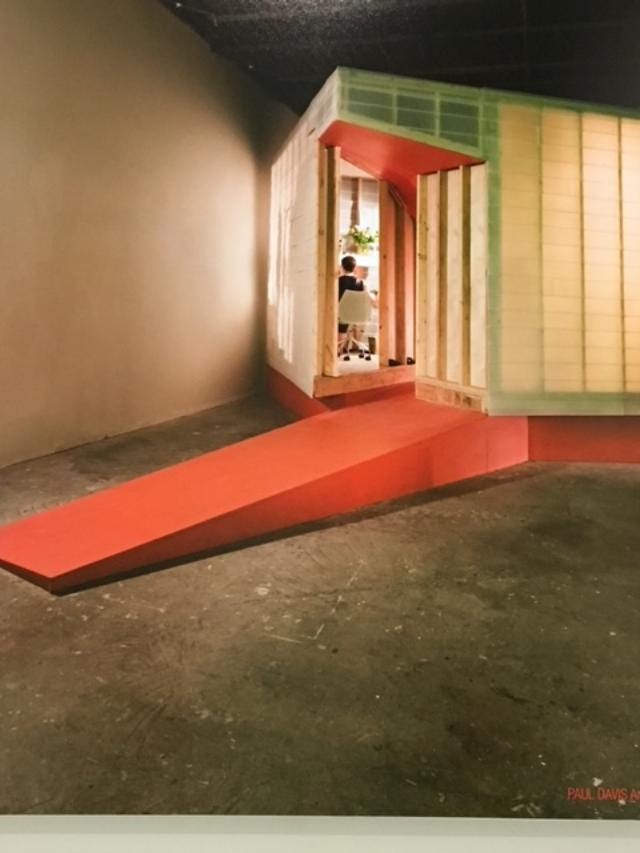
The other day, for no special reason, I looked at a piece I had written in 2005 about the Flux Factory, an artist collective, after spending a month there as part of an art installation. Suddenly, I thought I could see the person I had been at the time, who was 58, in what felt like a new light.
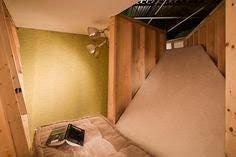
In early May 2005, I and two other writers, Grant Bailie from Ohio and Ranbir Sidhu from Brooklyn, had arrived in Queens to start living together. We’d agreed to stay in the gallery for a month and each write a novel in the little houses built for us by architects. For exercise, there was a large, tarred roof that looked onto a blurred view of Manhattan. On the roof was a potted rose bush, some weathered chairs, and a pile of old bricks. Down below was a nest of train tracks where a dinosaur egg might have hatched.
I look back at this time, more than twenty years ago, at a person who, two years later, would hatch out of her own dinosaur egg, into a new life with Richard. I couldn’t have known that then. I see a person who has no idea what comes next and thinks this is embarrassing. Thinks this is shameful. She never knew what came next, but by 58, shouldn’t she have formed a plan? She never knew what came next, thinking there would be more time to make more mistakes. I think at 58, this way of life, where you could just keep rolling along, was feeling fragile. A cold wind was blowing in on the number 58, on its way to 60.
I was suddenly able to see a person in a state of alarm who didn’t see it clearly at the time and couldn’t gauge how the alarm went into other people. It’s strange being able to see the alarm now. I don’t know what to call this change in perspective. I can tell you it’s enjoyable. It feels sudden, although it may have been forming over time. I’m pretty sure that, five years after these events, let’s say, in 2010 for example, I would not have been able to see what I’m seeing now.
And what am I seeing now? An impression I have today of how the past was, or may have been. An impression that seems more than an impression. It seems like a clarity, but we know all this is invented right now, as I’m speaking to you.
The feeling now, as I’m speaking to you is one of great lightness. It’s like becoming younger now than I was back then. Younger because lighter and lighter because I am no longer interested in the things the 58-year-old was feeling and thinking. I don’t share her attraction to sadness and different forms of abjection that represent the voice of “the alarm.”
The feeling of being lighter is not one of shedding layers. I have the same outline. I’m still the same house. But if you stand in front of me, you will be able to see the sky and clouds through me. I’m emptied out, in other words. There is all this space suddenly to fill with other things. What are those other things? They are less about me, strictly speaking, than in the past. I’m on a treasure hunt for joy and kindness I see in others. I’m on a treasure hunt for these things, even though I am also in a state of useful clarity about the way power works to defeat the best human hopes.

I wanted to live at the Flux Factory to dull the alarm. I think it worked. I was very happy there. No one knew my motive with regard to the alarm, not even me. Without knowing this motive, I would seem an unlikely fit into the Flux Factory. I don’t like mess or noise. I don’t know how to get along with large groups of people or even a few people.
At the Flux Factory, I was part of a group who were skilled at collective living. They were good at listening and sharing and adapting, and all the other skills that help people get along. I was probably the thing others had to adapt to.
There we were, on the morning of day three, snug in our art capsules, when a New York Times editorial accused the project of trivializing “the nature of writing” and predicted we’d produce either “teeny-tiny novels or very bad ones.” I thought a teeny-tiny novel sounded great, although still beyond me. On the day I’d first met Morgan Meis, who’d designed the project, I’d told him there was no way I’d be able to produce even the smell of a novel in a month. He’d said, “Safes are meant to be cracked.”
The project received lots of coverage, most of it positive, including two features by Julie Salomon in the New York Times and a column by Michael Greenberg praising us in the Times Literary Supplement. Some people saw the thing as a stunt and compared it to reality TV, although there were no video cameras around us, and on most days there were few interruptions.
The installation was dramatic and beautiful, and the weekly readings attracted crowds. Some people came every Saturday, as if following a soap opera with the real plot of us living together woven together with the plots of the stories we read. A filmmaker who’d written and shot a movie in a month was particularly amused by our challenge.
The Times editorial might have depressed us, but the way we were perceived didn’t much touch our sense of life in the moment. At the same time, we knew we were being watched, and like any creatures on display, we wanted to put on a good show. It was weird how fast we began to live in the collaboration and feel a need to ante up a fair share of creativity.
In the days leading to the opening, I’d watched the architects, with their tool belts strapped sexily around their hips, saw and hammer, transforming their ideas into solid forms. I’d collected fallen screws and slivers of wood, swept saw dust into mounds of cottage cheesy looking stuff. To meet the deadline of the opening, the architects worked through nights, catching naps and picking on chicken wings and salad. Oh god, I thought, you better come up with something to write. During the months leading up to the project, my mother had had a stroke. What about a comic noir, involving a detective with a sick mother? Near me in the gallery, Grant and Ranbir were working on books they’d planned. I felt a humming synergy in our vaguely public partnership that more than one visitor compared to a meditation circle.
In damning the novel project (before it had begun and without visiting the installation or speaking to any participants) the writers of the Times editorial hadn’t considered the way environments stir the way we think and feel. They hadn’t considered how being part of a collective process—the writers tucked into the architects’ houses and all of us, like Russian nesting dolls, tucked into Morgan’s installation experiment—they hadn’t considered how the sense of being part of something larger than yourself influenced individual creativity. They hadn’t calculated the stimulus of weirdness among people willing to look foolish.
Part of the gig was having artists and chefs prepare dinners for us each night. One night artist Miwa Koizumi prepared a meal for us that was also a performance and a commentary on packaging. She made newspaper placemats. Our menus were written on paper towels that also served as our napkins, and our four courses were presented in milk cartons, juice containers, plastic bottles, and jelly glasses. Food normally served in solid form was liquefied in surprising (and tasty) combinations. Three stately white fishes rested on beds of ramps under blankets of béchamel sauce, all snugged into milk-carton barges. FYI ramps are wild leeks with small onion-like bulbs and green shoots that taste like scallions.
Architects think about the ways space effects emotions and the play of life. At a panel presented in the space, Mitch McEwen (who built one of the houses), said she was interested in “the secret nature of a box” which led her to think about secrets in building structures, like cavity walls, and about espionage and the ways spies exchange messages in “dead letter boxes.” “The secrecy of writing appealed to me,” said Mitch, who was wearing her hair close-cropped and was sitting on her skateboard as she clicked images on her computer screen. The secrecy of writing—I’d never thought of it that way. The difference between public writing and private writing? I would make a terrible spy.

Before the experiment began, a reporter asked if I’d feel nervous about reading unfinished work aloud and whether I felt competitive with the other writers. I did feel competitive. Grant and Ranbir were speeding along with their stories. One night, they both gave electrifying readings. The dialogue was funny. Their performances were relaxed and sharp. It felt like the stakes had been raised for all of us.
We could hear each other moving around in our separate little houses. We could hear each other sleeping. We had been strangers who became comrades and then collaborators. I stole bits of conversation and physical traits from them and used them in my writing. A few days before the end, Paul Davis, one of the architects who’d built my house, talked about dismantling it when the project was over. I said I wanted to keep the library stool I’d used to climb to my bed because its rubbery, glandular smell had produced an image I’d used in my book. He thought about numbering some pieces and placing them in storage for a time the firm would build another version of the house. Then he said, “Maybe we should let it go and just remember it.”
I told Paula, a Flux artist, I was sad my house would disappear. She was a talented performer who glided around in long skirts and combat boots. She shot me a get-real look and said, “Everything at Flux Factory dies. Like us.”
After the closing, people carted away pieces of the houses. The rest was donated to Materials for the Arts. The meaning of what we did as it relates to how books get made, or how writers work, or whether you can witness any of this by marking off territory to watch it, I don’t think matters. An idea floats out like a net, and people show up for reasons they can’t name. They look at each other, wonder what they have to say to each other, and an action begins. During my time there, I didn’t need more than I had. I wrote eighty pages.
____________________________________
Support
If you enjoy what you read and have not yet taken a turn at paid support—it costs very little to jump in!—please consider joining today. To continue, the stack is entirely reliant on you. There are lots of benefits you can read about below, including a free 15-minute conversation about your writing projects. Please make sure to use a browser on your phone or computer, and not the Substack app.
______________________________
Streaming now
The Pitt and ICE

In this week’s episode, two ICE agents occupy the ER in downtown Pittsburgh, where the show is set. Patients in the waiting room leave. Nursing staff go home. The ICE agents have brought in a woman they have taken into custody. She’s been injured in the capture.
There are extensive scenes with the agents, and Dr. Robby tells them to move out of sight of the people he’s trying to treat because he can’t do his job. Jesse, a nurse who tries to help the injured woman is thrown on the floor, cuffed, and taken away with the captured woman. Robby tells Jesse he will contact lawyers from the hospital to free him, but no one knows where he will be taken. We’re left to think: Will lawyers find him? What power will they have in the situation? What power does anyone have engaging with gestapo? They have none. We have none.
I felt sickened and ashamed to be living here. I felt sickened and ashamed to be living here while all this is happening to other people. You already know this. I already know this. Hitler shot himself in the head in a bunker. It helped.
__________________________________________
Michael Klein, our next guest artist Saturday March 28 from 3 to 4 EST. To RSVP: lauriestone@substack.com
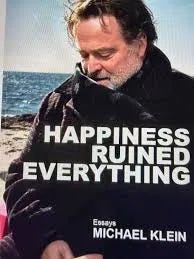
“As a kid, I read a lot of poetry because it was short. And there was a lot of it, right down the street from where I lived, at the Jefferson Market Library on Sixth Avenue between 9th and 10th Streets. In its previous life as a building, the library was the Women’s House of Detention. The cacophony made by the incarcerated women yelling down to their friends and lovers on the street below, filled the air of my childhood in the afternoons when school let out.”—Michael Klein
OMG. This moment swept into memory the way the Village in those days just lived side by side with the women in the prison, shouting down to the street, to you, you were the street and you were the women in the way your curiosity is always about other people. Why were they there? What had happened to them? You didn’t think there was anything weird about the jumble of things side by side when you were the age when everything was fresh and inexplicable.
_____________________________________
New trick

I would like to live in a world where you could take things back. I would say I miss you. I would say yes. I remember a woman kissing the head of a dog as other dogs sniffed each other mildly. I understand the desire of the woman to kiss the dog. We can’t help it. We could, but we don’t want to. I can’t know what the dog is feeling. I can imagine what the dog is feeling as if it were a person. A person who is happy to be alive in a way there are no words for. I don’t know what the dogs are feeling who are sniffing each other. I imagine they are sniffing in ways they don’t have words for. In ways that are the same as the impulse to kiss the dog. The lips of the woman on his fur. The smell of her perfume. The perfume she leaves on his head. The kiss and the sniff are not the same in people, and the kiss and the sniff are not the same things to people as they are to dogs, although they might be. The world of a dog is I miss you. The world of a dog is yes. The world of a dog is you can take things back. . . and throw it again.
______________________________________
Happenings for paid subscribers
UPCOMING GUEST ARTISTS on ZOOM, always on Saturdays from 3 to 4 EST To RSVP: lauriestone@substack.com
MICHAEL KLEIN, brilliant and beloved poet, prose writer, performer, and teacher on MARCH 28. His new book is Happiness Ruined Everything.
MARGA GOMEZ, utterly original actor, standup, and writer, April 25.
LAURIE & RICHARD, on the difference between Memory and Story, May 30.
To RSVP to these events, please email me at: lauriestone@substack.com.
To attend one event or receive one recording, with no future payment obligation, you can buy a “coffee” for $4 at ko-fi.com/lauriestone
Breakout sessions following the Zooms with guest artists
The BREAKOUT SESSION following Michael’s Zoom is on SUNDAY, MARCH 29 from 3 to 4:15 EST. There is a cap of 10 at each breakout. You are invited to share a piece of your own writing around 400 words. The fee is $30. To sign up please email me at: lauriestone@substack.com.
To request recordings of past Zoom Conversations
with Steven Dunn, with Margo Jefferson and Elizabeth Kendall, with Emer Martin, with Perry Yung, with Francine Prose, with Sophie Haigney (of The Paris Review), with David Cale that includes a reading from his hit solo theater piece Blue Cowboy, with poet David Daniel, and with Daisy Alioto, please email me at: lauriestone@substack.com.
Working together one to one on your writing or starting and growing a Substack publication.
If you would like to book time to talk one-on-one about a project you are working on or for guidance in gaining confidence and freedom in your writing practice, please email me at: lauriestone@substack.com.
If you would like to book time to talk one-on-one about STARTING AND GROWING a Substack publication, please email me at: lauriestone@substack.com. I can help you through the software, choosing a title, art design, and ways to gain readers.
__________________________________
Please “comment,” ”like,” and “share” below. Your engagement helps the algorithm notice the stack and gain a presence here for feminism and literary writing.
I think of your stay there often, I wish I'd known you then. I read about it at the time and told my students about it as a form of human display, Glad you are in our house now.
I will be thinking about this all day. Thank you.