
Hot on the trail
with you.


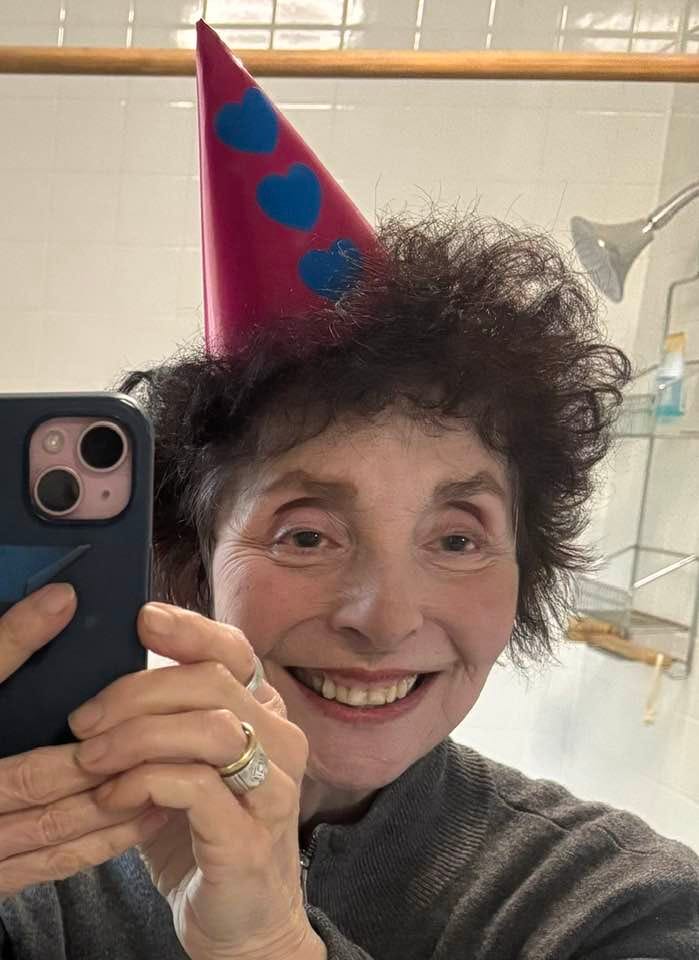
TO CELEBRATE THE 200TH BIRTHDAY OF FREDERIC CHURCH, Olana, his giant estate overlooking the Hudson, invited the world over for free ice cream and popcorn. There were also tours of his house and gardens, and you could have all the time you liked walking the miles of winding trails. At the visitor center, we were encouraged to make party hats. Guess who said, “I’m not wearing even a conceptual hat.” Richard was willing to be seen walking the grounds and passing people with me in the hat I made. The jaunty angle was his idea. It was much remarked on.
The air was warm. During the walk, we recalled other walks together at the Djerassi colony in Northern California, the walks around the little lakes at Yaddo, walks in the Lake District. We stood at the top of the hill outside the mansion, with its sweeping views of the river and low mountains in the far distance. It’s finally spring. Not so fast. It’s still cold at night.
I said, “From now on, let’s ignore anything we hear from other people about our age. Let’s just be us as we are inside us, inside our bubble.” He said, “Don’t you already live that way?” I said, “No. Today, I don’t think people saw me in a particular way because of my age, but you don’t know. You can’t tell unless they put it right in your face.” He said, “You can’t tell what anyone is thinking, ever.” I said, “There is something consistent in each of us, and yet neither of us believes in the concept of ‘the self’ as a unified field. Each of us is whoever we are today, looking at how people see aging.” Richard said, “You were the only person who wore their hat all day. Not even other children wore their hats all day.”
________________________________
The more of less.
THE OTHER MORNING, RICHARD AND I WERE TALKING about things we’d gained from having limits. Anyone who’s written a sonnet or a villanelle knows the strange freedom you get from guidelines with restrictions. I thought, for me, getting together with Richard, where the stakes for him were high, made me feel, in our early years—when we were slowly getting to know the wildly unfamiliar landscape of each other—I thought whatever is happening, this is not one of those times you say to yourself: I can get out of this, all I have to do is leave.
In my mind, it wasn’t an option, not only because of needing to keep anteing up in the poker game we were playing. I kept trying to imagine my life returning to what it had been before we met or assuming a different shape without Richard, and a black screen would lower. I could not see this life or me in any life, really, and so that was the limit.
This had not happened to me before. I was in my early 60s, and this had not happened because before was before I was in my early 60s. That’s part of it. Maybe, that’s all of it. In any case, the feeling of restriction was fantastic. What a relief. It was a party with cake. You have fun at a party with cake.
Richard thought that for him, as well, there was the factor of, Oy, I better make this work to justify all the mishegas I caused. I don’t believe he expressed this in Yiddish, but to that effect. I proposed something else as well, having to do with becoming a type-1 diabetic.
I thought for him there had been a kind of weird freedom in the diagnosis. He was twenty-three and had just started university at Leeds. The weird freedom, I proposed, is why he’s been such a good citizen of the illness. Having a condition that imposed restrictions (about how to balance food and insulin) was freeing in comparison to the restrictions of the British class system he’d grown up in, restrictions that are demoralizing and punitive and teach you to comply before you know who you even are. The class system judges you and evaluates you as lesser all the days of your life. Richard took on the restrictions of diabetes that contained no evaluation of him. This illness simply occurs, the way weather does, and inside the illness he has always managed his actions according to his experience, not according to anyone else’s established controls. In that sense, it was liberating. He said, “You may be onto something.”
___________________________________
When you least expect it.
I’M ABOUT TO CONSIDER A SUBJECT THAT WILL PROBABLY AROUSE YOUR SYMPATHY and even worse, your reflex say that you feel all the same emotions. I already know that. That’s the reason I’m writing this. The topic is insult you don’t immediately experience as insult, and when you do it lives in your window as a sick plant you will nurse and nurse and never throw out.
A little while ago, I scrolled past the post of a man I was once friends with, not close friends, more or less professional friends I would hang out with from time to time. He hosted a series where he interviewed people before a live audience. When a book of mine was nearing publication, I asked if I could some time be a guest. He said, “You’re not famous enough.”
I really enjoyed mentioning this to Richard. We were still in bed. I said, “I have so many stories like this I love to think about.” I told him four or five that were right there. There was the time a “friend” pressed me to buy an expensive ceramic pot from her dear artist pal, who lived near us, but the “friend” didn’t want to introduce me as someone the artist might like to know. There were the multiple times editors of publications asked me for the contact information of a more famous person I knew and didn’t suggest I might ever receive an assignment myself. One woman I knew, again not a close friend, called to tell me about a fabulous party she was planning. Not to invite me. To ask me to recommend caterers. That was a two-tired insult. I didn’t qualify as a guest or as a caterer. There was the time I was at an event with a woman I hadn’t seen in a while. We went way back as writers and blah blah, and when she stood nose to nose with me, all she could think to say was, “How’s MORE FAMOUS PERSON YOU USED TO BE CLOSE FRIENDS WITH?”
I said to Richard, “What’s the enjoyment for me in these stories?” He said, “Ultimately, it’s the enjoyment of seeing the way you are seen. Catching a glimpse of it because the person is unconscious of what they’re doing. It’s a sudden shock. It’s not instantaneous. There’s a gap, a moment before it registers, Oh, I’ve just been shot. Then you feel the bullet.”
I thought, yes, the pleasure is in a certain recognition of where you stand, even though where you stand isn’t good. It’s the same with aging, the thing I wrote about recently of finding you have become invisible to a certain kind of man—actually all men who are strangers. There’s a disparity between the way you see yourself and the way it’s brought home you are seen. If you are a female human, you have training for this all your life. In the case of being Girl, the disparity is a form of misidentification. In the case of these insults, I don’t feel misidentified. I’m being told how I appear in the eyes of the larger world.
The shock is in realizing I have over-estimated myself. My fantasies, conscious or unconscious, are being stripped away. In the moment of insult, you are the clown, who has been pompous. Oh, dear.
Well, happily, the insight lasts only for a moment. It doesn’t wake you up for long. That’s why, with each insult, there’s a fresh hestitation followed by a fresh sting. It’s not knowledge that can stick! Knowledge that can’t stick is comedy! To see that you are helpless to know certain things in a solid way—to see at least this thing clearly, stirs a kind of pleasure. I guess.

NOTE TO READERS: If in the comments you write the equivalent of a CARE emoji or an ANGER emoji, I will never forgive you. Those responses insult this chunk as a piece of thought. That’s what it wants to be. It does not want to be a bid for commiseration. In this moment, my feelings are not hurt. I’m writing about the phenomenon of hurt feelings and what they stir. If my feelings were hurt, this would be complete dreck.
_____________________________________
Which brings me to the next topic: the difference between “MEMORY” and “STORY.”
Richard and I will be offering a Zoom conversation about Memory and Story ON SATURDAY MAY 30 FROM 3 to 4 EST. You can ask questions in real time about your projects. They may include ways to consider stuff that happened to you and that you are still carrying around and think might qualify as a subject. Will it? How to transforms things that happen to you into material for dramatic narrative and still keep the reader interested. We have suggestions. TO RSVP, PLEASE EMAIL ME: lauriestone@substack.com
The MONTHLY ZOOM CONVERSATIONS are a benefit to PAID SUBSCRIBERS. You can start for as little as $2.50 a month. I know for a lot of people money is tight, and if this is the case for you and you want to contribute, please let me know and we will figure something out.
There are lots of benefits for paid subscribers including a free 15-minute conversation with me about your writing goals, free invitations to monthly Zoom conversations with guest artists, free access to the entire archive of 307 pieces, and more.
_______________________________________
Another memory with an oy that has served me!

I WAS IN MY EARLY TWENTIES, and I hadn’t published anything, I don’t think, and I was in a women’s writing group. It was one of those gatherings feminists were creating all the time, and it was so exciting to have these meetings to go to. I was writing poetry I think in those days, and maybe some stories. I didn’t know what I was doing.
One of the writers in the group was Alix Kates Shulman, who was a big star after writing Memoirs of an Ex-Prom Queen (1972), which I thought was great, and I thought she was great. She was friends with Kate Millett. She was a big deal in the movement and in the writing world.
I have the sharpest memory of one of the meetings. It’s stayed with me all these years. I read a poem, I think, and afterward Alix was clear about what she thought didn’t work and what she didn’t like about it. She wasn’t mean. She’s not that kind of person. She wasn’t pulling any punches. Other people said different things, some liked what turned Alix off. I didn’t know how to take in what she was telling me. What she was telling me was I wasn’t good enough and also she was telling me how I could be better.
When she was talking to me, all I could feel—I think, I mean who the hell knows—was disappointment I wasn’t as good as I wanted to be. She was 100 percent right about it all. The specifics don’t matter. I think what rubbed her the wrong way is what can still push itself into a piece of my writing, some kind of show-offy thing. She was 100 percent right about it all, and slowly, over years, I saw what she was talking about.
By the time I started writing for the Village Voice, a few years later, the thing I had taught myself to do—I’m giving myself credit for this, anyway—was listen to any feedback from writers I respected, any suggestion to make something better, any information about what was missing or swerving somewhere incomprehensible. I had incorporated the things Alix had told me, and I had learned to listen. When you are learning to speak like no one else, you learn to do that from all the other people who sound exactly like themselves.
_________________________________
Happenings for paid subscribers:
UPCOMING ZOOMS, always on Saturdays from 3 to 4 EST To RSVP: lauriestone@substack.com
LAURIE & RICHARD, on the difference between MEMORY and STORY, SATURDAY May 30, from 3 to 4 EST To RSVP: lauriestone@substack.com.
Here’s a little teaser for this conversation:
Here is a trick. If you want to create the illusion of intimacy between you and the reader, write like you’re talking to someone right in front of you. You were walking, and there they were, on the street, and you grabbed them up and said, “Let’s have coffee,” and while they were sitting across from you, you told them about something you were in love with telling them, that’s why you wanted to spend this time with them, to show them something you love.
The trick I’m talking about concerns syntax and vocabulary. Dickens, when he wrote dialogue, he would say it out loud. He would write the way someone would speak. I’m saying do this with everything you write. Turn it all into dialogue, or a monologue.
Scan your writing for words no one would use in speech and find other words that someone would use in speech, and as far as syntax goes, break every rule of grammar if the rule of grammar applies only to written language. Forget that. The reader will hear you and understand you, because they are sitting right in front of you.
To attend one event or receive one recording, with no future payment obligation, you can buy a “coffee” for $4 at ko-fi.com/lauriestone
Breakout sessions following the Zooms with guest artists
The BREAKOUT SESSION following the Zoom conversation about MEMORY and STORY is on SUNDAY, MAY 31, from 3 to 4:15 EST. THERE ARE STILL PLACES. There is a cap of 10 at each breakout. You are invited to share a piece of your own writing of around 400 words. The SLAM readings are thrilling impovs—we make a work together larger than the parts! The fee is $30. To sign up please email me at: lauriestone@substack.com.
There will also be a BREAKOUT SESSION on June 1, following the Zoom conversation on the difference between “memory” and “story.”
To request recordings of past Zoom Conversations
with Steven Dunn, with Margo Jefferson and Elizabeth Kendall, with Francine Prose, with Sophie Haigney (of The Paris Review), with David Cale that includes a reading from his hit solo theater piece Blue Cowboy, with poet David Daniel, with Daisy Alioto, publisher of Dirt , Michael Klein, and Marga Gomez, please email me at: lauriestone@substack.com.
Working together one to one on your writing or starting and growing a Substack publication.
If you would like to book time to talk one-on-one about a project you are working on or for guidance in gaining confidence and freedom in your writing practice, please email me at: lauriestone@substack.com.
If you would like to book time to talk one-on-one about STARTING AND GROWING a Substack publication, please email me at: lauriestone@substack.com. I can help you through the software, choosing a title, art design, and ways to gain readers.
__________________________________
Please “comment,” ”like,” and “share” below. Your engagement helps the algorithm notice the stack and gain a presence here for feminism and literary writing.
_________________________________
The brilliant Daisy Alioto has kindly republished my piece about awaiting the party for The Paris Review outside Cipriani’s, and here is the link: https://dirt.fyi/article/2026/05/coming-of-age
So many fabulous lines and insights that I am too lazy to quote. Thank you
I’m sure it’s primarily because I’m a lesbian, but when you speak about the invisibility of being aged, and reference it to the gaze of men, you leave me rendered utterly invisible because I don’t give a good goddamn about the gaze of men. I miss being visible to WOMEN, beautiful clever enchanting women.