
Guitar man
A shot in the dark.

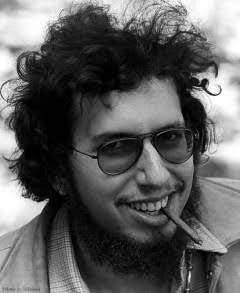
AFTER RICHARD AND I GOT MARRIED, we had happy hour drinks in town with our friend Kam. For the first few weeks, we imagined the marriage dividend was we wouldn’t get on each other’s nerves as much as before. Then we started getting on each other’s nerves the same amount. That was 18 months ago.
We feel a tighter squeezing of the hands as we slip off the surface of the earth. Our marriage is a party just as the power is shutting down.
I remember such a party in 1965, during the huge power failure in New York City. I was nineteen, and going to Barnard College, and living with a roommate in a small apartment on Broadway and 107th Street. Bruce was then my boyfriend, and he was more or less living with us. Also living in the building were the musician Dave Bromberg and his girlfriend. I’ll call her Trudy. I think that was actually her name.
Dave Bromberg was a singer and a songwriter, and he was friends with Bob Dylan. As you may know, Dave would go on to play guitar with Dylan often, and he’d have a separate huge career as a musician. He was lanky and goofy and friendly, and I think Bruce knew him from Columbia College, where Dave had been studying before dropping out to be an artist. This quality of Dave’s—the artist making his way vibe—outside institutions of higher education that I was so pleased to be a part of, this aspect of Dave gave off a dangerous and seductive glow.
At nineteen, living in an apartment in New York City, everything is your first time. Your first rambling man. Your first close-up, free spirit artist. Your first spontaneous orgy.
Trudy was a little older than me, and I remember having dinner at their apartment. She prepared stuffed pork chops. I had never cooked pork chops. I didn’t know they could be stuffed. I can smell them, and the other savory and juicy food she served. There were potatoes, roughly mashed. In the game of “house” they were playing, Trudy had the part of the Earth Mother girl opposite Dave’s playboy of the western world. He was heading somewhere, with that almost-famous sheen rising off him. She was bustling, and plump, and kindhearted—a door that said to me, “Do not enter. This way is the end of you.” Not that I knew what I was, at the beginning, middle, or end of me.
On November 9, 1965, when the power cut off in a massive Northeast blackout, Bruce had to walk to 107th Street from NYU on Eighth Street, where he was going to law school. In those days (and still, honestly) it wasn’t a big deal to walk five miles in the city, except the streets were dark, and in the dark that night there was a magical feeling of carnival reversal and anything goes.
That night, we hung out with Trudy and Dave in their apartment. They had candles, and we sat around talking. Maybe Dave played and sang. Maybe Trudy sang harmony. What I remember is they had sex. Did Bruce and I have sex, too, in the room with them? I think so. I think we would have thought it was rude to sit there and watch, or leave. During this period and in the many days to come before AIDS, this sort of spontaneous sex happened. I didn’t smoke pot often or drink hardly at all, so I was awake enough to take notes, and the notes I took are what, right now, look like a memory.
When you are nineteen (and still, honestly) you are casting around for ways your life can go. The man-and-wife arrangement of Trudy and Dave wasn’t something I wanted, although at the time it seemed the only item on the shelves. It was like going to a store in Soviet Russia, where you had to buy the one thing in stock, let’s say a jar of preserved cherries available right after cherry-picking season. This idea of marriage, as the one jar you can buy in the supermarket of life, put me off marriage for seventy-eight years, and then suddenly—I think it was sudden—I didn’t care about how people saw me with regard to being married.
A few months after the Northeast blackout of 1965, Bruce and I got married, in order to move into a larger apartment. The building wouldn’t let us rent an apartment unless my father cosigned the lease, and my father wouldn’t cosign the lease unless Bruce and I got married, and so I did, with the feeling of a suitcase on a conveyor belt at the airport. We lasted five years. It was the sixties. Five years was a miracle, like the Hanukkah lights lasting eight days. I got married at nineteen to put an end to marriage.
Getting married to Richard at seventy-eight felt like the start of something. No one likes endings. We like arrivals. Richard and I met when I was sixty and he was fifty-six. Why are some people a plane you want to jump onto? Because they are the ones leaving the airport.
Yesterday on Warren Street, Richard and I bumped into our friend Jake. If you are recognized on Warren Street, it answers many questions for the rest of the day. I said to Jake, “I love you.” I said, “Richard and I both love you.” Jake owns a shop. He sees you in the way Godot would see you if he ever showed up. No one on Warren Street is waiting for Godot. If anything, we are waiting for Godot to leave.
When Richard and I continued walking, he remarked that The Pitt, the doctor show we were watching at the time, is a morality tale, where we’re instructed about how to act in the face of death as well as life. This explains why it was so much more fun to rewatch The Americans, where there is no possibility of moral certitude. At the end of The Americans, the FBI agent Stan allows Phillip and Elizabeth—who are spies and assassins—to escape back to their homeland, Russia.
Stan does this because he likes them. He’s been their neighbor, and he’s felt affection for them grow, day by day and year by year. Phillip doesn’t believe in spying for Russia. Elizabeth is the ideologue, and Phillip will do anything to stay near her. They are married, he keeps explaining to her. After a while, growing near each other, trees don’t know which roots are theirs.

___________________________________
Streaming now
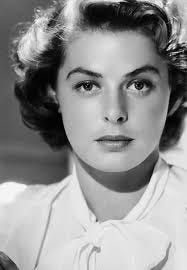
WE WATCHED INGRID BERGMAN: IN HER OWN WORDS (2015), directed by Stig Björkman (HBO) She speaks Swedish, English, Italian, and French! I love her in this strange portrait, in which she remains impenetrable. Fine. The four kids talk about her. Isabella Rossellini—the youngest—is the only one to use mama as a model and fling herself into aliveness. What other people think, be damned. Ingrid was beautiful and ambitious. Thrillingly. Get me out of Sweden. Then get me out of Hollywood. Then get me out of Italy. Then get me out of Sweden again. France, okay, what’s not to like. The kids, well, you know, she adored them in smallish doses. Domestic life was boring, and she said so. When she tried to lie, she failed. Isabella got scoliosis as a kid and Ingrid took care of her, and so Isabella got mama for a bunch of solid time and that is maybe part of the reason she could let mama leave again. Ingrid kept a diary. She wrote all the time. She held a camera all the time. Why didn’t she direct? Maybe she didn’t think she could. Maybe she was too in love with having the camera looking at her.
______________________________________
Where you come in.
If the writing here makes you feel alive, feel hope, feel like eating a stuffed pork chop!—please take a turn at supporting the stack. Honestly, it relies entirely on paid subscriptions. If you are a paid subscriber, the publication exists because of you. You can start for as little as $2.50 a month.
There are lots of benefits for paid subscribers including a free 15-minute conversation with me about your writing goals, free invitations to monthly Zoom conversations with guest artists, free access to the entire archive of 326 literary posts, and more.
__________________________________
The next Zoom conversation on writing craft is Saturday July 25 from 3 to 4 EST. To RSVP, please write to me at: lauriestone@substack.com
The focus will be on writing DRAMATIC NARRATIVE. What is it? How you can use it to write fiction, creative nonfiction, memoir, criticism, autofiction, travel writing, monologues, and just about any other genre people have named.
What genres do you work in? Do you like the way your writing is categorized for marketing? How much does the “I” of your narrator look out at the world and the social conditions that sharpen and flatten a life? How do we layer the outside world into a story that feel intimate and personal? Is it?

_____________________________________
Happenings for paid subscribers:
UPCOMING ZOOMS, always on Saturdays from 3 to 4 EST To RSVP: lauriestone@substack.com
LAURIE & RICHARD on writing DRAMATIC NARRATIVE in any prose genre: July 25, from 3 to 4 EST To RSVP: lauriestone@substack.com.
To attend one event or receive one recording, with no future payment obligation, you can buy a “coffee” for $4 at ko-fi.com/lauriestone
Breakout session/slam readings following the Zooms
The BREAKOUT SESSION following the Zoom conversation about DRAMATIC NARRATIVE is on SUNDAY JULY 26, from 3 to 4:15 EST. THERE ARE STILL PLACES. There is a cap of 10 at each breakout. You are invited to share a piece of your own writing of around 400 words. The SLAM readings are thrilling impovs—we make a work together larger than the parts! The fee is $30. To sign up please email me at: lauriestone@substack.com.
To request recordings of past Zoom Conversations
with Steven Dunn, with Margo Jefferson and Elizabeth Kendall, with Francine Prose, with David Cale that includes a reading from his hit solo theater piece Blue Cowboy, with poet David Daniel, with Daisy Alioto, publisher of Dirt, and others, please email me at: lauriestone@substack.com.
Working together one to one on your writing or starting and growing a Substack publication.
If you would like to book time to talk one-on-one about a project you are working on or for guidance in gaining confidence and freedom in your writing practice, please email me at: lauriestone@substack.com.
If you would like to book time to talk one-on-one about STARTING AND GROWING a Substack publication, please email me at: lauriestone@substack.com. I can help you through the software, choosing a title, art design, and ways to gain readers.
__________________________________
Please “comment,” ”like,” and “share” below. Your engagement helps the algorithm notice the stack and gain a presence here for feminism and literary writing. I LOVE YOUR COMMENTS!
__________________________________
I was once a small circus horse.
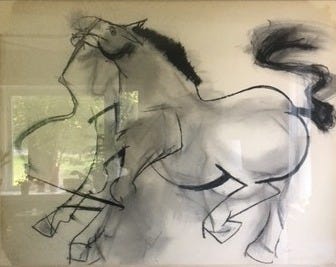
I CAN FEEL MY RIDER’S THIGHS along my ribcage. Once on a trail, I stepped on a salamander. It stayed in my thoughts. A flash of orange fire. My mane was fuzzy and warm from hay. Out riding, I would remember the smell of mint under my hooves and my mother’s eyes. I ran along shaded paths. My rider did not slip off during performances or drop his clubs. Humans evolved from beings who felt love before they felt sadness. My rider was a man who preferred to be with horses, and I was a horse who knew little apart from this man. Once this happens to a horse, there is no such thing as emptiness. Even if I no longer lived in the domain of humans, I would carry their alertness. The wanting of humans seeps into everything through their knees. Horses were once animals with toes. We could feel the ground, and we ran more slowly. The future was speed.
I particularly loved hearing about David Bromberg. An amazing musician who produced one of my all time favorite albums, Midnight on the Water. I used to play parts of this album for my classical violinist friends, to show how amazing fiddlers could be. Grateful to hear these memories of the person behind the music, in another of your beautiful and vivid essays.
The horse piece is breathtaking. Pure poetry through the mind of the horse. Exquisite writing.