
Falling Upwards
Is making a new book.


IS MONEY A PENIS? When you ask money what it is, money says yes, it is a penis and anything else you want it to be. Money is desire before it’s traded for something and attached to meaning. It floats. In ancient social systems, money ushers freedom from schlepping. Once you have a symbolic means of exchange for goods and services, if you want to buy something, you don’t have to haul your pig or your giant pot to the market to pay for it.
I was at a party that was a dog. A tall young man was holding the dog, and then the dog smelled something only a dog can smell and trotted off. The young man said, “Unrequited love, the story of my life.” I said, “It’s the story of everyone’s life.” He said, “Really?” He came over to where I was sitting on the porch, drinking champagne. I said, “The Way We Were.” He said, “Ka-ka-ka-aty.” I said, “We are Barbra Streisand, and we don’t want to capture Hubble, not really, who is a shadow.” The young man said he was going on a cruise for a month as crew before finding another place to live, and I could see he was living the way we are all looking to live, which is the way a dog lives. Everyone loved the dog, who thought being loved was the same as finding a half-dead beetle to knock around in the grass. Everyone could see in the dog a kind of longing not to carry around being human.
After the spill of the Exxon Valdez, in 1989, I flew to Seattle, on my way to Anchorage. A man in the airport was wearing a t-shirt that said, “Never drive a tanker drunk.” I told him where I was going. He said, “Watch out for bears.” I said, “What do I do if I meet a bear?” He said, “Wish you were somewhere else.” He said, “You will see brown bears, foxes, and moose, standing along the sides of roads.” He said, “I once looked out over the water, and the sky was thick with birds. I thought they were seagulls, but they were eagles. I saw a sky full of eagles.”
Everything turns out to be about love. That is something I believe. How much can we feel love. How much can we say we feel. How good are we at picking the people who want our love. I like thinking love is at the bottom of everything or at the heart of everything because becoming better at love is surely something I am capable of, even if it turns out I’m not. Being a glutton for love pretty much disqualifies you from having it for long. I am a car that remains what it has always been before it slides into a ditch, or drives past the ditch.
The other day, I read a piece by a woman who confused being the object of desire with falling in love. I wanted to tap her on the shoulder and say, “That is not falling in love. That’s when someone falls in love with you, and it can be annoying—like when that guy at the bar starts bothering you, or when I bother you.”
Falling in love is yours forever. It doesn’t even matter if your love is returned, or if the object of your desire moves on. It’s irrelevant because your attachment to wanting is what turns you on. The other person’s body turns you on, and your desire is something that can’t be controlled or diminished by anyone else. It’s perhaps the deepest part of who we are. You don’t have to agree with me.
Richard and I are walking in Hudson, and there’s a woman I haven’t seen in a while. This woman is thirty years younger than me, it comes up. I didn’t know this before because I just didn’t. We sit on a bench. She says, “I’m in love with my son.” I say, “Isn’t that to be expected?” She says, “I mean instead of my husband.” You can go anywhere with a line like that. I believe this woman and I are speaking the same language. Where did we find this language? What are we wearing? What did we eat for breakfast yesterday?
One day, when my mother returned from the dead, I said, “I’m glad to see you.” She said, “I must be dreaming.” I said, “You were right about me. I can see through your eyes, now.” She said, “You were a baby. How could you understand the world?” I said, “I don’t see other people clearly enough. I don’t know what they need, and I’m sorry you died before I could tell you this.” She said, “Do you think it would have changed my life?” I said, “You had another child.” She said, “Like having two kidneys.” It was lovely being in agreement with my mother. I didn’t like to think there was a cause you could put your finger on for things that happened in a person’s life. I didn’t think saying these things would make things easier between my mother and me. I said, “Let’s walk on the beach. Do you remember when we used to walk on the beach?” She said, “I was afraid of the waves. You were afraid of nothing. I made you that way. I don’t know how you came from me.”
When women write female characters and show the way they really feel—their doubts, their moments of coldness, their ambition, their blindness, their states of frozen confusion—I mean all or anything that’s true about how women exist in their lives, these authors have created what’s generally considered an “unsympathetic character.” A woman who is unlikable. For the most part, in the general critical reception of literature, the only way a female character wins “sympathy” for the reader is not to shock the reader into an awareness of what women really are.
This is one of the reasons it’s so refreshing and exciting to encounter Love Me Tender by the French writer Constance Debré. The narrator doesn’t care if you find her “sympathetic.” She doesn’t need you to. The first sign that a woman has gained freedom on the page or in life is that she’s lost status with men—as well as the moral approval of everyone else. It’s the beginning of freedom for a writer and for a person.
When, at age 53, I became a cater-waiter, I carried silver trays of hors d’oeuvres set on miniature topiaries. The guests at these events were younger, more beautiful, and more ambitious than I had ever been, more sure of their success than I had ever thought possible, and at the same time your could see their fear that their promised appointments with fame and book advances would be whisked away because the world was turning against them. I was rooting for the world.
My fellow cater-waiters were also much younger than me, and I loved them because I was lonely and liked working in a team. Every day, I miss that life.
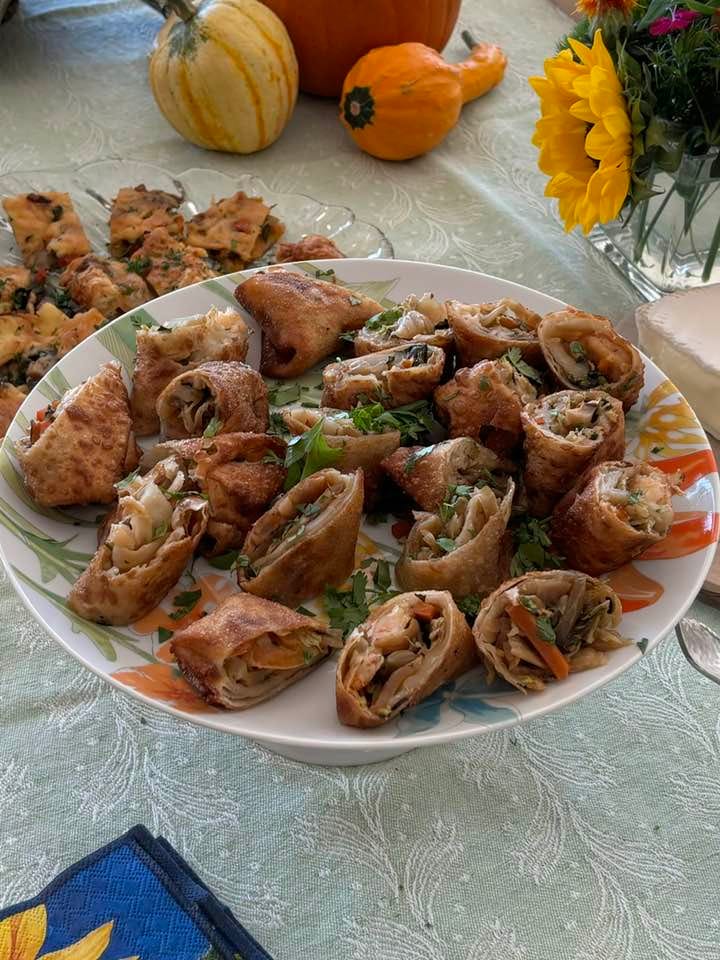
For the coming month, I’ve accepted two jobs to work as a server and a caterer. At the first job, I’ll be a server at a party in someone’s home. For the second job, I’ll be preparing the food, planning the event, and working the gathering as a server with a bar tender I will hire. I feel a special pleasure in doing these jobs as I get older. It’s part of the way getting older is—“That’s your problem.” It’s part of the way getting older is nothing, really, the same way that being female is nothing, really, except for the way the world insists you are what you are not. You want to know theTheT food I’ll be preparing?
The other day, a bobcat walked across our back yard. It didn’t see me. I said hello. Its tail was bobbed. It loped along on its tall legs. I think I would look good in antlers.
____________________________________
Biz
If you enjoy what you read and have not yet taken a turn at paid support—it costs very little to jump in!—please consider joining today. To continue, the stack is entirely reliant on you. There are more and more people on Substack, competing for the pie. If you think literary writing and feminism help to make a better world and that art is how we learn to live and breathe in our our minds, please support the writing here. There are also lots of benefits you can read about below, including a free 15-minute conversation about your writing projects and art practices. Please make sure to use a browser on your phone or computer, and not the Substack app.
__________________________________
Marga Gomez, our next guest artist Saturday April 25 from 3 to 4 EST. To RSVP: lauriestone@substack.com
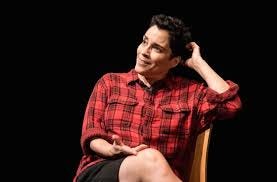
I have been thrilling to the brilliant work of Marga Gomez in theater and comedy for god knows how long, and it gets better all the time, layering memory, fake memory, social commentary, and doors into Latino culture and queer culture and girls loving girls. She is always working, always producing new shows. She’s from New York and has been based in San Francisco for a many years. Some of you may know her from that performance scene. Here a tiny bit of text from her show, Memory Tricks:
“My mother complained whenever she made a deal with me so I wouldn’t know that she got the better end. Like on the night of my seventh birthday. We were living on 169th Street in Manhattan. You could call that Harlem. We called it Washington Heights. We had the only house in the neighborhood. It was squiched in by three big apartment buildings. And some of our neighbors would occasionally throw beer bottles and bags of trash into our yard. But my parents acted like we lived on a country estate and they would throw these high-class patio parties for their friends in Spanish show business and never invite those neighbors.”
__________________________________
Happenings for paid subscribers
UPCOMING GUEST ARTISTS on ZOOM, always on Saturdays from 3 to 4 EST To RSVP: lauriestone@substack.com
MARGA GOMEZ, utterly original actor, standup, and writer, April 25.
LAURIE & RICHARD, on the difference between Memory and Story, May 30.
To RSVP to these events, please email me at: lauriestone@substack.com.
To attend one event or receive one recording, with no future payment obligation, you can buy a “coffee” for $4 at ko-fi.com/lauriestone
Breakout sessions following the Zooms with guest artists
The BREAKOUT SESSION following Michael’s Zoom is on SUNDAY, APRIL 26 from 3 to 4:15 EST. THERE ARE STILL PLACES. There is a cap of 10 at each breakout. You are invited to share a piece of your own writing around 400 words. The SLAM readings are thrilling impovs—we make a work together larger than the parts! The fee is $30. To sign up please email me at: lauriestone@substack.com.
To request recordings of past Zoom Conversations
with Steven Dunn, with Margo Jefferson and Elizabeth Kendall, with Emer Martin, with Perry Yung, with Francine Prose, with Sophie Haigney (of The Paris Review), with David Cale that includes a reading from his hit solo theater piece Blue Cowboy, with poet David Daniel, with Daisy Alioto, and with Michael Klein, please email me at: lauriestone@substack.com.
Working together one to one on your writing or starting and growing a Substack publication.
If you would like to book time to talk one-on-one about a project you are working on or for guidance in gaining confidence and freedom in your writing practice, please email me at: lauriestone@substack.com.
If you would like to book time to talk one-on-one about STARTING AND GROWING a Substack publication, please email me at: lauriestone@substack.com. I can help you through the software, choosing a title, art design, and ways to gain readers.
__________________________________
Please “comment,” ”like,” and “share” below. Your engagement helps the algorithm notice the stack and gain a presence here for feminism and literary writing.

Bravo, for writing a very Laurie Stone-ish essay, which no one else can do.
If I heard the essay read in a rhythm, or at least the way I heard it in my head as I saw it on the page, I would have said, lovely prose poem. It skips like a Stone.